-
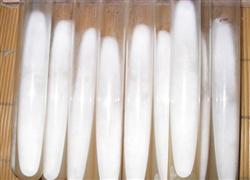
Detailed Explanation of Key Techniques for Identifying Wood Ear (Black Fungus) Spawn
1. The mycelium is snow-white, like fine wool, with short, neat, dense, thick and strong strands, advancing evenly side by side until it reaches the bottom of the bottle, growing uniformly and consistently from top to bottom, coming out in a solid block when dug out, not loose. 2. After the mycelium has fully colonized the bottle, brown water droplets are generally secreted on the surface of the mycelium. Later, pale yellow...
-

How to prevent and treat deformed mushrooms? First, identify the common types
Deformed mushrooms take many forms. The main ones commonly seen in production are: landmine mushrooms, hollow mushrooms, big-bottom mushrooms, hard cap opening and early cap opening, red roots, and water rust spots. Landmine mushrooms. The main cause is that the casing soil material is too coarse, the soil is rather hard, the casing layer is thick, the surface of the casing layer contains relatively little water, while the temperature and humidity conditions of the lower part and the substrate are suitable for fruiting body formation and growth, so fruiting bodies are easily differentiated and formed on the surface of the substrate or in the middle and lower layers of the casing soil, and then push out through the soil surface. Solution: choose high-quality humus soil, preferably peat soil, and mix in a certain amount of rotted cow manure or wheat bran, etc. in proportion; when collecting and sun-drying the soil, it should be sieved so that most soil particles remain comparable in size to @#@245@#@ particles, with the largest about 1/2 the size of a corn kernel, accompanied by some soil particles; casing is generally about 3 cm, and if conditions permit, first apply a layer of coarse soil 1-1.5 cm thick, then fine soil, and pay attention to maintaining uniform moisture content.
-
How do you identify poisonous wild mushrooms? Master these identification methods
So far, more than 10,000 species of wild mushrooms (fungi) have been discovered and recorded nationwide, among which there are as many as 192 species of poisonous mushrooms (fungi), and in the Jiangsu-Zhejiang area there are more than 30 species of poisonous mushrooms. Wild mushrooms (fungi) generally grow during the plum rain season and under high-temperature, high-humidity conditions in summer and autumn, so incidents of poisoning from eating them also mostly occur during this period. Poisonous wild mushrooms (fungi) often have the following characteristics: (1) High brightness of color. (2) The surface of umbrella-shaped and other mushrooms (fungi) is fish-scale-like. (3) There are ring-shaped protrusions on the mushroom stem. (4) The mushroom
-
How to Identify Poisonous Edible Mushrooms and Prevent Poisoning
In summer, wild edible mushrooms appear in large numbers, and many poisonous mushrooms have morphological features similar to many edible mushrooms, causing people to eat them by mistake and be poisoned. At present, there are 40 known poisonous edible mushrooms in China, 30 of which can be fatal, and fewer than 20 are common. Every year, accidents of death caused by mistakenly eating poisonous edible mushrooms occur. Methods for identifying wild edible mushrooms: First, wild edible mushrooms with strange shapes, bright colors, and spines or warts growing on the cap; those with both an annulus and a volva on the stipe are mostly poisonous; second, wild edible mushrooms with a foul odor, an extremely spicy or extremely
-
What are the methods for identifying edible mushrooms? A detailed explanation
Methods for identifying edible mushrooms. For oyster mushrooms (Pleurotus ostreatus), white, dense, thick mycelium with a cottony appearance and wall-climbing behavior indicates superior spawn. If wood-chip spawn is used, decomposed wood chips that turn pale yellow with a small number of primordia appearing indicate superior spawn. If the mycelium is sparse or forms strands, the cottonseed-hull substrate turns dark red, the wood-chip substrate turns white, the mycelium pulls away from the bottle wall and shrivels, yellow exudate accumulates at the base of the spawn bottle, or mold spots appear on the surface of the substrate, it is inferior spawn. For wood ear (Auricularia auricula), white, uniform mycelium indicates superior spawn. If
-
How to identify edible mushroom mother cultures by appearance?
Excellent purified mushroom cultures are the fundamental guarantee for successful edible mushroom cultivation. The appearance identification methods for several edible mushroom mother cultures are introduced as follows: Shiitake mushroom mycelium on potato dextrose agar (PDA) medium is pure white, thick and robust, appearing floccose or velvety; after filling the test tube it has a certain ability to climb the wall, with edges showing irregular wavy curves. At around 24°C, the mycelium generally fills the test tube slant in 12-15 days. It has a distinctive shiitake aroma. Oyster mushroom mycelium on PDA medium is snowy white, dense and thick
-
How to Identify Mother Cultures and Spawn of Edible Fungi? A Detailed Guide to the Methods
Shiitake (Lentinula edodes) spawn: the mycelium is snow-white, thick and strong, spread out, and uniform, with even margins and a fast growth rate; on the bottle wall it develops in a fan-shaped, feather-like pattern, growing vigorously, and secretes soy-sauce-colored droplets. After the mycelium has fully covered the bottle, within 10 to 15 days an amber-colored transparent liquid is commonly seen, along with the distinctive fragrant aroma of shiitake, with no foul or musty odor. If the mycelial column inside the bottle pulls away from the bottle wall, this indicates that the substrate moisture is too high; if it has pulled away and the mycelial column also begins to shrink, with the surface mycelial skin thickening and turning dark brown, this indicates that the spawn has begun to age and cannot
-
A Detailed Guide to Identifying and Controlling Common Pests of Shiitake Mushrooms
1. Mites, commonly known as fungus lice, are divided into two types: flour mites and straw itch mites. Straw itch mites are small and difficult to see with the naked eye; they tend to gather in clusters on the surface of the growing substrate. Flour mites are larger, white and shiny, do not form clusters, and appear powdery when numerous. On shiitake mushroom blocks infested by mites, the mycelium is gnawed on, and in severe cases the mycelium can be eaten completely. If mites occur in the spawn, a cotton plug dipped in 50% dichlorvos can be inserted to fumigate and kill them. If mites appear during the mycelium-running stage, they can be killed by spraying 0.5% dichlorvos, or by spraying a 2000-fold dilution of 25% permethrin-ester compound. If mites occur during the fruiting stage
-
How to identify contaminant fungi in edible mushroom cultivation? Simple identification methods to share
During the cultivation of edible mushrooms, various harmful organisms and abiotic disturbances often occur. Mushroom growers all consider contaminant fungi to be a major enemy in production, and they must be recognized and prevented in advance, with targeted control, in order to ensure a good harvest. 1. Competitive contaminant fungi are mainly some saprophytic fungi that compete with edible mushrooms for nutrients, water and oxygen in the substrate, especially in the early stages of cultivation management when they are more likely to invade the mushroom blocks, secrete toxins, and inhibit the expansion and spread of the edible mushroom mycelium. 2. Infectious and non-
-
How to Identify the Quality of Edible Mushroom Spawn? Practical Tips Shared
Edible mushroom spawn, like the seeds of crop vegetables, is the internal factor and foundation for achieving high and stable yields. The quality of the spawn directly affects the yield of edible mushrooms and even determines the success or failure of cultivation. Therefore, identifying and assessing the quality of spawn is very important. 1. Look 1. Check whether there are abnormal spots or patches of red, yellow, black, green, etc. around or on the surface of the substrate in the spawn bottle (bag). If any of the above phenomena exist, it indicates that the spawn has been contaminated by foreign molds (except for varieties that produce pigments, such as shiitake and nameko),
条件筛选