-

Key Techniques for Large-Bag Bed-Free Three-Dimensional Cultivation of Pholiota microspora (Nameko Mushroom)
Harvesting: When the mushrooms reach 70-80% maturity, that is, when the veil membrane of the cap has not yet stretched, they can be harvested. When harvesting, hold the substrate surface with one hand and gently twist off the mushroom cluster with the other, so as to avoid pulling up large chunks of substrate. After each flush is harvested, tidy the substrate surface and withhold water for 5-7 days before managing the next flush. Advantages of this cultivation model: it saves the wooden poles needed to build racks. No need to thread curtains or build racks, saving resources and reducing labor intensity; high-altitude work is changed to low-altitude work, making it easier to operate. Moisture in the substrate is easy to maintain, and during fruiting
-
Detailed Explanation of Pollution-Free High-Yield Cultivation Techniques for Goji Berry in Greenhouses
Goji berry (Lycium barbarum) is a perennial deciduous small shrub of the genus Lycium in the Solanaceae family. Its tender shoots and leaves (also known as goji tips) are eaten as a vegetable and can be stir-fried, served as a cold dish, or used in soups. They are nutritious, delicious and refreshing, and are highly favored by consumers. Lishui County, Jiangsu Province began introducing and cultivating it in 2002. The products are mainly sold to large and medium-sized cities such as Shanghai, Nanjing and Wuxi, and demand in the market exceeds supply, achieving relatively high economic returns. The pollution-free high-yield cultivation techniques for goji berry in greenhouses are introduced as follows: 1. Variety selection: Choose the large-leaf goji. This variety has large, green, oval-shaped leaves, with leaves
-
Disease conditions of the chicken-claw fungus in pollution-free cultivation
The shaggy ink cap mushroom (Coprinus comatus) is deeply favored by mushroom growers for its rich nutrition, delicious taste, tender and smooth flesh, and strong market demand. It has been widely cultivated across the country with very broad development prospects. However, in actual cultivation, mushroom growers are often troubled by a kind of Xylaria (commonly known as chicken-claw fungus). Due to neglected prevention and control, by the time large-scale infection appears, they randomly use some high-residue pesticides for treatment, which not only has no effect but also often causes the pesticide residues in the finished mushrooms to exceed the standard and affects product sales. For example, in mid-October 2006, Hubei Province
-
Causes of Tea Geometrid Outbreaks and Pollution-Free Control Methods
Tea geometrid, also known as the arching worm, measuring worm, and hanging-silk worm, belongs to the order Lepidoptera, family Geometridae. In Liandu District, this pest is mainly distributed in tea areas such as Bihu and Lixin, and is a voracious pest. If control is not timely, it often causes severe reductions in summer and autumn tea yields, and leads to decline in tree vigor, seriously affecting tea production. In previous years it occurred every year, but the damage was not great. In August 2007, this pest broke out over a large area in the Huanglingshang tea garden of Lixin Township, not only severely affecting the tea yield of that season, but also causing decline in tree vigor and poor cold resistance
-
Pollution-free, High-quality and High-efficiency Cultivation Techniques for Chuzhou Chrysanthemum
Chuzhou Chrysanthemum was originally named "Chiju" (pond chrysanthemum), and together with Zhejiang "Hangju" (Hangzhou chrysanthemum), Henan "Huaiju" (Huai chrysanthemum), and Bozhou "Boju" (Bozhou chrysanthemum), it is collectively known as one of China's four famous chrysanthemums. Chuzhou Chrysanthemum is not only enjoyed as an ornamental flower, but is also a precious dual-purpose product for both medicine and tea. During the Guangxu period of the Qing Dynasty, "Chuzhou Chrysanthemum" was once listed as a tribute item, hence it is also called "Gongju" (tribute chrysanthemum) or "Chugongju" (Chuzhou tribute chrysanthemum). It is currently a product under origin protection in China, and the eastern Anhui region is cultivating and developing it on a large scale. 1 Biological Characteristics 1.1 Morphological Characteristics Chuzhou Chrysanthemum belongs to the Asteraceae family and is a perennial root plant, with a plant height of 60-
-
Detailed Explanation of Key Points of Pollution-Free Pear Bagging Technology
① Bag selection: The selection of paper bags for pear bagging should be reasonably made according to the tree growth conditions in the orchard, production goals, and economic capacity. Since the main purpose of bagging pears is to improve the smoothness and finish of the fruit surface, lower-cost single-layer bags can be chosen, such as Kaixiang bags, Tianjin bags, etc.; for those aiming to improve quality, double-layer bags with a black inner bag can be chosen. ② Bagging period: Pears should be bagged after fruit thinning is completed in early to mid-May; the best bagging time is on sunny days from 9:00 to 11:00 in the morning and from 2:00 to 6:00 in the afternoon. ③ Bagging
-
Detailed Explanation of Key Points of Peach Quick-Freezing Processing Technology
(1) Process flow: raw material selection → pitting and color protection → blanching and cooling → peeling → packaging and adding sugar syrup → pre-cooling → quick freezing → frozen storage. (2) Key operating points. Raw material selection: after peaches are picked, ripe ones must be processed immediately; hard, unripe fruit must be ripened. Properly ripened peaches have bright color, rich flavor, and are easy to pit and peel. Pitting and color protection: after the raw material ripens, remove the pit with a small knife or a pitting machine, and immediately place the flesh in cold water to avoid contact with air and prevent discoloration. The pitting machine has fruit
-
What are the effective methods for protecting pepper seedlings from freezing in winter?
During winter pepper seedling raising, sudden cold waves often strike, the temperature drops abruptly, and the seedlings are prone to freezing damage. If the temperature drops slowly, they are less likely to freeze. If the temperature is not very low but lasts for a long time, especially when low temperature is accompanied by rain, a condition known as "wet cold", the seedlings are also very prone to freezing damage. The severity of freezing damage to the seedlings is also related to how quickly the temperature rises after the low temperature. If the temperature rises slowly, the seedlings thaw slowly and easily regain their vitality. If the warming and thawing are too
-
How to raise ecological free-range chickens? Master these 6 key breeding points
1. Choosing a site: Generally, choose woodland, tea gardens, orchards and hillside land. For woodland, natural forest is the best, and artificial economic forest is second only to natural forest. Hillside land requires a gentle slope, shelter from the wind and facing the sun, and a sufficient water source. The surroundings of the chicken farm must have no major pollution sources, and must be more than 1 km away from residential areas, hospitals and slaughterhouses. 2. Selecting good breeds: Dual-purpose chicken breeds for both eggs and meat, male chicks of layer breeds, and rural free-range chickens can all be used as ecological chicken breeds. 3. Preparing feed: The feed for raising ecological chickens must
-
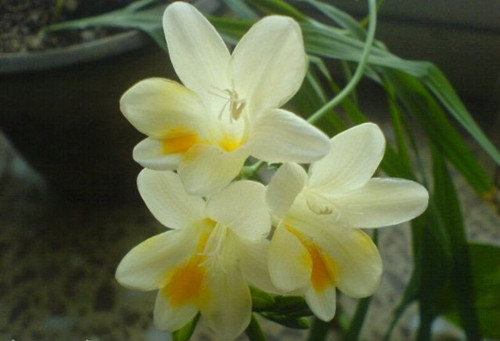
Freesia Blooming and Blooming Period
Is the blooming period of freesia always fixed? Why does it sometimes fail to bloom? Under what conditions can it bloom? With these questions in mind, let us further explore the issues regarding freesia blooming and its blooming period; in fact, freesia is very easy to grow, and as long as the corms are healthy, they will not rot right after being planted.
条件筛选