-

What to Do About Rotten Walnut Fruit? A Full Explanation of Prevention and Control Methods
What to Do About Rotten Walnut Fruit
-

What are the key points for managing walnut trees? Explained clearly in one article
Key points for managing walnut trees
-
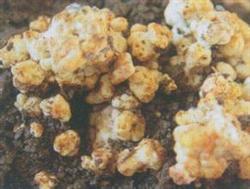
What to Do When Oyster Mushrooms Get Walnut Meat Fungus Disease? Occurrence Patterns and Integrated Control
Recently, many readers have reported that the oyster mushrooms they cultivate have been affected by walnut meat fungus (Diehliomyces microsporus). We are therefore reposting an article titled "Occurrence Patterns and Control Techniques of Walnut Meat Fungus in Oyster Mushrooms" published by Yang Yongheng, An Xiurong and others of the Tai'an City Institute of Agricultural Sciences, Shandong, for growers' reference: In recent years, Tai'an City and its surrounding...
-
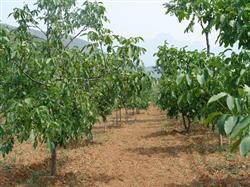
What is walnut branch blight? Get to know this walnut disease
How to grow walnuts efficiently? Please give guidance. Walnut cultivation can refer to the following planting methods: Seedling selection: high-quality seedlings should be selected for planting. High-quality seedlings refer to those with pure varieties, well-healed graft unions, more than 15 lateral roots, a basal stem diameter of more than 1.2 cm, a seedling height of more than 60 cm, straight and smooth stems, and no damage or pests and diseases...
-
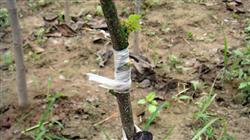
How to Graft a Walnut Tree? Methods and Step-by-Step Guide
How to graft a walnut tree? Please explain the methods. There are several walnut tree grafting methods you can refer to: Cleft grafting is suitable for older rootstocks with thicker trunks (over 4 cm in diameter) and for top-working large trees. For the rootstock selected, saw it off 30 cm from the base, smooth the cut surface, and use a knife to split vertically down the middle of the rootstock to a depth of about...
-
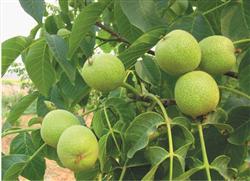
How to prevent and control pests and diseases in walnut cultivation
How to prevent and control pests and diseases when growing walnuts? Please give guidance. Here are two walnut pest and disease control methods for reference: Control method for the walnut shoot borer: The walnut shoot borer, commonly known as "walnut black," has adults that appear from June to July, and larvae that cause the most serious damage in July. This pest has weak resistance to pesticides, so you can choose pollution-free pesticides such as 10% cyhalothrin EC at 1500-2000 times dilution, or 15% imidacloprid at 3000 times dilution, and begin control at the end of June. Spraying once more after 7-10 days gives better results.
-
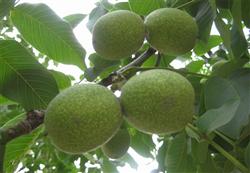
How can thin-shelled walnuts be cultivated to achieve high yields?
How can thin-shelled walnuts be cultivated for high yields? Please explain and guide. Thin-shelled walnut cultivation can refer to the following planting methods: 1. Apply base fertilizer in autumn. After the walnuts are harvested that year (around September 20) and before leaf fall, apply base fertilizer. For trees in the initial fruiting stage, dig a strip ditch or ring ditch at the vertical projection of the canopy, with a ditch depth of 60cm and width of 50cm. For large trees in full fruiting stage...
-

-
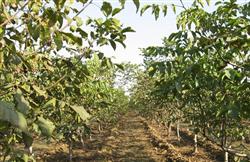
Control Methods for Sclerotial Root Rot in Walnut Seedlings
Sclerotial root rot, also called southern blight, mostly affects one-year-old seedlings, causing the cortex of the main root and lateral roots to rot, the aboveground parts to wither and die, and sometimes the entire plant to die. 1. Disease symptoms: Under high temperature and high humidity, white silky mycelium is produced at the base of the seedling root collar and on the surrounding soil and fallen leaves, after which small sclerotia grow...
-
Detailed Explanation of Key Technical Points for Spring Management of Ma Walnut Trees
I. Planting of Ma Walnut Trees 1. The suitable time for planting is from March to mid-April, after the soil thaws and before the buds sprout. Early planting makes it easy to survive, with deep rooting. When choosing a site, the specific environmental requirements for walnut growth and development should be considered. The orchard site is best chosen on sunny flat land or gentle slopes, with sandy loam soil being ideal, and requires a soil layer of more than 1 m, with the groundwater level more than 2 m below the surface. The planting area should be leveled, aged, and measures taken to prevent alkalinity and waterlogging. For mountainous areas, fish-scale pits can be built first, then the tree discs gradually expanded. Before planting, large pits must be dug and sufficient base fertilizer applied. The correct method of digging pits is: dig pits 80-100 cm square, keep topsoil and subsoil separate, and apply one small cartload (50-100 kg) of barnyard manure organic fertilizer per tree. When backfilling the pit, first fill with topsoil mixed with base fertilizer, then fill with subsoil, tamping while filling, and water thoroughly before planting.
条件筛选