-

Will Frequent Watering Kill a Phalaenopsis? Understanding the Dangers of Overwatering
Do gardening friends always feel that watering flowers is a form of love? Especially for the delicate Phalaenopsis (moth orchid), you just can't resist giving it a little extra water? Stop right there! Frequent watering may be slowly murdering your precious orchid! Today let's talk about why Phalaenopsis can't be watered too much, and just how much harm overwatering really does to the plant. Phalaenopsis and ordinary flowers and plants
-

What are the effects of underwatering on plants, and which plants need to be watered every day?
Fellow plant lovers, do you always struggle with the question of watering too much or too little? Today let's talk about how badly underwatering can "sabotage" your plants, and then dig into which water-loving fanatics need to be watered every day. After reading this, you definitely won't be confused anymore! When watering is insufficient, the first thing to throw a fit is the leaves. Leaves that were once glossy and plump slowly
-
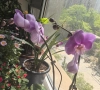
Is a Phalaenopsis orchid's root system turning white a sign of underwatering? An analysis of the causes
Healthy roots are the foundation of a Phalaenopsis orchid's growth. If the roots turn white, it is often related to improper water management. 1. Causes of white roots: Whitening caused by underwatering: the roots appear light grayish-white and feel somewhat hard, along with the potting medium (sphagnum moss or bark) being dry, pale, and compacted, no condensation on the inside of the pot wall, and the overall pot feeling
-

What are the signs of underwatering in Phalaenopsis orchids? Is yellowing of the leaves a sign of underwatering?
Those of you who grow Phalaenopsis orchids have probably had this experience: staring at those few glossy green leaves, always wondering, "Is it thirsty?" "Does yellowing of the leaves mean I'm not giving it enough water?" In fact, this flower looks delicate, but the art of watering it is quite profound. Too little water really does cause a lot of trouble, but yellowing leaves are not necessarily a sign of underwatering. Pha
-

How to Clean Phalaenopsis (Moth Orchid) Leaves and Precautions for Wiping Leaves Under Strong Light
Growers of Phalaenopsis have surely noticed that the orchid leaves always collect a layer of dust, feel rough to the touch, and look listless. At times like this, you want to give them a wash, but you are afraid of damaging them - after all, these leaves look so tender, so what is the right way to wash them? Some people also ask, is it okay to wash the leaves under the blazing sun? Why should you wash Phalaenopsis
-

Peach blossoms are woody plants; a comprehensive understanding of the characteristics of peach blossoms
The peach blossom is a deciduous small arbor belonging to the rose family (Rosaceae), native to China, and its fruit can be eaten directly as a fruit, delicious and sweet. Next, let me briefly introduce the peach blossom to you!
-
Is the lily a bulb plant? Understanding the basic characteristics of lilies
The lily originates from China and is widely distributed across the temperate regions of the Northern Hemisphere, including eastern Asia, North America and Europe. There are many varieties of lilies, with at least 120 species discovered so far, and 55 of them are native to China alone. There are also numerous recently developed hybrid varieties, such as the oriental lily, the fire lily and the Asiatic lily
-
What kind of woody plant is the purple-spotted peony? Let's get to know it
The purple-spotted peony (Paeonia rockii) is a plant endemic to China and a precious floral germplasm resource, with its root bark used for medicinal purposes. The purple-spotted peony is distributed on slopes under secondary summer-green broadleaf forests or in shrubland, as well as in rock crevices. It is of certain significance for studying the phylogeny of the genus Paeonia and for breeding new peony cultivars. A nature reserve has been established on Mount Taibai in Shaanxi, and it should
-
Is night-blooming jasmine easy to grow? Understanding its growing difficulty in one article
Night-blooming jasmine is a vine-like shrub of the Apocynaceae family, genus Telosma. It is also called night fragrant flower and night orchid fragrance. Its branches are slender, and it blooms in summer and autumn; the yellow-green flowers open in the evening and give off waves of strong, penetrating fragrance. In the south it is mostly used to decorate courtyards, windowsides, pond edges and pavilion sides, and it is also a semi-wild vegetable grown for its fresh flowers and flower buds.
-
Introduction to Portulacaria afra 'Foliis variegatis': a plant classified under other families and genera
Portulacaria afra 'Foliis variegatis', also known as the variegated elephant bush, is a variegated cultivar. Native to South Africa, it prefers a sunny, warm and dry environment. Its leaf shape and leaf color are relatively beautiful, with a certain ornamental value; potted plants can be placed next to televisions and computers, can absorb radiation, and can also be planted indoors to absorb formaldehyde and other substances, purifying the air.
条件筛选