-
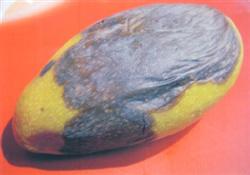
Occurrence Patterns and Control Methods of Mango Anthracnose
1. Damage symptoms: It mainly damages mango flowers, fruit, and tender shoots. After tender leaves are infected, many small round brown spots appear, surrounded by a yellow halo, and they gradually expand into round, polygonal, or irregular brown lesions, which later rupture and perforate. Wounds on leaves and young fruit caused by gall midges, leafhoppers, and other pests are also easily infected by this disease. Severely infected...
-
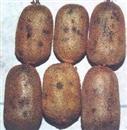
Occurrence Patterns and Control Methods of Kiwifruit Gray Mold
Kiwifruit gray mold mainly occurs during the flowering stage, young fruit stage and storage period of kiwifruit. In severe years, the incidence rate in orchards and during storage can reach more than 50%. Kiwifruit gray mold has become one of the main diseases affecting the healthy development of the kiwifruit industry. 1. Symptoms When young fruit (late May to early June) is affected, residual stamens and petals are densely covered with gray spores. At the initial stage, the fuzz on young fruit turns brown, the skin is infected, and in severe cases it can cause fruit drop. Contaminated stamens and petals attach to leaves and form concentric ring lesions centered on them; the lesions expand and leaves drop. If rain occurs, the disease develops more severely. After fruit is affected, gray-brown mycelium and spores form on the surface, followed by black sclerotia. During storage, fruit is easily infected by diseased fruit.
-

Occurrence Patterns and Control Methods of the Pear Buprestid Beetle
The pear buprestid beetle begins eclosing in late April, and in early to mid-May the adults chew an oval-round hole to emerge. After emerging, the adults feed on leaves during the day, rest quietly on the leaves in the morning and evening, and when startled have the habit of dropping to the ground and feigning death. About 10 days after emergence and activity, the adults begin to lay eggs; before laying, they crawl along the trunk and insert their ovipositors into rough, raised cracks in the bark to lay eggs, mostly at the fork junctions of branches and trunks that are 2 years old or older, laying 2-3 eggs per site, with each female able to lay 20-40 eggs. Mid to late May is the peak egg-laying period, and early June is the peak hatching period. After hatching, the larvae first bore into the cortex
-
Occurrence Patterns and Control Techniques of Jujube Iron-Skin Disease
Jujube iron-skin disease, also known as fruit-shrinking disease and black rot, commonly called wu zhuo, wu liao tou, dry waist, black waist, iron scorch, fire head, etc., is a fruit disease that seriously harms jujube trees. Since the early 1980s, the damage from this disease has become increasingly severe. It begins around the coloring stage, develops rapidly and in concentrated fashion, and often breaks out in epidemics. It occurs in many jujube-producing areas including Hebei, Henan, Shandong, Shanxi, Inner Mongolia, Guangxi and Sichuan. In normal years the disease causes yield losses of 20%-50%, and in severe years losses reach 70%-80%, or even
-
Yellow Peach Disease Occurrence Patterns and Control Methods
1. Peach leaf curl: The occurrence and damage of this disease are closely related to the climate in early spring. When peach buds begin to swell, if the temperature is low (10-16°C), lasts for a long time, and humidity is high, the disease occurs severely. When the temperature is above 21°C, the disease basically stops developing. 2. Peach bacterial shot hole: The pathogen of this disease overwinters in the diseased tissues of branches. After the beginning of spring, as the temperature rises, the bacteria in the diseased tissues begin to become active. After the peach tree blooms, the epidermis of the lesions ruptures, and the lesions overflow from the diseased tissues. The bacterial cells spread through wind, rain, and insects.
-
A Detailed Explanation of the Occurrence Patterns and Control Methods of the Jujube Leafroller
The jujube leafroller belongs to the order Lepidoptera, family Tortricidae. Common names include leaf-tying worm, leaf-sticking worm, leafroller, and so on. It occurs and causes damage to varying degrees in most jujube-growing areas nationwide, and is one of the major pests of jujube trees. I. Damage characteristics: The jujube leafroller uses its larvae to spin silk and damage buds, leaves, flower buds, flowers, and fruits. Especially the third-generation larvae, which are in the fruit-coloring period, often glue jujube leaves and jujube fruits together with thin silk, and within this shelter gnaw at the jujube skin and flesh at the fruit stalk, causing a large number of fallen and rotten fruits. II. Life habits: In Shandong, He
-
Occurrence Patterns and Control Methods of Jujube Fruit Shrink Disease
I. Symptoms and Damage Jujube fruit shrink disease, also known as jujube fruit wilt disease, jujube fog wilt disease, etc., is one of the major diseases in all major jujube-growing regions of China. In jujube fruits affected by fruit shrink disease, yellow-brown irregular discolored spots first appear on the fruit shoulder or body, then the fruit skin becomes water-soaked and earthy yellow with indistinct edges, and later the fruit skin turns dark red, shrinks, and loses its luster. In the diseased area of the flesh, brown spots and earthy yellow softness appear from the outside inward. Diseased fruits taste bitter. The fruit stalk turns brown or dark brown. The entire diseased fruit is shrunken and small, and falls off before maturity.
-
Occurrence Patterns and Control Methods of Jujube Witches' Broom
Jujube witches' broom is a devastating disease that should be prevented rather than cured. It is very prevalent in jujube-producing regions of China. Once a tree is infected, it rarely bears fruit the following year, and even if it does, the fruit loses its edible value; after 3~4 years the entire tree dies. I. Causes of jujube witches' broom: The main cause of jujube witches' broom is the invasion of mycoplasma-like organisms. Mycoplasma-like organisms can be spread through grafting. Under natural conditions, natural root grafting between trees can also spread the disease, and some leafhoppers are also carriers of mycoplasma-like organisms. II. Integrated control measures: 1. Select and breed disease-resistant
-
Occurrence Patterns and Control Methods of Jujube Fruit Shrink Disease
Jujube fruit shrink disease, also known as black rot, is a new disease of jujube trees. When this disease breaks out severely, it has a serious impact on both the quality and yield of jujube fruit. 1. Symptoms: The disease mainly damages the fruit, causing fruit rot and premature fruit drop. Affected fruit first develop a pale yellow halo on the shoulder or body, which gradually expands into sunken, irregular pale yellow lesions; then the peel becomes water-soaked and infiltrated, with scattered needle-like round brown dots, the flesh turns earthy yellow, loose and soft, and the diseased tissue becomes spongy and necrotic, while the outer peel turns dark red and lusterless. Diseased fruit
-
Detailed Explanation of the Occurrence Patterns and Control Techniques of the Jujube Leafroller
The jujube leafroller belongs to the family Tortricidae, order Lepidoptera. The jujube leafroller damages the leaves, flowers, and fruits of jujube trees, seriously affecting the yield and quality of jujube. The jujube leafroller has a single feeding habit, only damaging jujube trees and wild sour jujube, with larvae feeding on jujube leaves, flowers, and fruits. It produces 3 generations per year, overwintering as pupae in cocoons under old cracked bark and in clods of soil around the trunk. In the following year, eclosion begins in late March, with the peak of eclosion in early April; adults are strongly phototactic, and eggs are laid singly on smooth twigs and leaves. The first-generation larvae hatch in early May (before the Beginning of Summer)
条件筛选