-
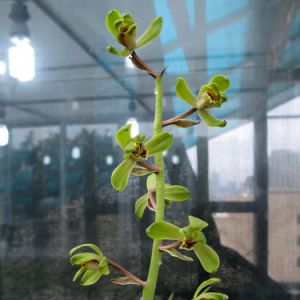
How is the Huilan orchid 'Lao Ran Zi' as a lazy bloomer? Orchid photo appreciation
Petal type: Red-sheath class plum petal. History: Selected during the Daoguang period of the Qing Dynasty by the Ruan family of Jiashan, Zhejiang. Also known as Ruan Zi. Characteristics: The three petals are short, narrow and deep, with level shoulders, divided sepals with a large Guanyin hood-shaped central column, and a large round tongue; sometimes the flowers bloom in a congested manner; the tip of the lip petal is pinched narrow and not spreading, upturned or skewed, hence the common name 'Steelyard-hook-head Lao Ran Zi'. The flower scape is slender and long. It is one of the old eight varieties of Huilan...
-
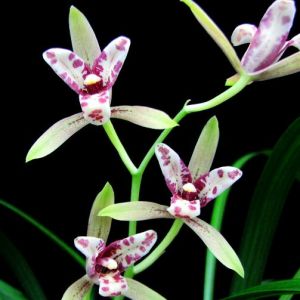
Jianlan 'Neon Butterfly': blooms in a riot of colors, fragrant as a shower of stars
Neon Butterfly, also known as (Star Rain Flowing Fragrance): one of the most beautiful leaf butterflies among Jianlan (Cymbidium ensifolium), a new variety from Sichuan, with extremely beautiful leaf butterflies! The flowers open as pink-based three-star butterflies, large and fragrant, with bright red butterfly patches and strong contrast, making it a rare gem among the four-season leaf butterflies!
-
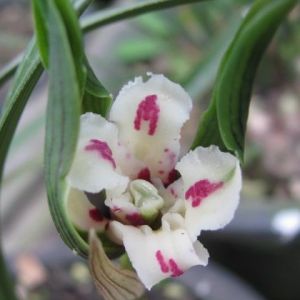
Taidou Die Chunlan, also known as Rui Wang, is rare in number and has repeatedly won gold awards at orchid shows
Chunlan Taidou Die: a rui die, a rare flower, a famous variety. Xue Jinze image history: Taidou Die is also known as Rui Wang, discovered in western Hunan, China. It is currently rare in number and has won gold awards many times at orchid shows. Characteristics: each plant has 5 leaves, leaf length 25-35 cm, leaf width 0.8-1.2 cm; large-flowered butterfly-type flower, often blooming with multiple lips and multiple petals, up to 7...
-

How to care for orchids in spring? A full breakdown of the key cultivation points
Water. In spring, avoid "wet" - "moist" is enough! For my orchids grown in granular medium, a thorough watering once every 4-5 days; those grown in New Zealand peat moss generally get watered about once every 5-8 days! After watering, please use a fan to dry the leaf surfaces, so as to eliminate water standing on the leaves breeding bacteria and water pooling in the hearts of new shoots! Choose a late afternoon with moderate temperatures and plenty of sunlight to water...
-
How to appreciate plain-colored Chinese orchids? Master these key appraisal points
Plain-colored flowers have only a single pure color (whether white, yellow, pinkish green, peach red, or even entirely black), with no purplish-red stripes or spots. Those with a plain-colored lip are called plain-heart orchids. If color appears at the base of the lip, they belong to the peach-cheek plain type. Plain-colored flowers and plain-heart flowers have the modest, elegant bearing of a gentleman, matching the traditional Eastern cultural value of "prizing the plain." Fragrance...
-
How to choose orchid potting medium? Let's talk about all things orchid potting medium
Potting medium is one of the staple foods of orchids and the foundation of growing them. With a good potting medium, more than half the battle of orchid growing is already won, so its importance goes without saying. Orchid growers all place great importance on and pay close attention to potting medium, yet their assessments of it differ widely - each side has its own reasons, as the saying goes. Their choices of potting medium are extremely varied - like the Eight Immortals...
-
How to mix orchid potting medium? Sharing practical small formulas
Potting medium is the material foundation on which orchids depend for survival, and it is also one of the factors that promotes more shoots, vigorous roots and strong seedlings. Below are several formulas that the author has repeatedly tested and verified as suitable for different orchids. Formula one: 70% shiitake soil, 20% rice husk charcoal, 10% coarse river sand, plus an additional 10% bone charcoal (this formula is suitable for planting Cymbidium goeringii and Cymbidium faberi).
-
-
-
How to grow orchids at home? Remember these four key points
First, avoid using a large pot for a small plant. The downside of using too large a pot is that there is too much growing medium in the pot. If you water too little, the outside is wet but the inside is not, and the roots cannot get water. If you splash too much water, the outside dries but the inside does not, and the growing medium easily rots, and the roots rot along with it. You may think that more growing medium means more nutrients, but that is wrong! Second, avoid using fertilizer in excessive amounts. Fertilizer can promote the growth, strengthening, and blooming of orchid plants, ...
条件筛选