-
How to tell the difference between Cymbidium goeringii and Cymbidium faberi? A guide to distinguishing the two orchids
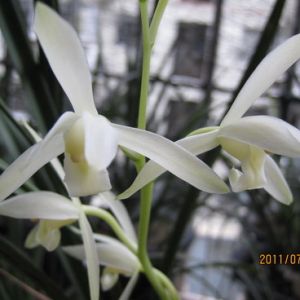
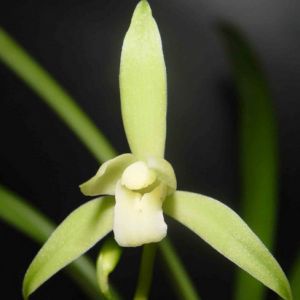
A beautiful white flower, it doesn't have a name yet.
-
How is the Xianghe Huilan orchid? A detailed introduction to its variety characteristics
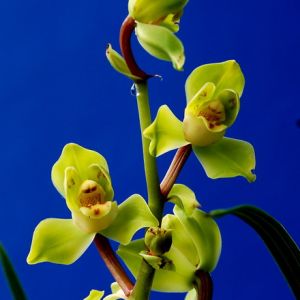
The Huilan orchid Xianghe was named by Yang Yuanyuan of Changzhou City, Jiangsu Province, and the flower originates from Hubei. In April 2000, it was brought to Changzhou from Suizhou, Hubei, by orchid enthusiast Zhu Jianqing of Lishui, Shaoxing, Zhejiang, and its three outer petals "taper at the base and flare at the corners", while the petals and lip are short, round and broad.
-
How much is one seedling of Chunlan 'Liangxi Mei'? With pictures and prices
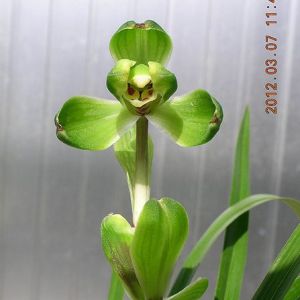
History of Liangxi Mei: selected in Suzhou in the early years of the Republic of China, obtained by Yang Ganqing of Wuxi and named after Wuxi's ancient name "Liangxi". Characteristics: leaf posture semi-drooping, upright-oblique when the seedling is thick and strong, leaf width 1-1.2 cm, length 20-30 cm, leaf groove shallow, leaf color yellow-jade green, fertilizing and low light cannot make the leaf color dark green, new seedling leaf tips have a white tip, and upon careful observation have pink coloring. ...
-
Recommended Cymbidium goeringii variety: How is Wanzi? Characteristics and price introduction
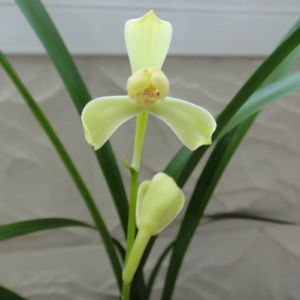
Siji Wanzi: The color is clean and lustrous, and the flowers are relatively large. Its flowering quality among Sijilan can be compared with that of Chunlan Wanzi, hence it is called Siji Wanzi. Sijilan Wanzi originates from Mingshan County, Ya'an City, Sichuan Province. It was first seen in 2004 at the Beijing Autumn Orchid Exhibition, brought by Zhao Shan, and in 2005 at the Leshan National Exhibition, the old variety was purchased from Zhao Shan's home and named.
-
-
Is Chunlan 'Dian Hongsu' easy to grow? Photo characteristics and how to tell real from fake
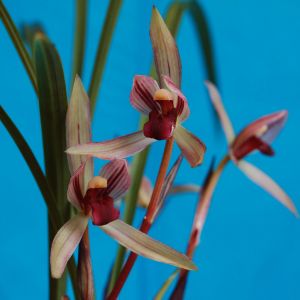
"Dian Hongsu" is a Yunnan Chunlan (Cymbidium goeringii) native to Jingdong County, Yunnan. It has 4-5 leaves, 30-40 cm long and about 0.8 cm wide, with an elegant leaf shape; it blooms in early spring, bearing two flowers, the flower stem is water-red, the petals are vividly multi-colored, the shoulders are level, and the fragrance is pleasant. Most striking is the entire lip, which is deep red and velvety, brilliant and eye-catching. It is an extremely precious red-pigmented variety among Chunlan...
-
How Do Orchids Reproduce? A Detailed Guide to Common Propagation Methods
Yongfu Su has a long history. Legend has it that in the past, when Yang Guifei was admiring orchids, she was particularly fond of this one for its exceptional fragrance and lingered there, reluctant to leave. While admiring the orchid leaves, she unexpectedly left her fingerprints on them, leaving concave-convex wavy fingerprint-like patterns on the leaves. Therefore, Yongfu Su is also called Guifei Su or Fingerprint Su. Characteristics: leaves broad and thick, leaf tips appearing...
-
What are the methods for identifying orchids? Teaching you how to identify orchids
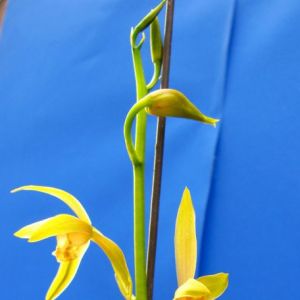
Cymbidium sinense 'Jinbi Huihuang' is a yellow-flowered variety of Cymbidium sinense, relatively few in number, with flower spikes already tall, blooming as beautifully as its name suggests, worth collecting.
-
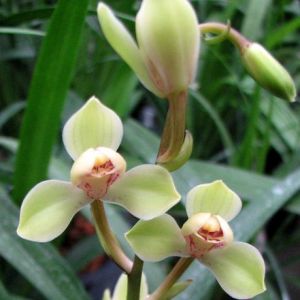
How to clean up blackened orchid root tips? Learn methods to restore root health
Zhonghua Hexian: named by Mr. Xu Zongquan of Shantou (Zhonghua Shuixian), once called (Chigan Xiahua) by Mr. Zheng Liyong! Produced in Sichuan, this line's leaves are relatively thick, slanting upright, with lotus-type narcissus petals, flowers large and held above the foliage, well-spaced with orderly arrangement, petals broad and thick, each bloom uniform, keeping its form after long opening, a fine variety worth cultivating...
-

How to help cymbidium orchids (Cymbidium faberi) settle into a new pot? A detailed guide to practical care tips
"Settling in" refers to the period a plant needs to adapt to its new pot environment after repotting. Cymbidium orchids settle in earlier than Chinese orchids (Cymbidium spp.), which means the cost of settling in is higher for cymbidiums than for Chinese orchids. As a result, cymbidiums are more prone to decline than Chinese orchids. Chinese orchids can be repotted often, but if you want to repot a cymbidium, you need to think twice before acting. Cymbidiums sometimes take years to settle in; generally speaking, a cymbidium that has been repotted for over a year...
条件筛选