How to Grow Orchids? These Care Methods Are Worth Learning
III. Environment
Growing orchids is a systematic project, and the orchid-growing site is the foundation of that system, occupying a very important position. Most orchid enthusiasts set up their growing sites according to local conditions, carving out space on their own balconies and indoors to grow orchids. Compared with the places on the mountains where orchids grow, balcony and indoor growing sites generally lack ground energy and dew, have higher nighttime temperatures, and have lower humidity. Because regions and locations differ, balcony and indoor growing sites also differ from one another; some get more sun, some less sun, some have strong wind, some weak wind, and so on. Once the orchid-growing site is chosen, you must clearly understand the shortcomings of your own site. Only by facing those shortcomings squarely can you remedy and change them through orchid pots, potting media, management methods, and so on. The orchid-growing site must be kept clean.
Sunlight: All things grow relying on the sun. Although orchids are shade plants, they also like sunlight. Sunlight can supply orchids with nutrients and can also kill viruses and sterilize, and it is an important factor in making plants strong. When conditions allow, expose them to as much sunlight as possible. Orchids grown under sufficient sunlight tend to have shorter plant form, thicker texture, and yellowish color, and are healthy and strong. The flowers they produce have thick petals, a fine and smooth texture, and bright colors. When a person feels hot or uncomfortable in the sun, it is time to shade them.
Temperature: Temperature is an important factor affecting orchid growth. Orchids grow slowly at low temperatures; the lower the temperature, the slower the growth, until they enter dormancy. At temperatures suitable for orchid growth, orchids begin to grow; the higher the temperature, the more vigorous the growth. At high temperatures growth again becomes slow; the higher the temperature, the slower the growth, until they enter dormancy. Orchids growing naturally or under cultivation are mostly in a slow-growth period, and are in vigorous growth for less time. The low-temperature period, high-temperature period, and suitable-temperature period are not fixed and unchanging; they change with the characteristics and strength of the orchids. Orchids grow under constantly changing temperatures, and the constantly changing temperatures produce temperature differences. Temperature difference is an important factor affecting the strength of orchids. Orchid growth is related to temperature, and orchid consumption is likewise related to temperature; the higher the temperature, the greater the consumption. To make orchids strong, while increasing nutrient supply you must reduce orchid consumption. The simplest and most effective way is to lower the nighttime temperature and widen the temperature difference. Closed balconies and indoor spaces generally have high nighttime temperatures. During high temperatures, special attention must be paid to lowering the nighttime temperature and widening the temperature difference. The way people maintain health emphasizes keeping warm in spring and cooling in autumn; in fact orchids are the same, and also need keeping warm in spring and cooling in autumn, so that orchids have a process of adapting to temperature changes and their resistance is strengthened. This is also the reason behind the saying that orchids should not be moved out in spring. The resistance of orchids to high temperatures and low temperatures is related to the strength of the orchids and the temperature difference. The stronger the orchids, the better their resistance. The greater the temperature difference, the better the orchids' resistance performs.
Humidity: Orchids can grow normally in different humidity environments, and their humidity requirements are also loose and flexible. Humidity changes with temperature and ventilation; high temperature and strong ventilation mean low humidity. Under the natural environment of Jiangnan, humidity can already meet the growth needs of orchids, so there is no need to spend much thought on humidity. One point to note: just avoid high temperature combined with high humidity. If humidification is needed, it is best done at night, which both simulates nature and lowers the temperature, increasing the temperature difference.
Ventilation: The ancients paid great attention to ventilation, calling it the first essential of orchid growing. Ventilation plays roles in orchid cultivation such as regulating dryness and moisture, regulating temperature, and providing the driving force for nutrient exchange. Ventilation is divided into ventilation within the pot and environmental ventilation. Ventilation within the pot mainly depends on choosing good orchid pots and potting media, and in management the orchid pot must not remain constantly wet without drying. Environmental ventilation mainly uses natural wind, opening doors and windows as much as possible, creating temperature differences, letting air convect, and using fans, etc. Strong winds and cold winds in natural wind should be avoided.
Placement: In the same site, because positions differ, sunlight, temperature, humidity, ventilation, and so on also differ. Orchids should be placed in suitable positions according to their characteristics and the dryness and moisture of the orchid pots, which both matches the characteristics of the orchids and allows uniformity in management. After orchid pots are placed on racks, their position should not be changed frequently, nor their direction changed. During high temperatures, the sun must not shine directly on the pot body.
Environment: Shady, humid, with gentle breeze. Orchid growing must be shaded, either placed under tree shade or shaded with shade netting. How many layers of shade netting to use varies with orchid species, region, and season. Black shade netting absorbs heat, so silver-colored netting is relatively better. In short, if a person is comfortable in it, the orchids are comfortable. Cymbidium ensifolium likes light relatively more, while Cymbidium sinense prefers shade even more. General orchid books emphasize ventilation, but I think it should be gentle breeze. Orchids dislike strong wind blowing directly, especially dry strong wind, otherwise it easily causes orchid leaves to dehydrate and form black spots; orchids like air to move slightly, with orchid leaves lightly brushed, and some orchid enthusiasts even call it "air movement without wind." Therefore, the shade netting around the orchid shed should reach the ground, and below about 1.5 m from the ground double shade netting should be used. This can, on one hand, filter strong wind, and on the other hand, maintain a certain air humidity. Orchids like fresh, unpolluted air, and the orchid-growing site should be far from roads, cooking fumes, and dust. Orchid pot racks should be raised 40-60 cm for growing; too high and the air is dry, too low and there is no ventilation, so take a balance. The suitable air humidity for an orchid-growing environment is 50%-80%. Insufficient humidity is a difficult problem for home balcony orchid growing. Water-absorbing materials such as red bricks and sponges can be placed on the ground, water can be sprinkled on the ground regularly, and a water trough can also be added, but the water in the trough must be changed frequently, otherwise bacteria and mosquitoes will breed. Around it, plant some flowers and trees with strong transpiration, such as Malabar chestnut, pothos, and areca palm. Do not spray water on orchid leaves, especially on sunny days with high temperatures; doing so will undoubtedly provide a hotbed for pathogens and pests, and you will pay the price.
Resolving the contradiction between ventilation and humidity: Ventilation and humidity, that is, spatial ventilation and spatial humidity, and air permeability within the pot and potting medium humidity. These are the two issues of the macro environment and the micro environment. How to handle these two issues of the macro environment and the micro environment appropriately is the interest and key of orchid growing, and this is the mystery of orchid growing! Between ventilation and humidity, which is more important? Both are important, and the two cannot be separated. But if humidity is at 80-90, ventilation becomes extremely important. If humidity is at 40-50 or below 40, humidification becomes extremely important. So-called ventilation does not mean strong wind, but air permeability, that is, the potting medium in the pot must be air-permeable, the indoor space must have gentle breeze, fresh air must be exchanged frequently, and air must not be stuffy. "Ventilation should be placed first": more precisely, when humidity reaches 60-80, the issue of ventilation first can be considered; if it is below 50, humidification should be considered. Of course, various orchid types also have different humidity requirements. For example, Cymbidium faberi can have relatively lower humidity, around 50, while Cymbidium sinense needs higher humidity, around 80. Of course, pots and potting media can also be differentiated: for example, Cymbidium faberi can use clay pots and sweating pots because they are air-permeable, while Cymbidium sinense can use plastic pots and purple clay pots because they retain moisture. In dealing with problems and contradictions, absolutely do not be bookish or dogmatic; you must consider comprehensively and must not emphasize only one aspect. Whether ventilation, humidity, fertilizing, pesticide use, light, or pots and potting media, all should be considered comprehensively. As long as the cultivation environment can be made "secluded," that is optimal.
Closed balconies in the high-temperature season. Ventilation should be moderate, and natural ventilation is best. High temperature and stuffiness are the great enemies of orchid growing. Therefore, ventilation is very important for growing orchids on closed balconies in the high-temperature season. Closed balconies generally have push-pull aluminum alloy glass windows that can be opened and closed freely, and the degree to which the push-pull windows are opened can be used to control convection and form natural ventilation. In summer, with the bright sun high and heat waves striking people, the push-pull windows should not be opened too wide during the day, generally about 20 cm is suitable. This allows the temperature difference between the balcony and outside the window to form natural convection, with a gentle breeze lightly brushing and orchid leaves swaying, just right. If the window is opened too wide, the temperature difference is too small to form convection, and instead ventilation is poor. Practice has proven that closed balconies can completely rely on opening push-pull windows to form natural convection. Generally there is no need to use electric fans to blow air; natural ventilation is still better. Humidity should be moderate, and excessive wetness or dryness must be avoided. In summer evaporation is fast, and on clear days air humidity is low, which is the bottleneck restricting balcony orchid growing. Every effort must be made to create a micro environment suitable for orchid growth. According to my experience, using a water trough to increase humidity in summer is a good way to raise air humidity. The water trough is best set up together with the orchid rack, and each layer of the orchid rack should have a water trough. The depth of the water trough is generally best at 20-30 cm. Fill it with water and cover it with steel wire mesh, with orchid pots sitting on top. This both increases air humidity and has a certain cooling effect, achieving two things at once. Combined with sprinkling water on the ground, balcony humidity during the day can reach about 40%, basically meeting the humidity requirements of orchids. Humidity is not better the higher it is. Especially in summer, excessive humidity is the source of a hundred diseases in orchids, and orchid enthusiasts should take warning.
Avoid warm humid air belts in the micro environment. For growing orchids in balcony-type small orchid rooms, because the area is small and there is one wind direction, no warm humid air belt phenomenon appears. Nowadays, sunlight rooms have a relatively large area and use wall-mounted fans. The formation of warm humid air belts in the micro environment is caused by unscientific configuration of our air supply system. Once wind channels in several different directions interlace to form an unreasonable situation, warm humid air belts will form. Every time after we flush orchids with a heavy watering, we turn on the fans, thinking that water accumulated in orchid buds will dry quickly, but this is not the case. For orchids growing within a warm humid air belt, due to the characteristics of physical water vapor movement, water accumulated in the buds is difficult to dry. When there is slight water content, we generally cannot easily detect it with the naked eye. At this time it creates the best hotbed for harmful bacteria to breed, ultimately causing frequent disease in that zone. I visited many orchid enthusiasts in Zhejiang and toured the configurations in their orchid rooms. Leaving aside the use of integrated control systems for now, their wind system configuration indeed has something unique. For example, at the height of orchid leaves and in the middle of the orchid racks, two exhaust fans are installed in a row 3-5 m apart, and from a distance they form rows and columns facing the same direction, sending out gentle wind. At the same time, with the coordinated suction and exhaust of inlet and exhaust fans embedded in the walls at both ends, the orchids in the orchid room are always kept in fresh air, so it is no wonder the flowers and leaves flourish and grow strong. Scheduled air intake and exhaust is needed to ensure orchids get fresh air, and it promotes reasonable transpiration and metabolism, making orchids grow lush and verdant. This is undoubtedly a very excellent design. Therefore, fan arrangement is not better the more there is; rather, it should follow the flow toward one direction.
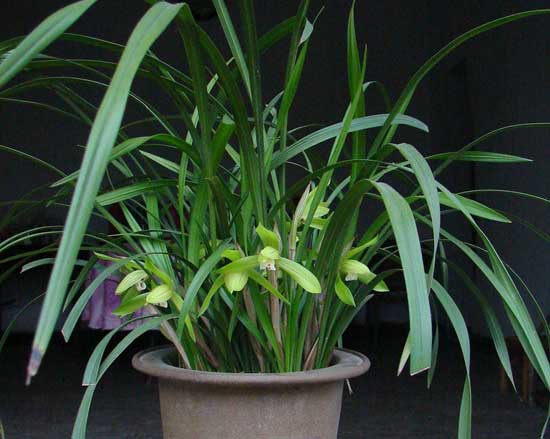
IV. Watering
How to water correctly
A veteran orchid grower said: "Watering takes three years." That is to say, to water orchids correctly, one must spend three years before mastering the knack. Why is watering so difficult? Mainly because climate changes differ each year, orchid garden environments differ (on the mountain, at the foot of the mountain, or in a greenhouse, on a balcony, and whether there is humidification...... etc.), placement locations differ (in the same orchid garden, each place has different light and ventilation, affecting how long each pot of orchids takes to dry), pot sizes differ (large pots dry slowly, small pots dry quickly, so watering times differ), potting materials differ (different potting materials have different water absorption rates, so watering methods differ; for example, with large-grain Kiryu stone cultivation, it may be necessary to water once every ten minutes, five seconds each time, continuously back and forth five times before the pot is wet enough, while other mixed materials may become wet enough after two waterings), orchid plant conditions differ (healthy large clumps are more drought-tolerant and can be watered after drying more; old pseudobulbs, small seedlings, or single plants have poor root systems and must be watered when they are about to dry), and orchid species differ (you can look at orchid roots: the thicker and larger they are, the more drought-tolerant, and you can let them dry a bit more before watering; fine, small, long roots are not drought-tolerant, and must be watered as soon as they dry), etc., all affecting the watering time differently. Therefore, watering has no fixed and unchanging method, but relies on the accumulation of personal experience. Still, there are some unchanging principles as follows:
(1) Do not water unless dry: Orchid roots are plump and thick and store considerable water, and are basically quite drought-tolerant. Therefore watering should be "clearly dry and wet," that is, when dry it should be very dry, and when watering it should be watered very wet. The greatest fear is half wet and half dry, or long wet without drying. Orchid roots are a bit like balloons: blow them full and then let air out, and they can be blown many times without fear. But if they are blown full and the air is not let out, after a week they lose elasticity, and the balloon also loses its original function. Therefore, orchid root rot is mostly caused by being too wet and poor ventilation in the pot. So if the surface material of the pot is not dry and the leaves are not slightly drooping, then there is no need to water.
(2) "Cool": When watering, choose cool weather with a temperature of 28°-20° and a little wind. In summer, 28° may be after ten o'clock at night, while in winter 20° becomes twelve noon (the lower the temperature, the warmer the watering). Therefore, when there is sunlight, watering is fine at 22° or below (at low temperatures, choose to water when there is sunlight, and orchid root growth is better); above 22°, choose cloudy days, dusk, or night for watering (the higher the temperature, the later the watering).
(3) Ideal watering times: 1. On sunny days, or when the shed temperature is above 23 degrees Celsius, it is best to water from 7 to 9 p.m., that is, the higher the temperature, the later the watering. 2. On cold days, or when the shed temperature is below 18 degrees Celsius, it is best to water between 11 a.m. and 3 p.m.; but on cloudy and rainy days, sometimes the temperature is also above 25 degrees Celsius, so be careful, that is, the lower the temperature, the earlier the watering. But note that if sunlight is strong and the temperature is low, you can water with confidence, because the quality of orchid roots is related to temperature and sunlight.
(4) Follow nature: When orchids need water and when they do not mainly depends on whether the orchids are sprouting. If they are sprouting, then the growth period has arrived. We see that in the plum rain season it rains for a whole month, and plants absorb large amounts of water, so they grow rapidly. As for summer and winter, excessive heat and severe cold are unsuitable for orchid growth and are dormancy periods. Therefore, when the orchid pot is dry, it should be watered. In summer, because the climate is severely hot and water evaporates quickly, it should be watered once dry; otherwise, orchids will dehydrate and die. In winter, temperatures are low. If there is no sunlight or wind, even if not watered for a month, orchids are not affected. Therefore, at low temperatures with no sunlight, frequent watering makes orchids prone to root rot. As for autumn, it is the period when orchids set pseudobulbs and prepare to bloom, so a slightly drier watering method should be adopted, that is, water again one or two days after the orchid pot dries. Therefore, the control of watering mainly depends on whether orchids are in the growth period, the pseudobulb-setting and flowering period, or the dormancy period, to decide the dryness and moisture of the orchid pot. Thus one should follow nature and consult the farmers' calendar to decide how to water orchids. (If the material in the pot is too fine, then it must not be rained on, otherwise root rot will occur.)
For more professional agricultural science and technology information, please scan the QR code to follow WeChat: NongXunNET

Please indicate the source when reprinting.