-
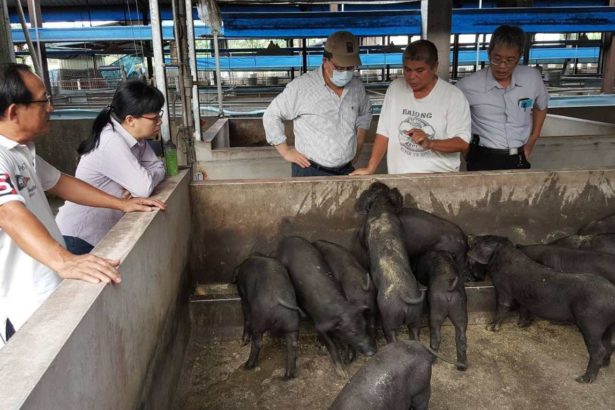
The Battle Over Epidemic Prevention and Food Waste 15"A More Scientific Era for Black Pigs! Livestock Research Institute Develops Specialized Feed, Pig Farmers: Looking Forward to More Research and Development, Moving Toward Transformational Development
The Battle Over Epidemic Prevention and Food Waste 15"A More Scientific Era for Black Pigs! Livestock Research Institute Develops Specialized Feed, Pig Farmers: Looking Forward to More Research and Development, Moving Toward Transformational Development
-

Taitung County Government Leads the Development of the Red Quinoa Specialty Industry
Taitung red quinoa has become a hit, and Taitung's specialty sightseeing tourism has become a hit along with it! Led by the Taitung County Government, 20 local hotel and accommodation operators, together with the Taitung Branch of the Soil and Water Conservation Bureau of the Council of Agriculture, Executive Yuan, the Taitung County Farmers' Association, and the Taimali Township Farmers' Association...
-

What conditions are needed for the growth and development of straw mushrooms?
1. Nutrition Straw mushroom is a saprophytic fungus that does not contain chlorophyll and cannot carry out photosynthesis to synthesize the nutrients it needs, so these must be supplied from outside. The nutrients required by straw mushroom are mainly carbohydrates and nitrogen-containing compounds. Carbohydrates mainly include sugars such as glucose, sucrose, maltose, starch, hemicellulose and cellulose. Organic nitrogen compounds mainly include peptone, amino acids and urea; inorganic nitrogen compounds include ammonium sulfate and ammonium nitrate. It is generally considered that the carbon-to-nitrogen ratio during the vegetative growth stage
-
Virus-free Technology and Industrial Development of Superior Potato Varieties
Aiming at the main problems currently existing in potato production, this study seized the favorable opportunity of planting-structure adjustment and extensively introduced superior potato varieties from home and abroad. Through trials and market-demand surveys, "Luyin No. 1" was selected as the main cultivar for Qingdao, with Kexin No. 3, Kexin No. 4 and Huayuan 525 as companion cultivars. Through systematic research on virus-free technology, rapid propagation technology and the acclimatization and transplanting technology of virus-free test-tube plantlets, the optimal virus-free protocol for potato was determined: taking 0.1-0.2
-
Potato Harvester Successfully Developed, Mechanized Harvesting Realized
On July 17, at the provincial potato mechanized planting and harvesting on-site demonstration meeting held in Xiazhaizhai Village, Nianbo Town, Ledu County, Qinghai Province, it was observed that a single-operator potato harvester produced and developed by a provincial private enterprise completed the potato harvest of a 8-fen plot in less than 40 minutes, equivalent to a whole day's workload of 10 laborers, while the machine's selling price was less than 1500 yuan. The staff of the Qinghai Provincial Agricultural and Animal Husbandry Machinery Extension Station distributed and promoted 40 such potato harvesters with an operating efficiency of 1.2 mu per hour to 20 grassroots stations on site.
-
Eight Major Disease Prevention and Control Measures for the Green Development of Mushrooms
Establish the "big prevention and control" concept of integrated management. The occurrence, and even the epidemic or outbreak, of edible mushroom diseases all follows certain developmental patterns. Patterns are science, and no carelessness is tolerated. On the surface, diseases appear only at a certain production stage, but the occurrence of disease requires quite a few conditions. If any one condition cannot be met, the occurrence of disease may be reduced, lowered, or even impossible, or even if it occurs, it cannot cause harm. Therefore, one should not only prevent or treat at the stage where the disease occurs, but should start from the source
-
What are the responses of soybean growth and development to light?
Soybean is a short-day crop, with a daylength range of 9-18 hours. The shorter the light, the more it promotes flower bud differentiation and advances flowering and maturity. When soybean grows its first compound leaf, it begins to respond to light. Generally, seedlings can complete the light stage after 5-12 days of short-day conditions. The appearance of flower calyx primordia on the plant marks the completion of the light stage. Due to long-term adaptation to light conditions in different regions, the short-day response of soybean varies considerably. Southern soybean varieties have a stronger short-day response, while northern soybean varieties are insensitive to daylength, so special attention should be paid when introducing varieties.
-
What are the temperature requirements for soybean growth and development?
Soybean is a warmth-loving crop, and the accumulated temperature required by soybean varieties in Heilongjiang Province is about 1800-2700°C. (1) The optimum temperature for seed germination is 18-20°C, at which germination is fast and seedlings emerge evenly; the minimum temperature is 6-8°C, but germination is very slow; when the temperature reaches 33-36°C, germination is fastest, but the seedlings are weak. (2) The minimum temperature required for emergence is 8-10°C. (3) For flower bud differentiation, 21-23°C is more suitable. For flowering, 22-25°C is more suitable. If the temperature is too high or too low, there will be fewer flowers. (4) The suitable
-
Rice direct seeding machine successfully developed, efficient and versatile, boosting rice sowing
Recently, a "Multifunctional Soil-Covering Direct Seeding Machine Rice Mechanical Direct Seeding Field Demonstration" organized by the China National Rice Research Institute was held in Buqiao Village, Fuyang City, Zhejiang Province, with more than 40 experts from home and abroad attending the field observation event. In recent years, China's rice mechanical transplanting technology has developed rapidly, and a number of different types of transplanters suited to China's rice production have been developed and produced. However, the development and research of rice direct seeding machines and mechanical direct seeding technology have lagged relatively behind, and no mainstream rice mechanical direct seeding technology has yet taken shape. To overcome the problems of poor seedling establishment, easy lodging, premature aging, and difficult and costly weed control
-
Analysis of the Introduction Performance and Development Strategies of Southern Pears in Hezhou
According to the deciduous fruit development concept of "southern pears and northern peaches" proposed by the Ministry of Agriculture in 1996, Hezhou City, Guangxi, began introducing southern pears from Zhejiang University, Guilin, Guangxi, and other places in 2000. A total of 11 southern pear varieties were introduced, and the current cultivation area is 1066.67 hm2. It is expected that the pear output in 2006 will reach 25,000 t. Based on current introduction observations, the soil, climate, and other natural conditions in Hezhou City are very suitable for the growth of southern pears. Many varieties show advantages such as high and stable yield, good taste, rich flavor, and strong resistance. The products are widely welcomed by consumers in the market.
条件筛选