Qianjie Coffee Plantation Summary of Breeding Steps: Seedling Raising, Field Planting and Shading
Before raising coffee seedlings, it should be noted that, under normal circumstances, green coffee beans do not have the conditions to germinate. Therefore, only by using fresh coffee cherries or the current year's parchment beans can coffee seedlings possibly be raised. Use clean river sand for raising coffee seedlings to ensure good
Before coffee breeding, the following situations should be noted:
1. Under normal circumstances, green coffee beans do not have the conditions to germinate. Therefore, only by using fresh coffee cherries or the current year's parchment beans can coffee seedlings possibly be raised with a high survival rate. According to our experience, freshly picked coffee beans can basically guarantee a 90% germination rate.
2. Use clean river sand for raising coffee seedlings to ensure good drainage and moisture retention. Water once every three to four days. Because of the production environment, Qianjie Coffee uses mountain sand;
3. As for the breeding time, of course, what is meant here is that when applied to actual production, attention should be paid to the breeding time. Using the backward calculation method, after the coffee is planted, it needs about half a year of moist environment to ensure a good survival rate given that coffee-producing areas only have a dry season and a rainy season. Therefore, it is necessary to know when the local rainy season begins (taking Southeast Asia as an example, the rainy season is from May to October). That is, when we plant in May, there can be half a year of rain. Counting back a full year, that is, February to May of the previous year, is the best breeding time. By the time of planting, we will have one-year-old coffee seedlings, and after planting there will still be enough time for the seedlings to recover.
1. Under normal circumstances, green coffee beans do not have the conditions to germinate. Therefore, only by using fresh coffee cherries or the current year's parchment beans can coffee seedlings possibly be raised with a high survival rate. According to our experience, freshly picked coffee beans can basically guarantee a 90% germination rate.
2. Use clean river sand for raising coffee seedlings to ensure good drainage and moisture retention. Water once every three to four days. Because of the production environment, Qianjie Coffee uses mountain sand;
3. As for the breeding time, of course, what is meant here is that when applied to actual production, attention should be paid to the breeding time. Using the backward calculation method, after the coffee is planted, it needs about half a year of moist environment to ensure a good survival rate given that coffee-producing areas only have a dry season and a rainy season. Therefore, it is necessary to know when the local rainy season begins (taking Southeast Asia as an example, the rainy season is from May to October). That is, when we plant in May, there can be half a year of rain. Counting back a full year, that is, February to May of the previous year, is the best breeding time. By the time of planting, we will have one-year-old coffee seedlings, and after planting there will still be enough time for the seedlings to recover.
Nursery preparation:
Nursery selection should pay attention to the shading effect. Seedlings exposed to direct sunlight are prone to withering and dying, which lowers the survival rate. Therefore, the nursery must have shading equipment. Shading materials can use shade nets, thatch or straw, or the nursery can be arranged beneath rows of large trees to cultivate coffee seedlings. Second, drainage facilities should be well built. Poor drainage easily causes seedlings to rot.
There are basically two ways to raise coffee tree seedlings: dibbling and cuttings.
After the coffee fruit is harvested and peeled, select fresh seeds of complete shape with mucilage for sowing. Spread the seeds directly on a seedbed filled with sandy loam, then cover with a layer of thin soil about 1 cm thick. The soil cover must not be too deep, otherwise the seeds will not germinate easily. After sowing is completed, water regularly to maintain soil moisture. In the second method, sow the seeds directly into 3-inch seedling pots filled with sandy loam, one seed per pot. Then cover with a layer of thin soil about 1 cm thick. After sowing is completed, water regularly to keep it moist.
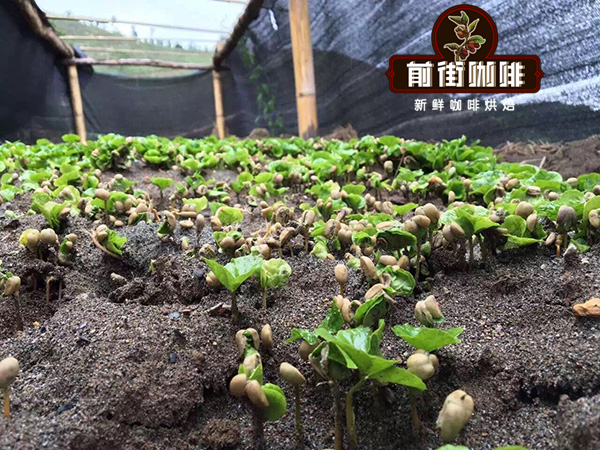
Normally, seeds need 45-60 days after sowing to germinate. When germinating, the downward-growing root extends first, pushing the coffee bean straight up, looking much like a soldier wearing a steel helmet; at this stage it is called Soldier. About two weeks later, a pair of cotyledons emerges, shaped like a butterfly; at this stage it is called Buterfly. After about another month, the first pair of true leaves grows. After the seeds sown on the seedbed grow 2-4 pairs of true leaves, they can be transplanted into 4-inch seedling pots.
After five to six months, when the seedlings grow 4-8 pairs of leaves, grafting can be carried out. Grafted plants are better able to adapt to the environment and have stronger disease resistance. However, it is usually not widely adopted.
Another propagation method is the cutting method, though this method has not yet been used in Taiwan, China. Choose one-year-old side branches from a mature coffee tree, not branches too close to the main trunk, and the branches should not be too thick. Cut into sections of 10 cm each, with each section bearing a pair of leaves. Then split each section lengthwise into two halves, each half having one leaf. Cut away part of the leaf remaining on each branch. Insert the branches into the seedbed or a pre-prepared seedling pot with the leaves facing upward, so that the leaves protrude from the soil. After watering thoroughly, continue caring for them for several weeks, and roots and leaves will grow.
When the seedlings grow their 8th-10th pair of cotyledons, they begin to grow opposite side branches, and thereafter a pair of side branches will grow at each pair of cotyledons. About one year or more after sowing, the seedlings grow to 2-3 chi tall and have about 3-4 pairs of side branches. They are then suitable for field planting into prepared farmland.