Crimson Seedless Grape Cultivation and Management Experience and Fertilization Plan
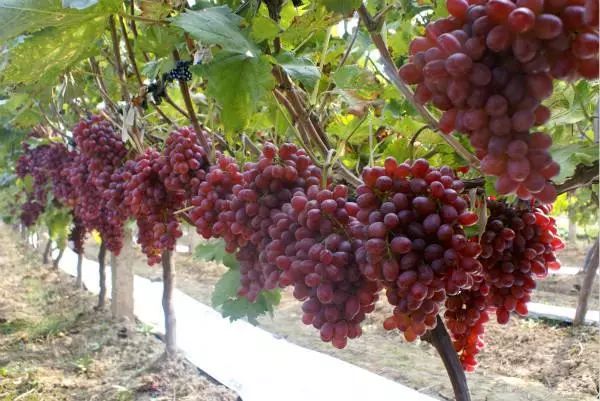
Crimson Seedless grape, a grape variety introduced from the United States in 1997, is also called Crimson Seedless grape due to translation reasons. After more than 20 years of trial cultivation, Crimson Seedless grapes are planted on a large scale in both northern and southern China, and it is one of the important varieties in China's grape industry. Although it is widely planted, the market prospects for Crimson Seedless are still good; last year some orchards were still able to sell it at a high price of 8.5 yuan/jin.
The main vine of Crimson Seedless is relatively brittle and is easily broken when it is laid down and buried in winter. It is recommended to bend the vine upward onto the trellis and tie it at an angle. When burying with soil, take soil from a distance to avoid root freezing injury. After the vines are unearthed, do not rush to put them on the trellis; lay the main vine flat, which helps buds sprout uniformly.
Since Crimson Seedless is a vigorous-growing type, it is recommended to use a horizontal trellis system to eliminate its apical dominance; balancing the tree vigor is beneficial for high yield. During winter pruning, the secondary shoots on especially vigorous shoots must be retained; the main vine extension shoot and reserve branches can be left about one meter long. Fruiting branches should be short-pruned, leaving 4-6 buds.
Crimson Seedless is a vigorous-growing variety, so water and fertilizer must be controlled, especially nitrogen fertilizer, which must absolutely not be used in the bud-break fertilizer. Mainly apply phosphorus and potassium fertilizers and farmyard manure. Every year, deep plowing and hole expansion should be carried out to facilitate rooting and improve fertilizer use efficiency. It is necessary to eat small meals frequently. In years with heavy winter snowfall, pay attention to controlling irrigation, and the bud-break water should be delayed. The fruit-sizing water must be watered thoroughly. Wintering fertilizer must be applied!
Begin the first round of bud removal at the 3-leaf stage, removing the weak buds among double buds and incompletely developed buds; at the 4-6 leaf stage, set the shoots, remove crowded branches and poorly positioned branches without flower clusters, and set the yield between 1000-1500; in areas with wind damage, leave more branches. One week before flowering, pinch the tips of all new shoots. This includes the main vine extension shoots and vegetative shoots; where space does not allow, reserve branches can be pinched at five leaves. If fertilizer and water management are proper, the length of new shoots before flowering should remain at 80-90 cm; if it exceeds one meter, it is excessively vigorous.
Crimson Seedless mainly has: grape leafhopper, downy mildew, and powdery mildew. Grape leafhopper is mainly due to poor spraying of lime sulfur mixture in early spring and before winter burial; spray with penetrating avermectin. Downy mildew and powdery mildew are mainly prevented. Before flowering, spray the tree with Baitai and Antaisheng plus boron fertilizer. Or spray the tree with DuPont Yibao.
Boron fertilizer should not only be sprayed but also applied to the roots. Flower thinning and fruit thinning should be done early. For cluster elongation, use gibberellic acid mixed with 30-40 liters of water; when the Russian olive blooms, the flower clusters can be elongated. If a sprayer is used to spray the flower clusters, add a synergist, and if necessary add brassinolide. For sizing, use gibberellic acid in a 1-gram package with 20 percent content, the same as above. Mix with 15-20 liters of water and dip the fruit clusters.
It is prohibited to spray the whole tree with thidiazuron, brassinolide, gibberellic acid, indoleacetic acid, naphthaleneacetic acid, etc.; use PBO, paclobutrazol, uniconazole, chlormequat, mepiquat chloride, etc. with caution; it is also best not to use humic acid and amino acid types.