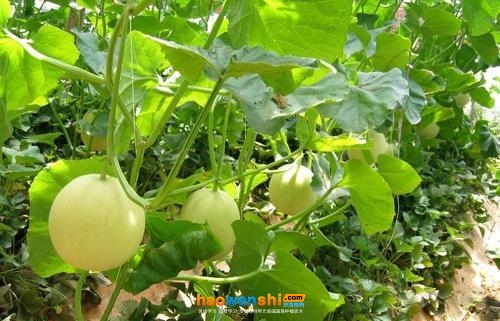
The main production areas in our country are Xinjiang, Gansu and other northwestern regions. In recent years, in the eastern and southern provinces of our country, such as Guangdong, Guangxi, Hainan, Shanghai, Fujian, Zhejiang, Nanjing and other places, exploration of moving thick-skinned melon cultivation to the southeast has also been carried out successively, and success has been achieved, with many places competing to cultivate it. It has now become an important crop for soilless cultivation in southern China that yields relatively good economic returns. The melons used for soilless cultivation are mainly thick-skinned melons, including both netted and non-netted types. Soilless-cultivated melons have good quality, a high unit price, and a short growing period, allowing fast turnover of facilities, making them a delicacy among melons eaten fresh.

Melon, also known as muskmelon, belongs to the Cucurbitaceae family and has two ecological groups, thick-skinned and thin-skinned. Melon is excellent in color, aroma and taste, and has a higher sugar content than watermelon, with some varieties reaching as high as 18%. Melon contains aromatic substances and various vitamins and minerals, which are beneficial to human health. When grown with soilless cultivation, melon can be produced year-round and supplied in all four seasons. Rockwool cultivation is mostly used, followed by sand culture, water culture, gravel culture, vermiculite culture, etc.
Soilless Cultivation of Melon
I. Biological Characteristics
1. Botanical Characteristics
Melon has a well-developed root system, with the main root mass distributed within 15-25 cm underground; it has relatively strong drought tolerance, but its root regeneration ability is weak, so it is not suitable for transplanting. The stem is trailing and can produce many secondary vines and tertiary vines. Leaves are simple and alternate, round or kidney-shaped. Thick-skinned melons have larger leaves than thin-skinned melons, and the leaf color is lighter and more flat-spreading. Flowers are monoecious; male flowers are unisexual, and most varieties have female-type bisexual flowers. The corolla is yellow, bell-shaped and five-lobed. The fruit is a pepo, developed jointly from the receptacle and ovary. Seeds are milky white or yellow, long ovate; the 1000-seed weight is 15-20 g for thin-skinned melon and 30-60 g for thick-skinned melon.
2. Growth Cycle
Germination stage: from sowing to the appearance of the first true leaf, about 10 d. Seedling stage: from the appearance of the first true leaf to the appearance of the fifth true leaf, about 25 d. Vine-extension stage: from the appearance of the fifth true leaf to the opening of the first female flower, about 25 d. Fruit-setting stage: from the opening of the first female flower to fruit maturity, 20-40 d for early-maturing varieties and 70-80 d for late-maturing varieties.
3. Requirements for Environmental Conditions
(1) Temperature. Melon likes warmth, tolerates heat, and is extremely intolerant of cold; it dies when exposed to frost, and growth stops when the temperature drops to 10 degrees C. The suitable temperature for seed germination is 25-35 degrees C, with the fastest germination at around 30 degrees C. During the seedling stage and stem and leaf growth, a daytime temperature of 25-30 degrees C and a nighttime temperature of 16-18 degrees C are suitable. During flowering and fruit setting, the most suitable temperatures are 25 degrees C-30 degrees C during the day and 15-18 degrees C at night.
(2) Light. Melon is a light-loving crop and generally requires a long photoperiod of 10-12 h. The light compensation point is 4000 lx, and the saturation point is 55000 lx.
(3) Water. Melon prefers dry conditions and requires low relative humidity; generally, a relative humidity below 50% is best. During the fruit enlargement period, soil moisture must not be too low, so as not to affect fruit enlargement. During the fruit ripening period, soil moisture should be low, but not too low, otherwise fruit cracking is likely to occur.
(4) Soil. The melon root system requires soil with good aeration and water permeability, with sandy loam being best. The suitable pH is 6-7. For every 1000 kg of fruit produced, 2.5-3.5 kg N, 1.3-1.7 kg P2O5, and 4.4-6.8 kg K2O are required, and the ratio of N, P, K is 2:1:3.7.
II. Cultivation Season and Variety Selection
1. Cultivation Season
In both southern and northern China, spring and autumn cultivation can generally be carried out, with earlier or autumn-delayed cultivation according to the regional climatic conditions. In the north, an additional summer crop can also be added, and if heating conditions are available, an additional overwintering crop can also be added.
2. Variety Selection
Melon
Soilless cultivation should focus mainly on producing high-quality, premium melons. In variety selection, in addition to focusing on quality selection, special attention should also be paid to the disease resistance of the variety.
III. Cultivation Methods
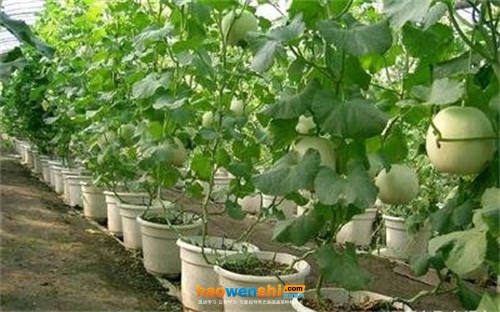
Melon soilless cultivation can use water culture (nutrient solution) and substrate culture. Substrate culture is easier to manage than water culture, and using brick trough, bag, and pot forms for melon substrate cultivation also gives relatively good results. The following mainly introduces the composite substrate trough cultivation technique for melon.
IV. Composite Substrate Trough Cultivation Technique
1. Raising Seedlings
Use nutrient pots to raise seedlings. Soak the selected seeds in warm water for 4 h, then disinfect them with 0.1% potassium permanganate for 2-3 h, remove them and rinse with clean water, and germinate them at a constant temperature of 30 degrees C. When 80% of the sprouts have grown to 0.5 cm, sow them on a sunny morning into nutrient pots filled with substrate, and after sowing cover with a layer of film to retain heat and moisture. If conditions permit, grafted seedling raising can be used, which can improve seedling resistance.
2. Seedling Stage Management
(1) Temperature Management
From sowing to emergence, maintain about 30 degrees C during the day and not lower than 20 degrees C at night. After the cotyledons break through the soil, remove the plastic film to lower the temperature, keeping it about 25 degrees C during the day and 13-15 degrees C at night. Ventilate and harden the seedlings 10 days before planting.
(2) Water Management
Soil moisture should reach 60-70% of field maximum water-holding capacity. Watering in the morning is best.
(3) Dwarfing to Promote Fruit Set
Spraying 60 uL/L ethephon at the seedling stage when there are 2 leaves and 1 heart can promote the formation of female flowers.
3. Cultivation Trough Specifications and Substrate Ratio
The cultivation trough specifications are 70-80 cm wide, 20-25 cm deep, and the length depends on the greenhouse span. A layer of plastic with drainage holes is laid flat on the bottom of the cultivation trough. For the cultivation substrate, use peat: vermiculite: perlite = 3:1:0.5 by volume; after mixing evenly and disinfecting, fill it into the cultivation trough, with the substrate slightly higher than the cultivation trough, shape the substrate into a turtle-back form, cover it with a layer of black plastic film, and water the substrate thoroughly before cultivation.
4. Planting
Melon seedlings can be planted when they have 3-4 true leaves. It is best to plant on a clear morning, using double-row planting. Be careful to keep the root system intact and undamaged. Planting density varies with variety, cultivation region, cultivation season and pruning form, and is generally controlled between 1500-1800 plants/667 sq m.
5. Environmental Regulation
Within 1 week after planting, a relatively high environmental temperature should be maintained, about 30 degrees C during the day and 18-20 degrees C at night; to prevent high temperature from harming the plants, environmental humidity can be increased. During flowering and fruit setting, control the daytime temperature at 25-28 degrees C and nighttime at 15-18 degrees C. During the fruit enlargement period, control the daytime temperature at 28-32 degrees C and nighttime at 15-18 degrees C, maintaining a day-night temperature difference of 13-15 degrees C until fruit harvest. Throughout the whole growth process, maintain relatively high light intensity, especially during the fruit-setting, fruit-enlargement, and ripening stages. While keeping warm, strengthen ventilation and air exchange, and environmental humidity should be controlled at 60-70%. If conditions permit, apply additional CO2 gas fertilizer. Overall, during the melon growing period, environmental regulation should follow the principle of “increasing temperature, reducing humidity, ventilating, and transmitting light”.
6. Plant Adjustment
(1) Pruning and Pinching
The two most commonly used methods of pruning melon are two-vine pruning and four-vine pruning. Two-vine pruning is relatively early-maturing, while four-vine pruning is mostly used in general cultivation. Four-vine pruning generally involves pinching the growing point when the seedling has 4-5 leaves, leaving 4 secondary vines extending in four directions; when the secondary vines have 4-8 true leaves, pinch the growing point to promote the sprouting and growth of tertiary vines. Female flowers generally form on the first node of tertiary vines, and in production, tertiary vines are used to set fruit, retaining 2 leaves and then pinching.
(2) Pollination
Melon has poor fruit-setting ability and requires manual supplementary pollination. Pollination is carried out from 8-12 a.m., and bumblebees can also be used for pollination.
(3) Leaf Thinning and Fruit Thinning
Old leaves at the base are prone to disease and should be removed as early as possible; overly dense vines and leaves can be thinned to facilitate ventilation and light transmission. When young melons are the size of eggs, fruit should be set in time. Select and retain young melons with moderate node position, proper shape, and no pests or diseases. Generally, 3-5 melons are retained per plant, while small-fruited varieties can retain more than 10.
(4) Turning the Fruit
Turn the fruit in time after the fruit size is set. Turning the fruit can make the fruit grow uniformly, with consistent color and even sweetness. Each time the fruit is turned, it can only be moved 1/5, and it must not be turned 180 degrees, so as to avoid sudden scorching of the bottom surface by strong sunlight. The best time to turn the fruit is 2-3 h before sunset.
7. Nutrient Solution Management
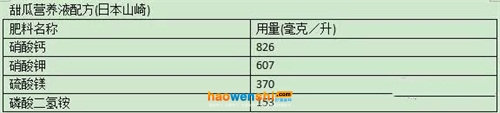
(1) Nutrient Solution Formula
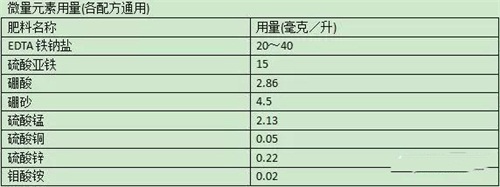
Use the Japanese Yamazaki melon formula.
Micronutrients and Nutrient Solution Formula
(2) Nutrient Solution Concentration Management. The nutrient solution concentration management indicators are: seedling stage 1.0 ms/cm, planting to flowering stage 2.0 ms/cm, fruit enlargement stage 2.5 ms/cm, and ripening stage to harvest stage 2.8 ms/cm.
(3) pH Value. The suitable pH for thin-skinned melon growth is 6.0-6.8.
(4) Solution Supply Amount and Water Management. Generally, during the seedling stage, supply solution once every 1-2 d; at the mature stage, supply solution 1-2 times per day. Each supply amount ranges from 0.5 L per plant to 2 L according to plant size. The principle is that the plants are not deficient in nutrients, do not wilt, and the substrate moisture is not saturated. On sunny days, the nutrient solution concentration can be appropriately reduced, and on cloudy and rainy days and in low-temperature seasons, the nutrient solution concentration can be appropriately increased, generally preferably 1.2-1.4 doses.
8. Harvest
Harvesting in the early morning is best; cut off the melon stalk with a knife or scissors, leaving a 1-2 cm long melon stalk when cutting. However, melons harvested in the morning have high water content and are not tolerant of transport, so melons for long-distance transport should preferably be harvested from 1-3 p.m.