Introduction to Extremely Heat-Tolerant Cauliflower Varieties and Analysis of Taiwan's Breeding Advantages
Taiwan mangoes and orchids are marketed worldwide, but many people do not know that cauliflower seeds are also a shining light of the island that has made its name known around the world. Cauliflower is one of the few advantageous items in the country with a complete industrial chain in seed production and breeding. Private seed companies are particularly strong, having been ahead of research institutions from very early on.
Taiwan mangoes and orchids are marketed worldwide, but many people do not know that cauliflower seeds are also a shining light of the island that has made its name known around the world. Cauliflower is one of the few advantageous items in the country with a complete industrial chain in seed production and breeding. Private seed companies are particularly strong, having been ahead of research institutions from very early on. In addition to focusing on developing sweet, tender green-stem loose-curd lines, breeding early-maturing and heat-tolerant varieties is also their strength.
According to estimates by the Seed Improvement and Propagation Station of the Council of Agriculture, in addition to domestic market demand, cauliflower seeds are exported to Southeast Asia at more than 10 metric tons per year, giving them considerable high economic value.
Early maturity and heat tolerance are Taiwan's cauliflower breeding advantages
The story of Taiwan's cauliflower seed exports is very inspiring. Cauliflower was originally a cool-temperature crop. The optimum temperature for curd development is 17 to 18 degrees Celsius. Curd formation must go through low-temperature vernalization. If it is too hot, it is difficult to form curds; if it is too cold, it instead bolts and flowers early. It is quite sensitive to both temperature and light. Located in the subtropics, Taiwan has relatively high temperatures, which greatly challenges cultivation techniques.
But if there is one thing Taiwanese farmers do not lack, it is courage. The Taiwan Agricultural Research Institute of the Council of Agriculture and various seed companies, year after year, trial-planted cauliflower in various places. Just as some people fear cold and some fear heat, among thousands upon thousands of cauliflowers, there are always a few that are relatively less afraid of heat. Through long-term domestication and selection, they finally turned a disadvantage into an advantage and bred early-maturing (with a shorter growing period) and heat-tolerant varieties suitable for subtropical cultivation.
Lin Chen-yu, assistant research fellow in the Vegetable Section of the Fengshan Tropical Horticultural Experiment Branch of the Taiwan Agricultural Research Institute, said that early maturity and heat tolerance are often combined, presumably because of genetic linkage. Today, different cauliflower varieties have their suitable planting seasons, and Taiwan has already achieved year-round cultivation.
According to statistics from the Agriculture and Food Agency of the Council of Agriculture, in 2015 the domestic cauliflower planting area was 1,679.2 hectares, with annual output of about 45,718 metric tons. Puyan Township in Changhua County had the largest planting area, and production areas were also concentrated in Nanzi District and Luzhu District in Kaohsiung, as well as around Chiayi and Yunlin.
Adversity forged resilience. Domestic seed companies such as Ching Nong, Known-You, Sheng Sheng, Shin Hwa, and Jiasue Seeds invested early in selecting heat-tolerant varieties, seized the initiative, and exported seeds all the way to countries such as China, India, and Southeast Asian nations.
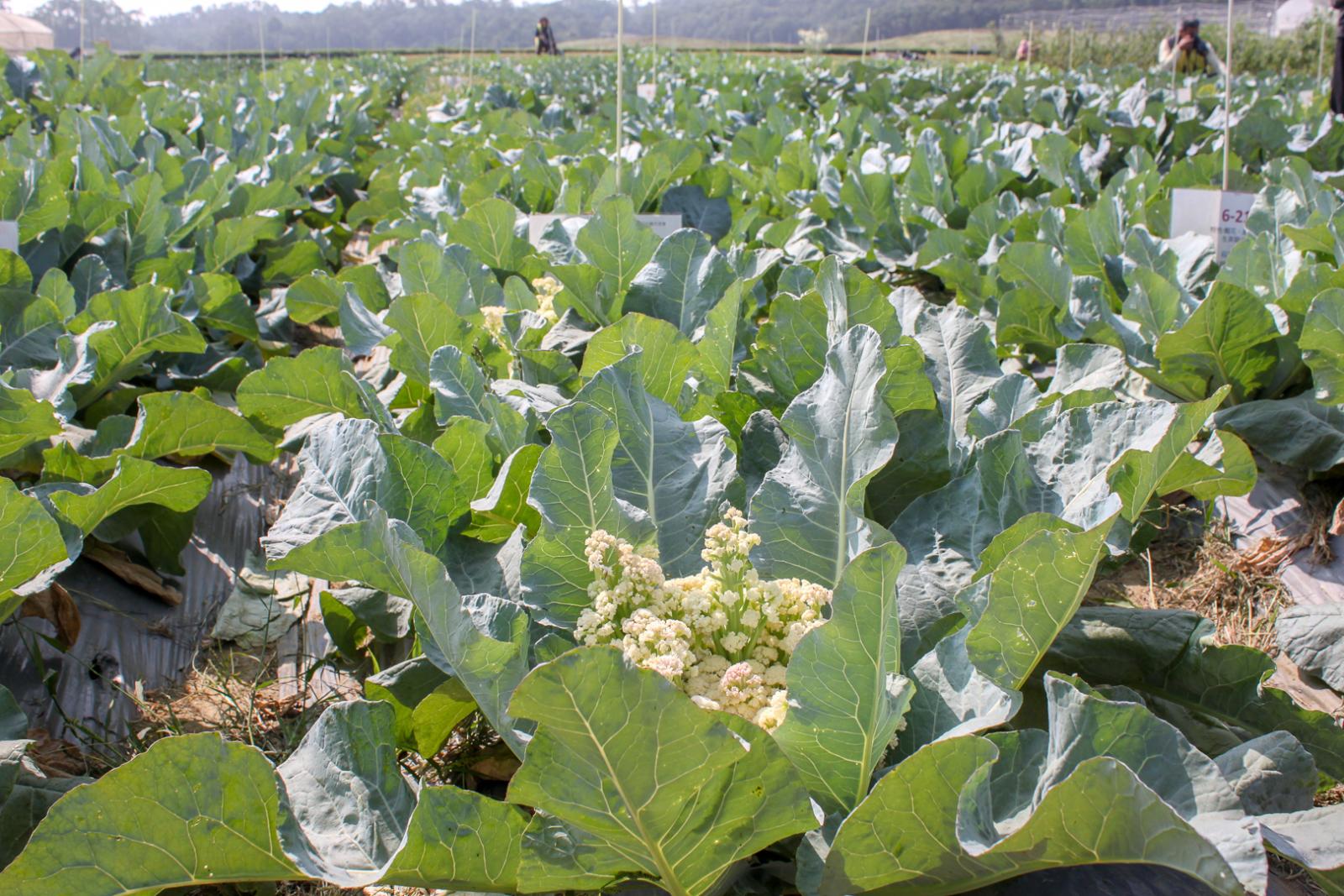
Agricultural improvement stations trial-plant cauliflowers from different companies and different varieties in the field and hold variety exchange meetings for seed companies to observe and exchange ideas.
Taking a different path, the loose-curd line leads the world
Another key technology that has won international admiration is the cauliflower loose-curd line. Cauliflower can be divided into hard-curd and loose-curd lines according to the tightness and softness of the curd. Abroad, hard-curd types suitable for salads are the mainstream; green-stem loose-curd is sweet, tender, and suitable for stir-frying, and better suits Taiwanese palates. Therefore, Taiwan's seed companies invested in breeding early on to differentiate themselves from foreign markets, and instead opened up a broad avenue.
Ching Nong Seed Company, which has cultivated loose-curd line selection and breeding for more than 60 years, analyzed that loose curd is a natural gene mutation. Abroad, it is regarded as an undesirable mutation, and such genes are less often retained, so the development of the loose-curd line started relatively late and has rarely undergone natural selection.
"For Taiwan's seed companies, cauliflower is an internationally competitive item among vegetables. In addition to being very popular in Taiwan, its market share in China is also very high." Wang San-tai, research fellow and head of the Vegetable Section of the Fengshan Tropical Horticultural Experiment Branch of the Taiwan Agricultural Research Institute, said that earlier only Taiwan and China's Fujian region ate loose-curd cauliflower, and afterward seed companies expanded overseas business and gradually secured a place throughout China.
Compared with hard curd, loose curd is lighter per head and less tolerant of storage and transport. However, as China's highway system has become increasingly developed, transport losses have been greatly reduced. Because the local population is large and the market is big, many overseas major companies have also begun to notice the loose-curd line. Taiwan started loose-curd breeding relatively early, and currently still has an experience advantage.
Taiwan's cauliflower seeds are not only competitive overseas; for domestic farmers, cauliflower is considered a crop with a relatively high cultivation threshold among the Brassicaceae, unlike cabbage, which easily suffers from the problem of "vegetables worth gold, vegetables worth dirt." It is quite worth developing.
For domestic farmers, cauliflower is considered a crop with a relatively high cultivation threshold among the Brassicaceae, unlike cabbage, which easily suffers from the problem of "vegetables worth gold, vegetables worth dirt."
Meeting international markets and climate variability head-on: stabilizing supply for processing and accelerating breeding are key
In recent years, the Tainan District Agricultural Research and Extension Station has developed a conveyor-belt continuous cauliflower/broccoli cutting machine, hoping to further capture the frozen vegetable market. However, with the opening of international markets, how to maintain the quality and stable supply volume of frozen cauliflower is a challenge for both agricultural authorities and frozen processing operators. For front-end breeders, in the face of climate variability such as either drought or flooding, and either extreme cold or extreme heat, in addition to maintaining existing breeding advantages domestically, how to respond to market demand and accelerate the breeding of new varieties has also become very important.
The Seed Improvement and Propagation Station mentioned that domestic traditional breeding techniques already have decades of research foundation, and newer molecular marker-assisted breeding techniques have also accumulated about ten years of results. Recently, the Seed Improvement and Propagation Station and some seed companies have tried applying molecular biotechnology to cauliflower breeding. This technology can develop and establish molecular markers, effectively reducing the manpower and time needed for cauliflower crossbreeding.
"Early maturity, heat tolerance, and good taste are characteristics Taiwan's seed companies already have. In the future, we hope to improve and enhance the competitiveness of the loose-curd line." Wang San-tai gave examples: whether there is a way to be more heat-tolerant so that curds can grow in environments above 40 degrees Celsius, or to be more disease-resistant and suitable for cultivation in cold northern regions, are all directions companies can work toward.
Hsu Han-chun, assistant research fellow in the Crop Improvement Section of the Tainan Station, also added that the cauliflower varieties needed in the future must not only be heat-tolerant and flood-tolerant, but should also remain insensitive to cold, because cauliflower exposed to cold easily bolts, flowers early, and changes color. Not only is the taste poor, but the appearance is also poor. If it is too hot, it is also difficult to form curds, causing delayed growth. Therefore, both must be taken into account to make a breakthrough.