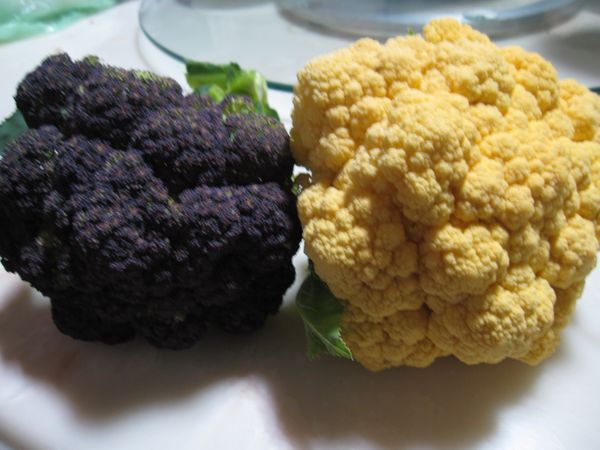
What are the characteristics and nutritional value of purple cauliflower and yellow cauliflower?
If you grow cauliflower, you must know how to grow cauliflower? Generally, the cauliflower we see in the market comes in only two colors, white and green, and we rarely see cauliflower of other colors. So would you like to learn about the characteristics of purple cauliflower and golden cauliflower?
If you grow cauliflower, you must know how to grow cauliflower? Generally, the cauliflower we see in the market comes in only two colors, white and green, and we rarely see cauliflower of other colors. So would you like to learn about the characteristics of purple cauliflower and golden cauliflower?
Purple cauliflower
Purple cauliflower is relatively rare, and its varieties were also introduced from abroad. In 1979, the Taiwan Agricultural Research Institute of the Council of Agriculture introduced 25 purple cauliflower varieties from the United Kingdom. After 33 years of selection and domestication, a new purple cauliflower variety suitable for cultivation in Taiwan, China was finally bred last year and named "Tainung No. 1".
The place of origin of purple cauliflower is the Mediterranean coast of Europe, but purple cauliflower seeds imported to Taiwan, China did not adapt well to the local environment, including insufficient heat tolerance, a short cultivation period, difficulty in seed collection, and tall plants that easily lodge. Tainung No. 1 (purple cauliflower) has a growing period of only 55 to 65 days, 10 to 20 days shorter than the original varieties.
Chen Ganshu, director of the Fengshan Branch, said that they introduced 25 purple cauliflower varieties from the United Kingdom in 1979. The varieties at that time could be called giant monsters, over one meter tall, with heads as large as a washbasin. Because it is a temperate vegetable, it needed domestication to adapt to the tropical climate of southern Taiwan, China, so that it could grow suitably in Taiwan, China.
The head of purple cauliflower is purplish red and rich in anthocyanins. The main edible part is the crisp, tender purple head, which is rich in vitamins A, B1, B2, and C, has strong antioxidant capacity, and is low in crude fiber. It also contains potassium, calcium, phosphorus, iron, and a small amount of selenium and other components.
Anthocyanin is a water-soluble nutrient with antioxidant and anti-inflammatory properties, and it can stabilize the human immune system. A characteristic of anthocyanin is that it does not readily dissolve in fats, so its nutrients are not lost. The Taiwan Agricultural Research Institute of the Council of Agriculture also reminds that the curd buds of purple cauliflower are fine and dense, so if it is boiled in soup, the purple cauliflower will all break apart and be difficult to scoop out.
Golden cauliflower (also called orange cauliflower or cheese cauliflower)
Golden cauliflower is rich in β carotene and vitamin A, and contains 25 times more than white cauliflower! Because the edible part is the flower buds, it is rich in plant hormones and compounds.
Like other cruciferous vegetables, golden cauliflower contains not only vitamins A, B, B2, and vitamin C, but also protein, fat, carbohydrates, calcium, phosphorus, iron, β carotene and so on. Golden cauliflower is rich in vitamin C, 3.5 times that of lemon and 26 times that of apple; it contains the minerals copper, manganese, chromium, potassium, and iodine; eating about 100 grams of cauliflower a day is enough to supply the vitamin C needed for one day.
Golden cauliflower is a natural vegetable with no added coloring; its yellow color is caused by its higher carotene content. In addition, golden cauliflower also contains anti-cancer substances (compounds) such as β glucosinolates, dithiolthiones, the plant compound sulforaphane, indoles, β carotene, glutathione, aromatic isothiocyanates, and so on. It is a nutrient-rich ingredient.
Purple cauliflower contains more anthocyanins, while golden cauliflower contains more vitamin C, β carotene, and vitamin A. From the perspective of nutritional composition, golden cauliflower is slightly better than purple cauliflower; but each also has its own characteristics. Which cauliflower do you prefer?