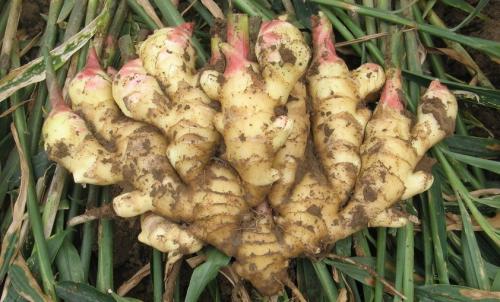
When is the best time to plant yellow ginger? Sowing methods and field management techniques
Yellow ginger is a vegetable we eat in our daily lives, but do you know how to grow it? What are the high-yielding ginger varieties? Do you know? Below, let us first look at the yellow ginger planting method. Throughout the entire growing period of yellow ginger, the suitable temperature is 15-30°C, and the time around Qingming
Yellow ginger is a vegetable we eat in our daily lives, but do you know how to grow it? What are the high-yielding ginger varieties? Do you know? Below, let us first look at the yellow ginger planting method.
Throughout the entire growing period of yellow ginger, the suitable temperature is 15—30°C, and the time around Qingming is the best time to plant ginger. During the sprouting and seedling emergence stage, the suitable relative soil moisture content is 70—80%. Too little soil moisture will affect growth, while too much moisture will cause rotting and reduce quality. Wild yellow ginger grows under forest, and although it has a shade-tolerant habit, the generally suitable annual sunshine duration is 1750—2000 hours. Yellow ginger has strong adaptability to soil, and planting it in some poorer soils can still yield certain returns.
There are four propagation methods for yellow ginger, namely seed propagation, rhizome propagation, bulbils propagation and tissue culture propagation. At present, rhizome propagation and seed propagation are mostly used.
Cultivation techniques:
(1) Sowing methods
1. Seed sowing and breeding: generally, open field plots are used for raising seedlings. The sowing period should preferably be from late March to mid-April. Mix the seeds with fine sand or fertile soil for sowing, sow shallowly and cover shallowly, and cover with grass to preserve moisture. Seedlings emerge in about 25-30 days.
2. Direct sowing of seed ginger: select 1-2-year-old ginger pieces of uniform thickness, fresh and vigorous as seed ginger, cut into 3-5 cm lengths (weighing about 15-20 g), keep 1-2 dormant robust buds on each ginger piece, and use about 150-250 kg of seed per mu.
Plant yellow ginger at about 8000-10000 plants per mu (sparse in fertile fields, dense in lean fields); for sowing time, you can choose spring sowing (February-March) or winter sowing (November-December), with winter sowing being better; planting depth is 8-10 cm, and the soil cover thickness is 6—8 cm.
(2) Field management
Timely topdressing: at the seedling stage of yellow ginger (late April), spray 2 kg of urea per mu; at the early flowering stage (late May to early June), apply 6 kg of potassium sulfate and 2 kg of urea per mu.
Intertillage and weeding: carry out intertillage and weeding twice before row closure. For troublesome thatch grass, 10% glyphosate can be used per mu.
Scientific water management: in years with normal climate, irrigation may not be needed; in severe drought, watering and irrigation are needed to promote good growth of ginger pieces and accumulation of saponins.
Pest and disease control: for cutworms attacking underground stems and aboveground stems, a 500-fold dilution of 90% crystalline trichlorfon can be sprayed to kill them; for fields prone to rhizome rot, seed dressing with carbendazim before sowing can reduce the damage.
Chemical regulation: in June during the vegetative growth period of yellow ginger and in July and August during the rhizome enlargement period of yellow ginger, use 150 g of paclobutrazol or 4 g of mepiquat chloride per mu, dilute with 50 kg of water and spray, which can control seedlings and promote ginger, increase leaf thickness and raise yield.