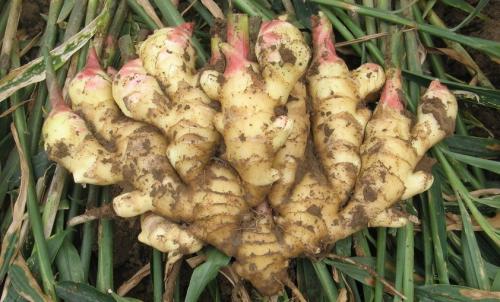
How to Grow Ginger: High-Yield Techniques and an Introduction to Top-Dressing and Earthing Up Methods
As the saying goes, "old ginger is the spiciest." Compared with young ginger, old ginger contains the most gingerol and has a stronger pungency, so when you want to dispel cold, promote blood circulation, or remove fishy odors, old ginger is usually used in cooking, and it should be cooked with the skin on for the best effect; as for
As the saying goes, "old ginger is the spiciest." Compared with young ginger, old ginger contains the most gingerol and has a stronger pungency, so when you want to dispel cold, promote blood circulation, or remove fishy odors, old ginger is usually used in cooking, and it should be cooked with the skin on for the best effect; as for the other less pungent types, young ginger and pink ginger, these are mostly used for pickling as appetizers, or they can also be steamed and eaten. So where is fresh ginger suitable for planting?
(1) Carefully Select Ginger Seed
For ginger cultivation, select excellent varieties. At present, the main superior ginger varieties include: Shandong Laiwu Large Ginger, Guangzhou Fleshy Ginger, Anhui Linquan Hutou Ginger, and more than 20 other varieties. These varieties all have strong adaptability and good yielding ability. You can choose suitable varieties according to local natural conditions.
(2) Cultivate Strong Sprouts
1. Sunning the ginger and resting the ginger
Sunning the ginger is usually carried out 20—30 days before sowing. Sun the ginger in moderation; if the midday sun is strong, you can use straw mats to shade it. Bring it indoors in the evening to prevent it from being damaged by cold at night. After sunning the ginger is finished, place the ginger seed indoors, cover it with straw mats or old cotton quilts, and pile it for 2—3 days; this is called "resting the ginger." Sunning and resting the ginger can raise the temperature of the ginger pieces, promote the decomposition of internal nutrients, speed up sprouting, reduce the moisture content of the ginger pieces, and prevent the ginger pieces from rotting.
2. Selection
After sunning and resting the ginger, discard the thin, weak, shriveled ginger pieces and those whose flesh has turned brown or become soft. Keep robust ginger pieces that are plump and full, bright in skin color, fresh in flesh, not shriveled, and free from disease and pest damage as ginger seed.
3. Sprout promotion
Place the ginger seed in an environment with a temperature of 20—25°C and a humidity of 70—80% to prompt the seed ginger buds to sprout quickly. This is mostly done around the Awakening of Insects solar term. For open-field cultivation, postpone it by 25—30 days.
(3) Land Preparation
For the ginger field, choose fertile loam soil with relatively high terrain, deep soil layers, rich organic matter, good water and fertilizer retention, loose and airy texture, and slight acidity. Do not grow ginger in the same field year after year. For the selected ginger field, after the autumn crop is harvested, plow deeply to 25 cm. After weathering through winter rain and snow, in early to mid-March of the following year, after the soil thaws, apply base fertilizer together with harrowing: apply 5000—8000 kg of fully decomposed high-quality barnyard manure per mu, 30 kg of urea, 13 kg of diammonium phosphate, 50 kg of potassium sulfate, 1 kg of zinc sulfate, and 0.5 kg of borax; to prevent underground pests, use 2 kg of 3% phoxim granules per mu mixed with 12-15 kg of soil and spread evenly. Then level and harrow the land finely.
(4) Sowing
Sowing at the right time is the prerequisite for obtaining high yields. In the Huaibei region, plastic-film cultivation is generally sown in early to mid-April; conventional cultivation can generally be sown in early May, when the soil temperature stabilizes above 15°C. Within the suitable sowing period, earlier is better than later. Before sowing, first soak the seed in Bordeaux mixture prepared with quicklime, copper sulfate, and water at a ratio of 1:1:100 for 20 minutes. Then break the large ginger seed pieces apart, with each seed ginger piece preferably 50--75 grams; generally keep only 1 short, strong bud, and for a few ginger pieces you may keep 2 strong buds depending on the condition of the young buds, removing all other young buds. When breaking the ginger apart, if you find that the base of the young buds has turned black or the cut surface of the broken ginger piece has browned, strictly discard them. After breaking the ginger apart, dip the broken surface in fresh, clean plant ash to seal the wound.
Water once. Generally, well water is used for irrigation. In summer, watering in the morning or evening is best. During continuous rainy days, drain promptly to ensure there is no standing water in the ginger furrows.
(5) Top-Dressing and Earthing Up
Ginger is a fertilizer-tolerant crop with a long growth period and a high fertilizer requirement, so top-dressing should be applied reasonably according to different growth stages. Around the Beginning of Autumn solar term, ginger shifts from the seedling stage to the vigorous growth stage, and its demand for fertilizer and water increases markedly, so the "turning-point fertilizer" must be applied. Generally, after the plastic film is removed, apply 75 kg of cake fertilizer, 30 kg of urea, 10 kg of potassium sulfate, 0.5 kg of zinc sulfate, and 0.25 kg of borax per mu. Cover with soil to close the furrow and build up the ridge, so that the original furrow where the ginger plants grew becomes a ridge and the ridge becomes a furrow. Generally, water 2 days after fertilizing.
In mid-September, to ensure the nutrient supply needed for ginger rhizome expansion, the "supplementary fertilizer" must be applied. Apply 5—7.5 kg of urea per mu. When top-dressing, you can open a small furrow under the ridge and apply it, or dissolve the fertilizer in water and flush-apply it along with the water. Apply nitrogen, phosphorus, and potassium in a balanced formula to enhance the plant's disease resistance, and strictly avoid applying excessive nitrogen fertilizer; fourth, clear the furrows and drain water in time to prevent standing water in the field. Chemical control of ginger anthracnose: spray with 70% thiophanate-methyl wettable powder at 1000 times dilution plus 75% chlorothalonil at 1000 times dilution; or use 50% Shibaigong at 1000 times dilution for foliar spraying at the initial stage of disease onset, once every 7—10 days, for 2—3 consecutive times.