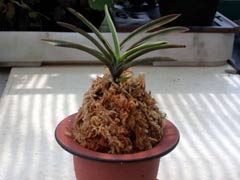
Winter jasmine bonsai takes flexible shapes; care requires attention to light and watering
Winter jasmine bonsai is a bonsai made from winter jasmine, a plant in the Oleaceae family, as its material. Winter jasmine is a deciduous clumping shrub with slender, supple branches that often arch and droop. In early spring it blooms before leafing out, producing small golden-yellow flowers; it gets its name because it flowers earlier than most other flowers, and it is one of China's traditional bonsai materials.
The most striking feature of this bonsai is that it is easy to shape. Winter jasmine branches are pliable, making them easy to wire and train, and it is suitable for many forms such as the weeping style, waterside style, and curved-trunk style; its root system is well developed, and after root exposure treatment the gnarled roots can be revealed, making it even more ornamental. Every early spring, the bare branches are covered with golden flowers, and the sight of flowers before leaves is very elegant.
In terms of care, winter jasmine likes a sunny, well-ventilated environment and is fairly tolerant of cold and drought, but it fears waterlogging in the pot, so watering should follow the principle of watering when dry and letting it dry between waterings. The potting soil should be loose, fertile, well-draining sandy loam. After flowering, spent flower branches should be pruned promptly, overly dense branches and leggy growth should be thinned out, and pinching back during the growing season can promote branching and keep the plant compact.
Repotting is mostly done after flowering or in autumn, and old roots can be pruned and base fertilizer added at the same time. In daily care it can be placed on a balcony, windowsill, or in a courtyard in a spot with good light. If light is insufficient, the branches tend to become thin and weak and flowering decreases; if water accumulates in the pot for a long time, it may cause root rot. These two points need special attention in management.