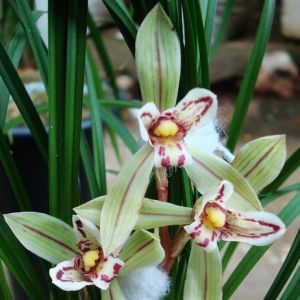
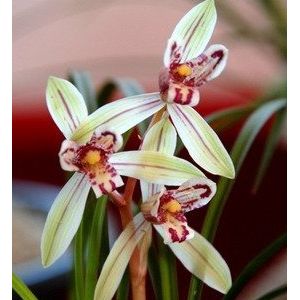
Xinhai Die is a highly ornamental butterfly-type flower variety among Cymbidium tortisepalum (Lianban orchids).
Xinhai Die is a butterfly-type flower variety among Cymbidium tortisepalum (Lianban orchids). It is a perennial herb of the genus Cymbidium in the family Orchidaceae, and is mainly circulated in Lianban orchid-producing areas such as Yunnan. The character "Xin" in its name highlights the delicate, quiet fragrance, while "Die" (butterfly) refers to the butterfly-like variation of the petals, which resemble a colorful butterfly at rest when in bloom, so it is often grouped by orchid enthusiasts together with varieties such as Xinghai Die into the Lianban orchid butterfly-flower series.
In terms of morphology, Xinhai Die has slender leaves with fine serrations along the leaf margins. Its flowering period is mostly in winter and spring, and a single scape often bears several flowers. The sepals or petals of the flowers carry butterfly-like patches with striking color contrast, a thick and velvety texture, and a clear, far-reaching fragrance, making them highly ornamental. It should be noted that the butterfly-like expression is related to the vigor of the plant and the cultivation conditions; strong seedlings tend to produce standard butterfly flowers more easily.
For care, you can follow the general habits of Cymbidium tortisepalum. The potting medium should be loose and breathable; bark or granular material mixed with an appropriate amount of humus can be used. The placement should provide sufficient diffused light and good ventilation. Water according to "dry when wet, wet when dry," avoiding long-term water accumulation in the pot. During the growing season, apply thin fertilizer frequently. In summer, pay attention to shading and cooling. In winter, allow appropriate low-temperature exposure, which is beneficial for flower bud differentiation and normal flowering the following year.
Common problems in daily management are mostly root rot caused by overly frequent watering, or stem rot and anthracnose induced by high temperature and high humidity. Mealybugs are also prone to breeding when ventilation is poor, so prevention should be done in advance and treatment should be timely. When introducing plants, it is recommended to select plants with strong roots and glossy leaves. Be extra discerning with seedlings whose butterfly patches are unusually vivid, and choose reliable channels to avoid many detours.
Related Reading