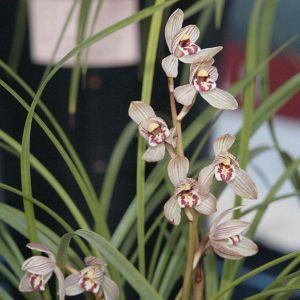
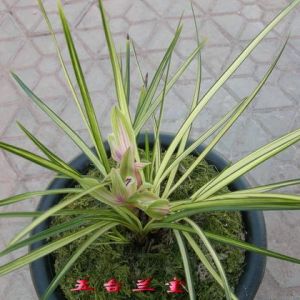
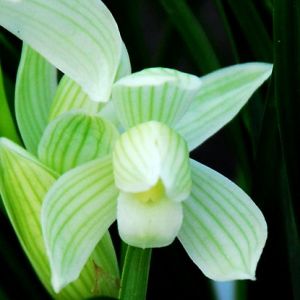
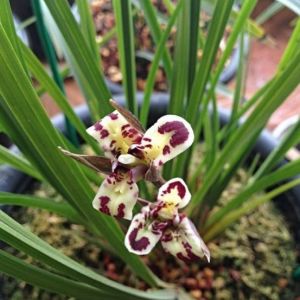
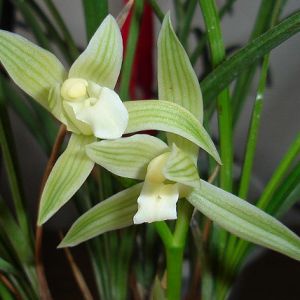
Cangshan Qidie is a classic butterfly-type flower variety among the Cymbidium tortisepalum (Lianban orchid) of Yunnan.
Cangshan Qidie is a butterfly-type flower variety of the Lianban orchid (Cymbidium tortisepalum), named after its origin in the Cangshan area of Dali, Yunnan. Its main characteristic is the butterfly transformation of the petal-like lips, with vividly colored patches appearing on the inner petals that resemble spread butterfly wings, so that the whole flower looks like a colorful butterfly perched and resting, giving it high ornamental value among Lianban orchids.
In appearance, Cangshan Qidie has slender leaves with an elegant, flowing posture, strongly contrasting flower colors, and relatively thick, substantial petals. Its flowering period is similar to that of most Lianban orchids, mostly concentrated in winter and spring, and the flowering period is fairly long; when the bloom is stable, the butterfly transformation effect is especially prominent, which is why orchid enthusiasts often regard it as a classic butterfly-type flower variety.
For care, it prefers a warm, humid, well-ventilated semi-shaded environment, and the growing medium should be loose, breathable granular materials such as bark and Kanuma soil. Watering should follow the principle of letting the medium dry before watering again, avoiding long-term water accumulation in the pot that can cause root rot, and during the growing season a light fertilizer can be applied frequently in small amounts. In summer, take care to provide shade and cooling; in winter, keep it appropriately warm and maintain a certain day-night temperature difference, which is beneficial for flowering and for the expression of the butterfly-transformation patches.
Within the Lianban orchid family, the Cangshan area also produces well-known varieties such as Cangshan Honghe, Cangshan Suhe, and Xiaoxuesu, and Cangshan Qidie together with them forms the Cangshan Lianban orchid variety series. When purchasing, it is recommended to focus on observing the degree of butterfly transformation and the stability of the bloom, and also to pay attention to distinguishing the quality so as to select a plant worth collecting.