Grow Salvia farinacea this way for longer-lasting strings of flower spikes
Salvia farinacea (mealycup sage) is a perennial herbaceous plant in the genus Salvia of the Lamiaceae family. In production it is often grown as an annual or biennial flower, and it is also known as blue sage and "yi chuan lan". Although its name contains "orchid", it is not an orchid at all; it gets the name only because its flower spikes look somewhat like those of an orchid. It is also not the same species as the salvia used as a culinary herb, so there is no need to confuse the two when growing it.
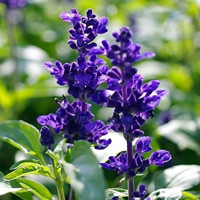
Its ornamental value lies in its blue-purple spike-like inflorescences, with small flowers packed densely into long strings. The flower color is elegant and easy on the eye, and the blooming period is mostly concentrated in summer and autumn; with proper management it can keep blooming for several months. Besides the blue-purple range, there are also white and blue-and-white cultivated types, which create a strong sense of layering when planted in masses. During the flowering period it often attracts bees and butterflies, so using it in flowerbeds and flower borders gives good ornamental and ecological effects alike.
For care, Salvia farinacea likes a sunny, warm environment. It has fairly good heat tolerance but only average cold tolerance, so in low-temperature areas in winter, pay attention to cold protection, or simply grow it as an annual flower. Loose, fertile, well-drained soil is best. Water by the principle of letting the soil dry between waterings, and avoid long-term waterlogging. During the growing season, apply light fertilizer frequently, supplement phosphorus and potassium fertilizer appropriately before flowering, and promptly cut off spent flower spikes after blooming to encourage it to bloom again. Propagation is mainly by sowing in spring, and with suitable conditions it can also be propagated by cuttings.
In use, it is suitable for mass planting in flowerbeds and flower borders, and also for balcony pots and cut flowers. It is a commonly used material in summer and autumn flower borders. If it fails to bloom or grows poorly in home care, it is often related to insufficient light, waterlogging, or lack of fertilizer; checking and adjusting these aspects first usually brings improvement.