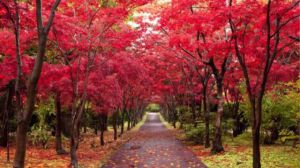
An Introduction to the Characteristics, Common Varieties and Care Methods of Japanese Maple
The Japanese maple (Acer palmatum) is a small deciduous tree of the genus Acer in the family Aceraceae, named for its palmately lobed leaves that resemble a chicken's claw. It has a graceful form with fine, dense branches and foliage, and its ornamental effect is especially striking after the leaves turn red in autumn, making it one of China's traditional foliage trees, often used in courtyard landscaping, park greening and bonsai making.
The leaves of the Japanese maple generally have seven palmate lobes, with fine serrations along the edges of the lobes; they are green in spring and summer and turn red or orange-red in autumn. The bark is smooth, the twigs are slender, purple small flowers bloom during the flowering period, and the fruit is a small winged nutlet that disperses in the wind once mature. It prefers a semi-shaded, moist environment, is afraid of scorching sun exposure, and does not tolerate waterlogging.
There are quite a few common cultivated varieties and cultivars, such as red maple, also called red Japanese maple, whose leaves are purplish-red year-round; the feather maple, whose leaves are finely divided like feathers; and also fine-leaved Japanese maple, linearilobum Japanese maple and others. Different cultivars differ in leaf color, leaf shape and plant form, and can be chosen according to landscaping needs and personal preference.
As for care, the Japanese maple is best planted in loose, fertile, well-drained soil, and during high summer temperatures and strong light it should be properly shaded to prevent the leaf edges from scorching. Watering can follow the principle of watering when dry and letting it dry out between waterings; during the growing season a little light fertilizer is enough, and pruning should mainly consist of thinning out overly dense branches and diseased or weak branches. It has a certain degree of cold hardiness, and in cold northern regions it is best to give it a little protection in winter.
Many people easily confuse the Japanese maple with red maple; in fact, red maple can be regarded as a variety of the Japanese maple, and the most intuitive difference between the two is leaf color: red maple is reddish year-round, while the ordinary Japanese maple is green in spring and summer and red in autumn. Understanding these differences makes it easier to avoid mistakes when selecting and caring for them.
Related Reading