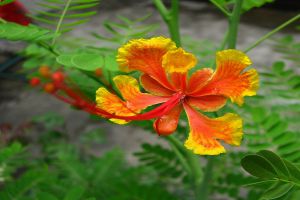
The flowers of the peacock flower (Caesalpinia pulcherrima) resemble butterflies, making it suitable for planting both in courtyards and in pots.
The peacock flower, also known as the yellow butterfly, is an evergreen shrub of the Fabaceae family, native to tropical regions and commonly seen in courtyard and park landscaping in southern China. Its flowers are mostly orange-red with yellow-tinged edges, and when in full bloom they look like colorful butterflies resting on the branches, offering strong ornamental value.
The peacock flower has a very long blooming period, and in warm climates it can bloom almost continuously year-round, which is why it is so popular among flower lovers. Its leaves are pinnately compound, and the branches bear thorns, so care is needed when planting or pruning to avoid being scratched.
Potted peacock flowers should be placed in a spot with plenty of sunlight; the more light, the more abundant the blooming. It likes a warm environment and has poor cold tolerance, so in winter it needs to be moved indoors or given protection from the cold to avoid frost damage. Water so that the potting soil is allowed to dry slightly between waterings, and never let water accumulate for long periods, which can cause root rot. During the growing season, a light application of diluted fertilizer can be given as appropriate, and after flowering, spent blooms and overly dense branches should be pruned promptly to encourage new growth and continuous blooming.
It should be noted that the seeds of the peacock flower and other parts of the plant are not suitable for eating, and households with children or pets should place it out of easy reach. Overall, the peacock flower has beautiful blooms and a long flowering period, and is relatively low-maintenance, making it a worthwhile ornamental flower whether used to accent a courtyard or grown in a pot on a balcony.
Related Reading