Characteristics, Habits and Garden Applications of Chinese Fringe Flower (Loropetalum chinense var. rubrum)
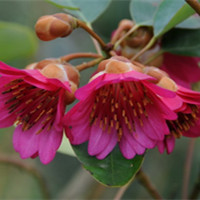
Chinese fringe flower (Loropetalum chinense var. rubrum) is an evergreen or semi-evergreen shrub of the genus Loropetalum in the witch hazel family (Hamamelidaceae), and can also be grown into a small tree. It is a variety of Chinese fringe flower (Loropetalum chinense) and is native to our country, with cultivation relatively concentrated in Hunan, Jiangxi and other places. Its most striking feature is that its leaves stay purplish red all year round; it blooms in spring, with flowers ranging from pink to purplish red and petals slender like ribbons, resembling tassels when in full bloom, giving it high ornamental value.
Chinese fringe flower prefers a warm, humid environment with plenty of sunlight, tolerates slight shade, and likes loose, fertile, well-drained acidic soil; it is afraid of waterlogging and alkaline soil. It has strong sprouting ability and tolerates pruning, and can be pruned and shaped multiple times a year. When the climate is suitable, besides the main bloom in spring, it often blooms again in autumn.
In horticulture, there are many cultivar types of Chinese fringe flower, usually classified into groups according to differences in leaf color depth and flower color; leaves may be dark red, bright red or light red, and flower colors also differ as pink or purplish red. Among them, the types with fine, dense branches and leaves are especially suitable for making bonsai and shaped trees.
In garden applications, Chinese fringe flower is often used as hedge, color-block and mosaic pattern material, and can also be planted as a specimen or pruned into a ball shape. It is a common tree species for colorful-leaf landscaping in southern regions. In daily care, make sure to provide sufficient light, as the leaf color tends to turn green when light is insufficient; watering should follow the principle of alternately dry and wet, avoiding long-term waterlogging that causes root rot. Propagation is most commonly done by cuttings and grafting.
Related Reading