White or Green Bitter Gourd: Which Is Better? Nongxi No. 29 and EX-2682 Take Top Honors
The Taiwan Seed Improvement Association and the Fengshan Tropical Horticultural Experiment Branch of the Agricultural Research Institute under the Council of Agriculture, Executive Yuan (hereinafter referred to as the Fengshan Experiment Branch) co-organized a bitter gourd variety competition, in which "Nongxi No. 29" from "Nongxi Enterprise Co., Ltd." won the white gourd group championship, while the green gourd group was won by "EX-2682" from "Known-You Seed Co., Ltd."
Easy to grow, good-looking, good-tasting: excellence on every front
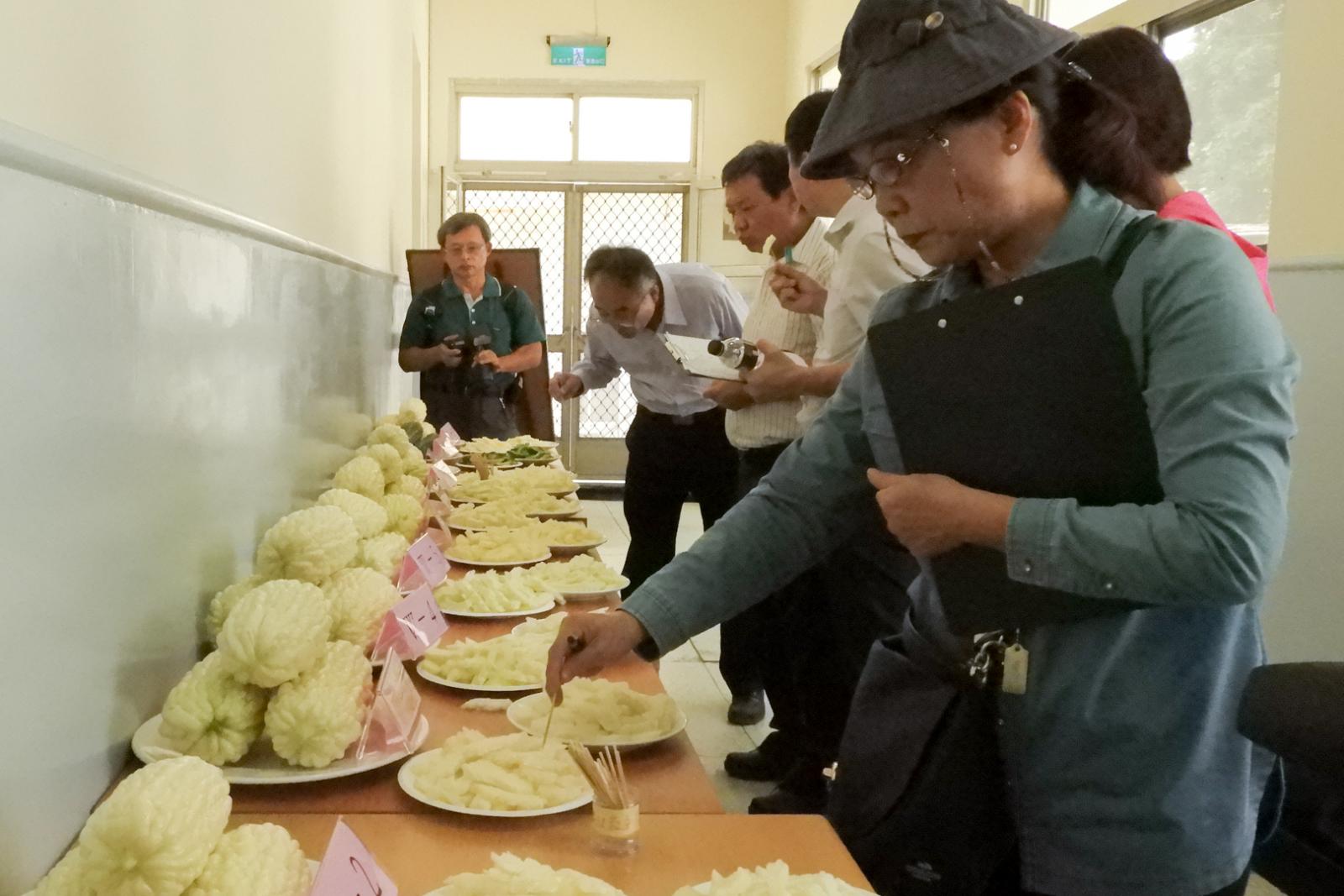
Five seed companies participated in the "bitter gourd variety competition," each entering their own prized bred varieties. A total of 11 varieties were entered in the white gourd group, and 6 varieties in the green gourd group. Judging was held on November 30 at the Fengshan Experiment Branch, with four major scoring criteria: "plant vigor" (20%), "appearance and uniformity" (40%), "yield" (20%), and "taste evaluation" (20%).
The judges did not score solely based on the bitter gourd fruits displayed on site; they also visited the net houses where the bitter gourds were grown to observe plant growth, disease resistance, yield, fruit appearance, and leaf appearance, among other scoring points. Finally, the Fengshan Experiment Branch prepared raw bitter gourd slices and boiled bitter gourd slices for the judges to taste and evaluate their flavor and texture.
Lin Chao-neng, assistant researcher in the Vegetable Division of the Fengshan Experiment Branch, who was responsible for field management for this competition, pointed out that for fairness, after the Taiwan Seed Improvement Association received seeds sent in by each seed company, the seeds were first assigned numbers. The bitter gourd seeds received by the Fengshan Experiment Branch had already had variety and company identities hidden. Lin Chao-neng then renumbered them according to the two types, white gourd and green gourd, and sent them to a nursery to be sprouted and grafted. Finally, the grafted seedlings were sent to the Fengshan Experiment Branch for planting and cultivation. Even the Taiwan Seed Improvement Association did not know the final numbers of the bitter gourd seeds that had been submitted.
In addition, each variety was planted twice at different locations within the net house, reducing the influence of differences in weather, ventilation, or other environmental factors due to planting location on plant growth and fruiting characteristics, so that judges could observe the average performance of the same variety in two areas.
The judges tasted raw and cooked slices of all participating varieties to assess their flavor and texture.
"Market demand" is key
There were five judges for this competition, including Liao Wen-wei, a researcher at the Seed Improvement and Propagation Station under the Council of Agriculture, Executive Yuan; Wang Yu-hua, head of the Farm Management Division at the Agricultural Research Institute; Hsiao Cheng-hung, secretary of the Taichung District Agricultural Research and Extension Station; Shen Pei-sheng, secretary of the Xiluo Township Farmers' Association in Yunlin County; and Huang Mu-lan, deputy manager of Taipei Agricultural Products Marketing Corporation, who scored from the perspectives of academia and industry respectively.
The final rankings were determined by combining the four major scoring criteria. The varieties that won awards all performed excellently in each category and met market demand. Chen Kan-shu, branch director of the Fengshan Experiment Branch, personally observed the field growth of each variety and also expressed agreement with the judging results.
Hsiao Cheng-hung pointed out that the various standards also had to be considered in a cross-cutting way. For example, although high yield was valued, if yield was excessive but the fruits were on the small side, or if the fruit size of the same variety varied too much, both would affect the score. However, this judging was mainly based on the preferences of the Taiwan market; other varieties that did not win awards might be varieties preferred by overseas consumers.
Huang Mu-lan, deputy manager of Taipei Agricultural Products Marketing Corporation, observed from an industry perspective. She revealed that no matter the variety or grade, each has its own customer base: some people like to eat large ones, some like to buy small ones, and even split fruits are bought by some. The most important thing is still to do a good job in grading and packaging and to maintain stable supply, because for businesses, stable production means they can ship to customers every day.
In the past, the Taiwan Seed Improvement Association had never held a bitter gourd variety competition, because bitter gourd has a long growing period and is relatively troublesome to cultivate. Therefore, choosing bitter gourd as the competition theme this year was a major innovation.
Wang Chen-mao, chairman of the organizer Taiwan Seed Improvement Association, stated that the association holds variety competitions for different crops 2 to 3 times each year, but this was the first time for bitter gourd, and nearly all seed companies in the association that develop bitter gourd varieties entered products. He thanked the Fengshan Experiment Branch for assisting in holding this competition, especially since the results attracted attention from every company, making field management a source of great pressure. Varieties inherently have their own characteristics in adapting to climate and soil environments, so he emphasized that the purpose of hosting variety competitions was to let every company see its own strengths and weaknesses, which would help future variety improvement.