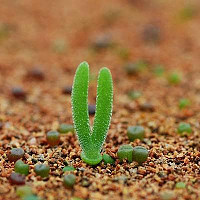
Aizoaceae is a diverse family of succulent plants
Aizoaceae is a family under the order Caryophyllales, mostly consisting of annual or perennial succulent herbaceous plants, and also including a small number of subshrubs. The plants generally have thick, fleshy leaves or stems used to store water to adapt to arid environments, and the leaves are mostly opposite; some species have very unusual leaf shapes and are highly ornamental. The flowers are usually solitary at the top of the plant and brightly colored, making this a group that attracts much attention from succulent plant enthusiasts.
Plants of this family are mainly distributed in the region of South Africa and Namibia, with a few found in arid or coastal areas such as Australia. The number of genera and species in the family is enormous, and commonly cultivated groups include Lithops, Conophytum, and Monilaria, among which Lithops is called "living stone" because its appearance closely resembles pebbles, while Monilaria is very popular because its seedlings look like rabbit ears. In addition, Mesembryanthemum crystallinum, which can be eaten as a vegetable, is also one of the representative species in this family.
In terms of care, most Aizoaceae plants prefer a sunny, well-ventilated environment and are suited to loose, breathable, well-draining gritty soil. Watering should follow the principle of preferring dry over wet, avoiding long-term moisture in the potting soil that can cause root rot. Many species have a dormant habit during the high temperatures of summer and need reduced watering and shading, while they tend to grow more vigorously from autumn to spring, when water and fertilizer can be supplemented appropriately.
In terms of use, plants of this family are mainly ornamental, suitable for placement in balconies, windowsills, and other well-lit locations, and can also be used to create succulent-themed landscapes; a few species can even be eaten as vegetables. Common problems are mostly related to improper water management, such as leggy growth, root rot, or dull plant color. Maintaining sufficient light and controlling the amount of watering are the keys to growing Aizoaceae plants well.
Related Reading