What is Monilaria obconica? An introduction to Mesembryanthemaceae succulent plants
Other names for Monilaria obconica
Jade Rabbit Ear
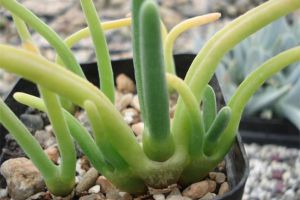
Morphological characteristics of Monilaria obconica
The leaves of Monilaria obconica are semi-transparent with a granular texture, very cute. It also has branches and tends to grow in clusters.
The flowers are generally white, the fruit is ingot-shaped, and there are 50-150 seeds.
The stem is thick, fleshy and jointed. The leaves are fleshy and dimorphic: during the growing period the leaves are slender and opposite, often not connected; during dormancy the leaves are short and thick, hemispherical in shape, with the opposite leaves highly connected.
Growth habits of Monilaria obconica
Native to South Africa, it is a very drought-tolerant succulent plant. It does not need much sunlight, and in summer it must be shaded, kept ventilated, and given no water.
When summer temperatures are too high, it will dry up and directly enter a dormant state; after enduring until autumn, watering will restore its growth.
In spring and autumn it can be watered frequently, which keeps the rabbit ears standing upright. When short of water, the rabbit ears will droop.
Home care methods for Monilaria obconica
Suitable growing temperature
The suitable growing temperature for Monilaria obconica is generally 15-25 degrees, and not below 5 degrees in winter.
When the temperature exceeds 35°C, the entire plant will wither and directly enter the dormant period.
Soil
For artificial cultivation, peat, vermiculite, and perlite can generally be used, along with a relatively large amount of granular soil (good for drainage and aeration); since the root system is well developed, use a relatively deep pot.
Water and fertilizer management
Watering: during the growing period, water thoroughly after the soil dries out; no water is needed during the dormant period.
Fertilizing: during the growing period, a light fertilizer can be applied; do not fertilize too frequently.
Propagation methods
The main propagation method for Monilaria obconica is sowing, and it can also be propagated by division.
Suggested planting combination: Sedum rubrotinctum
Related Articles
- How to prevent and control pests and diseases on desert rose? Ventilation and dryness are the key to prevention
- The three main causes of cotton diseases: climate, seeds and cultivation
- How to Grow Bird's Nest Fern in Water? Master Temperature, Light, and Water Change Techniques
- A Complete Guide to Identifying and Controlling Common Potted Flower Pests
- Do Carnivorous Plants Need Watering? Pot Watering and Wet/Dry Assessment Methods
- How to manage cotton during the flowering and boll-setting stage? Apply flowering and boll fertilizer heavily, use chemical regulation and pruning to prevent premature senescence
- How to Grow Chinese Hibiscus? Master These 5 Key Points for Blooms All Year Round
- How to Grow Tulips in Water? The Complete Process from Bulb Preparation to Blooming