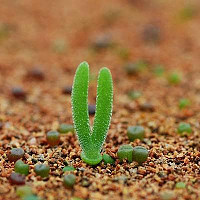
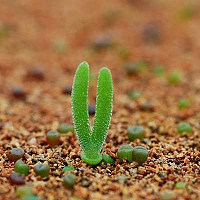
Monilaria obconica Looks Like Rabbit Ears, Understanding Its Dormancy Makes Care Easy
Monilaria obconica is a perennial succulent of the genus Monilaria in the family Aizoaceae, native to the region of South Africa. Its leaves are semi-transparent and cylindrical; at the seedling stage, two opposite new leaves stand upright, closely resembling a rabbit's ears, which is why growers affectionately call it "little rabbit." It is a popular small ornamental potted plant.
Its growth pattern differs from that of most succulents: it grows mainly in the cool autumn, winter and spring seasons, and enters dormancy during the high temperatures of summer. During dormancy, the above-ground parts gradually dry up and appear dead, but this is actually just the plant's way of protecting itself, and it will sprout again once the weather turns cool. A well-cared-for mature plant can also produce flowers resembling small daisies, making it even more ornamental.
For care, a loose, breathable gritty soil should be used, and watering should follow the principle of watering when dry and letting it dry between waterings, to avoid root rot caused by the potting soil staying wet for long periods. In spring and autumn, give it plenty of soft light to prevent leggy stems and leaves; in summer, shade it, reduce watering and improve ventilation to help the plant get through the summer smoothly, which is also the key part of growing Monilaria obconica well.
There are two main common problems: first, the above-ground parts wither during dormancy and are mistaken for death and thrown away, when in fact keeping the roots and waiting until autumn will bring it back; second, insufficient light causes leggy growth, stretching and deforming the rabbit ears and spoiling the look. As long as you understand its dormancy habits and provide a suitable environment, Monilaria obconica can keep its lovely appearance all year round.