Differences and Characteristics Between Golden Trumpet Tree and Pink Trumpet Tree and Their Propagation Methods
The genus Tabebuia consists of tropical trees. After being introduced to Taiwan, China, they grow well on the plains of the central and southern regions. In recent years, horticultural landscape cultivation has been increasingly on the rise. Winters in the north are damp and cold, so protection against cold damage must be strictly maintained. There are mainly two varieties:Golden Trumpet TreeandPink Trumpet Tree.
Two species are commonly cultivated in Taiwan, China:
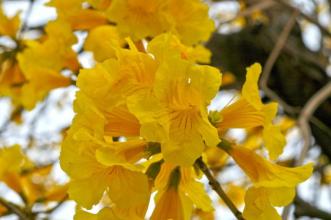
One is the Golden Trumpet Tree (T. chrysantha), also known as Yellow Trumpet Tree, Brazilian Trumpet Tree, Golden Trumpet, Yellow Bell Tree, and Ipe Tree. It is the national flower of Brazil and is a tree that changes its appearance with the four seasons; spring, from March to April, is the peak blooming period. It flowers first and then grows new leaves. When in full bloom, there are many flowers and few leaves, with almost no foliage. The flower color is bright yellow and vivid, so colorful and splendid that people cannot help but stop in their tracks and look up in admiration at this beautiful encounter before their eyes. However, the blooming period is shorter than the former, and the flowers wither and fall in about ten days or so; in summer, green buds and tender leaves begin to sprout, accompanied by the gradually elongating linear capsules densely covered with fuzz on the surface, after which the fruit ripens and splits open, and seeds with thin wings at both ends drift with the wind and scatter all over the ground; in autumn, the branches and leaves are still lush and full of green; after winter arrives, leaves gradually fall in profusion, and the branches become bare, possessing a rather vicissitudinous beauty; in recent years, many road sections in central and southern Taiwan, China, have been widely planted with them as street trees.
The other is the Pink Trumpet Tree (T. pentaphylla), also known as Rosy Trumpet Tree, Paraguay Trumpet Tree, Rose Trumpet Tree, and Red-flowered Ipe Tree. It often blooms before the new buds sprout in spring, with racemes or panicles flowering before the leaves. The corolla is peach pink to magenta. When in full bloom, the small flowers cluster into masses, filling the tree with abundant blossoms and presenting a scene of a thousand charms and myriad tender feelings; before the flowers wither, palmately compound leaves begin to grow, forming an aesthetic in which peach pink to magenta flowers and emerald green leaves complement each other, adding a romantic charm to spring. Cultivation along the banks of the Liuchuan River in Taichung City is quite flourishing.
Propagation can be done by sowing seeds, cuttings, or air layering, with sowing as the main method.
For sowing, spring to summer is the suitable period. The optimum germination temperature for seeds is 24-28°C. Sowing immediately after harvest gives a higher germination rate; if sowing and raising seedlings in autumn, insulation is needed to overwinter during low temperatures or cold waves in winter; when seedlings are about 15 cm tall, they can be transplanted, and the best time is before new buds sprout in spring. Transplanting is taboo in winter.
For cuttings, spring and autumn are the suitable periods. Cut strong 1-2 year old branches, each section about 10-15 cm. After insertion, keep them appropriately moist, and in about 3-4 weeks they will root and become seedlings.
For air layering, spring is the suitable period, and the rainy season is best for the operation. Strong branches from the previous year should be selected. There is little selectivity regarding cultivation soil, but loam or sandy loam rich in organic matter is best. The cultivation site should be high and dry, and drainage must be good. Sunlight must be sufficient; it prefers direct light with full sun, and 70-100% sunlight is best. In shaded places, growth and flowering are poor. When planting young seedlings, the planting hole should be dug large, and organic fertilizers such as compost and decomposed chicken manure should be buried in advance as base fertilizer, so that future growth will be faster and stronger; during the young tree stage, additional topdressing may be applied as appropriate to promote faster height growth; for mature trees, spring to summer is the period of vigorous growth, and water supply must be sufficient. Apply a small amount of topdressing once a month. Various organic fertilizers or the three major nutrients are all ideal, and increasing the proportion of phosphorus and potassium fertilizers favors flowering. For mature trees, pruning is most taboo from late autumn to early spring, so as not to cut off already differentiated flower buds and affect flowering. After the flowering period, prune and shape once to encourage lateral branches and more flowers. It is a tropical tree species suitable for cultivation in hot and humid regions with high temperatures and no frost damage. Growth stops when the temperature is below 16°C, and if the temperature drops further, it begins to shed leaves. In winter, it needs warmth and shelter from wind to overwinter. In Taiwan, China, cultivation and growth are better in the central and southern regions, while winters in the north are low in temperature and also rainy and humid, so protection against cold damage must be strictly maintained. It is robust by nature, prefers high temperatures and humidity, tolerates heat and drought, is not tolerant of frost and cold, grows quickly, has few pests and diseases, and the suitable growth temperature is 23-32°C.