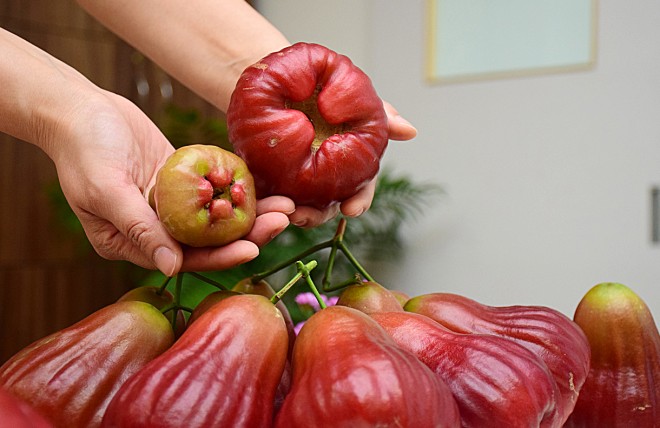
Notes on Cultivation and Management of Taiwan Taisugar No. 3 Black Sugar Barbie Wax Apple Seedlings
Wax apple is a very distinctive tropical fruit of Taiwan, China, loved by people overseas. The Agricultural Research Institute of the Council of Agriculture, Executive Yuan, recently made important progress in wax apple variety improvement research, breeding a new wax apple variety Tainung No. 3, with the trade name "Black Sugar Barbie", which has the characteristics of large fruit shape, deep red fruit color, high sweetness, good flesh flavor and good storage and transportation quality. It is very suitable as a premium gift-box wax apple, is highly praised by the market, and set a price record of 1050 yuan per kilogram, attracting the attention of farmers. Authorization has now been completed for three fruit tree production and marketing groups, and "limited" and "designated zone" guided production and exclusive sales will be carried out. A small amount will be marketed this year, and mass production supply will be available after next year.
Brief introduction to variety characteristics:
Large fruit shape (average single fruit weight 200g; maximum fruit weight can reach 380g).
The fruit skin is obviously raised and is deep red or dark red; summer fruit can still maintain the reddening characteristic.
The flesh is firm, crisp and juicy, with fine flesh, high soluble solids (10~12°Brix), and acidity of about 0.25%, with a sweet-and-sour flavor.
The rate of good fruit is high for winter fruit, spring fruit and summer fruit.
The rose apple fruit flavor is relatively mild; storage and transportation quality is good.
II. Notes on cultivation and management:
(1) The growth period is about 10~15 days longer than that of the Indonesian large-fruit variety.
(2) The fruit calyx segments are thick and tight, which easily causes disease and provides habitat for scale insect damage. Relevant disease and pest management must be carried out before bagging.
(3) The fruit skin is deep red or dark red, but branch pruning still needs to be coordinated to maintain a sufficient number of mature leaves; in addition, attention should be paid to the timing and amount of potassium fertilizer application, which is beneficial for maintaining the reddening characteristic. (4) The cultivation and management model of the Indonesian large-fruit variety can be followed, with proper fruit thinning and control of the number of fruits retained to maintain stable fruit shape. (5) The fruit cavity is slightly large. Attention to the timing and ratio of nitrogen, phosphorus and potassium fertilizer application during the flower bud stage and early fruit development stage can improve this. (6) Although the fruit cracking rate is low, attention should be paid to the suitable harvest period to avoid fruit cracking; during cultivation, management operations should be adjusted in a timely manner according to the environment to maintain this characteristic.