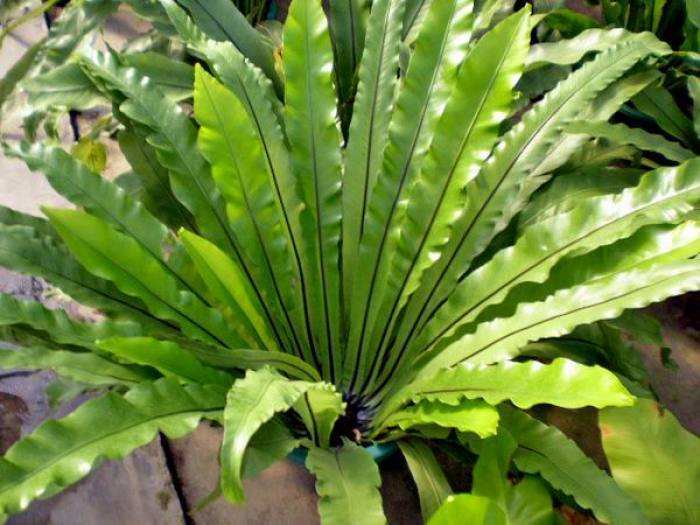
What Are the Characteristics of the Bird's-Nest Fern? Key Cultivation Points and Planting Methods Explained
The bird's-nest fern reproduces by spores. Its preferred growing environment is warm, ventilated and humid, with an optimal growing temperature of 20-25 degrees. It must not be placed in direct sunlight, and the light must not be too strong. If the light is too bright, a shade net is needed to block part of the light, and a shade net with a shading rate of 70-80% gives the best effect. The bird's-nest fern can also be grown on flat ground. This plant is robust by nature, has low requirements for soil, and suffers from few pests and diseases, so it can be said to be a very easy plant to grow. This is very different from the methods for growing the succulent Astrophytum ornatum. Let's take a look together!
Key cultivation points:
1. Sunlight - avoid strong direct sunlight; it grows well in semi-shade outdoors, under tree shade, or in a bright spot indoors
2. Temperature - good cold tolerance; during spore reproduction, the temperature needs to be maintained above 15 degrees C for the spores to germinate well
3. Soil - for potted plants, soil or finely crushed tree-fern material can be used as the growing medium
4. Watering - it likes a hot and humid environment, so it needs frequent watering, or a small dish of water placed under the pot to retain moisture long-term;in summer, besides watering, mist frequently to maintain humidity. Some netizens even say it cannot be drowned, and the more you waterit the faster it grows, so just water it generously!
5. Propagation - by the spore method or the division method. However, some netizens say the division method is not easy to succeed with, so it is best to use sporepropagation.
Cultivation methods: bird's-nest fern cultivation models
Choice of planting site and facilities: it is best to choose a south-facing hillside under trees in a natural forest, with natural ventilation and good drainage, where cold snaps in winter are unlikely to strike and the summer sun does not shine directly under the tree shade, and where it is not easily hit by typhoons; if no such site is available, a 50-70% shade net must be set up to avoid scorching sun, and in winter a windbreak wall or plastic sheeting should be used on the north side to avoid cold snaps causing frost damage.
Growing medium preparation: after obtaining the seedlings, prepare the growing medium according to the cultivation habits of the bird's-nest fern: mix crushed stone, coarse sand, tree-fern sawdust, peat soil (humus soil), rice husk and decomposed compost in a 1:1 ratio and stir evenly. Any medium that is loose, moisture-retentive, airy and well-draining can be used, and a pH of around 6.5-7.0 is best.
Number of plants to establish: about 2,800-3,000 plants can be grown per fen of land, with a row and plant spacing of about 75 cm per plant. Before planting, put 5 kg of growing medium in each planting spot to help the plants establish quickly.
Sprinkler irrigation facilities: to increase humidity, water must be supplied adequately. Manual sprinkler irrigation saves more water and labor. In the dry season, spray water two to three times a day for 30 minutes each time; in winter, reduce the number of sprayings to once a day, adjusting according to conditions.
Fertilizing: the bird's-nest fern is very sensitive to fertilizer, so the concentration must not be too high; too high a concentration easily causes fertilizer burn. Generally, a 500-1000 times diluted chemical liquid fertilizer is used for irrigation, sprayed once or twice a month; granular fertilizer is applied once a month, and reduced in autumn and winter. Each year, add 3-5 kg of medium compost around the rhizome to fix the plant and increase yield.
Harvesting: seedlings planted at 5-10 cm take 3 years to become mature plants; medium seedlings of about 1 chi are faster and still take 1-2 years; large seedlings of 45 cm, once established, can have their young leaves harvested. The harvested length is about 12-15 cm, picked by hand or cut with scissors; cutting at the base with scissors is neater and does not tear the plant. Tie the harvested young leaves into a bundle of about 4 liang, pack them properly in a plastic basket, then spray a little water over the basket and cover with newspaper to maintain humidity, and they are ready for sale. For mature plants, the harvest in summer is about 7-10 kg per fen of land per day.