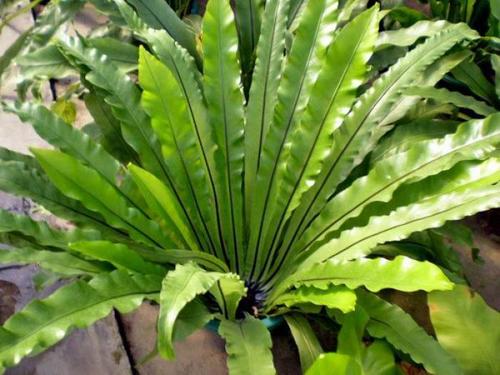
How to grow bird's-nest fern (Asplenium)? Cultivation environment conditions and water and fertilizer management explained
All varieties of bird's-nest fern can be grown in various different cultivation containers or on tree fern poles (boards), but round-leaf bird's-nest fern, feather-leaf bird's-nest fern, wave bird's-nest fern and fish-tail bird's-nest fern are cultivated more because of their unusual leaf shapes and higher ornamental value. Let's take a look below at the cultivation methods for bird's-nest fern!
Cultivation methods for bird's-nest fern
1. Cultivation environment: Bird's-nest fern is a partial-sun plant and is very shade-tolerant. Although the production site for potted plants does not necessarily need rain protection, simple shade net facilities are essential. On flat ground, it is recommended to use one layer of 80% or double layers of 60% + 50% shade net to prevent leaves from yellowing or sunburn due to too-strong sunlight.
⟦NL> 2. Source of seedlings: Seedlings of potted bird's-nest fern are mainly propagated by spores. Although spore sowing is time-consuming, it can produce a very large number of seedlings. Taking Taiwan bird's-nest fern or Asplenium nidus as an example, from spore sowing through two rounds of temporary transplanting, then planting into 4-inch pots, and growing until the leaves are 30-40 cm long, it takes at least two years. During the seedling stage, giving sufficient water and nutrients during the vigorous summer growth period can shorten the seedling stage. Feather-leaf bird's-nest fern and wave bird's-nest fern have no spores, so tissue-culture seedlings are supplied as seedlings.
3. Growing medium: Bird's-nest fern is an epiphytic fern, so the most suitable pH value for the growing medium is 6.3-7.3. A medium with good aeration and strong fertilizer-holding capacity is better, so use a medium containing relatively high organic matter, such as a mixed medium of peat moss, decomposed bark, tree fern fiber, bagasse and rice husks. The roots can also be completely surrounded with sphagnum moss and fixed onto a tree fern board (pole).
4. Water and fertilizer: Water is the most important factor affecting the growth of bird's-nest fern. To save labor, artificial sprinkler irrigation is used for watering. In summer, it can increase humidity and lower temperature, providing the best growing environment for bird's-nest fern. During summer droughts, it can be sprinkler-irrigated 2-3 times a day, while in winter once a day. Bird's-nest fern is relatively sensitive to chemical fertilizers, and the concentration must not be too high. It is recommended to apply liquid fertilizer with a relatively high nitrogen concentration twice a month during the vigorous growth period to promote rapid growth; a concentration of 2000-3000 times is sufficient. In addition, every 3-4 months, slow-release fertilizer such as Osmocote or Nutricote can be applied in the pot to avoid nutrient deficiency.