Sri Lanka on the Brink of Bankruptcy, Repaying Debt with Tea: Has the Organic Farming Revolution Worsened the Food Crisis?
Among the countries whose economies have been hit hard by the pandemic, Sri Lanka's situation is especially dire. Tourism revenue, a major source of foreign exchange, has plummeted, remittances from overseas workers have declined, and on top of an already severe debt crisis, Sri Lanka's risk of default has risen sharply this year. According to the World Travel and Tourism Council, tourism, which normally accounts for more than 10% of the country's GDP, has lost a large number of jobs due to the pandemic, and more than 200,000 workers have lost their livelihoods.
Fitch, one of the three major credit rating agencies, noted in its December assessment report that Sri Lanka's debt, including principal and interest, totals 26 billion US dollars, and that over the next five years, "without new sources of external financing, it will be difficult for the government to meet its external debt obligations in 2022 and 2023." Sri Lanka should repay about 7.3 billion US dollars in external debt within the next 12 months, yet data released by the central bank last month showed that the country's foreign exchange reserves stood at only 1.6 billion US dollars at the end of November.
In order to cut foreign exchange expenditures, the government has adopted a series of measures, including imposing strict import restrictions, which have triggered a negative chain reaction; moreover, on the 27th of last month, Sri Lanka's Ministry of Foreign Affairs even announced the temporary closure of the country's consulates in Nigeria, Germany and Cyprus to save costs.
Sri Lankan opposition MP and economist Harsha de Silva recently said in parliament that from February to October 2022, the total external debt Sri Lanka needs to repay will be 4.8 billion US dollars: "The country will go completely bankrupt."
A Food Crisis on the Island Nation
Today, because milk and various dairy products, wheat, sugar, vegetables and fruits and other basic foods all depend on imports, with foreign exchange running dry and inflation rising, many people can no longer afford the food they need for daily life.
Anushka Shanuka told a Guardian reporter that local vegetable prices have risen by more than 50%. Shanuka is a personal trainer and belongs to a relatively well-off group, but even he is now struggling to make ends meet.
For ordinary working-class people, the pain cuts even deeper. Anurudda Paranagama, a driver from the largest city, Colombo, has recently taken a second job to cope with rising food costs and to pay off his car loan; even so, his family has had to cut three meals a day down to two. The Silva family, who live in the suburbs, have begun watering down the milk at breakfast, and the milk tea on the dinner table has become "sweet tea" with just a little sugar added. He told Al Jazeera: "Our consumption patterns have now completely changed."
On August 31 last year, the Sri Lankan government declared a state of economic emergency, imposing price controls and rationing on 27 essential food items and deploying the military to ensure food supplies. But merchants who had bought these goods at higher prices refused to sell at a loss, and as a result, the rationing system not only failed to solve the problem but also gave rise to black market trading, while hoarding continued. The government had to cancel the rationing system in October. A Trade Ministry official told Agence France-Presse: "Prices may rise by 37% across the board, but we hope dealers will not seek exorbitant profits against their conscience."
As expected, the prices of several staple foods rose accordingly and shortages appeared. According to data from Sri Lanka's statistics bureau, local food prices surged a further 22% in December, setting a new record for the increase.
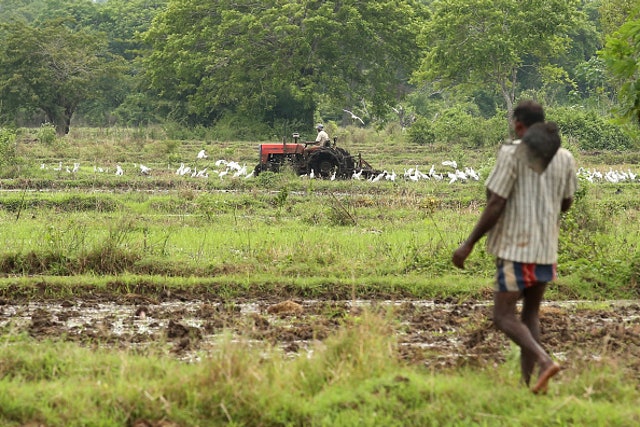
Although Sri Lanka is an agricultural country, its agricultural economic income mainly consists of cash crops such as tea, rubber, coconuts and, in recent years, emerging spices. Among these, tea exports represented by Ceylon black tea generate nearly 1.35 billion US dollars a year in export earnings for Sri Lanka (2019), accounting for 11% of total exports.
However, in terms of food crops that are vital to people's basic survival, its output is still insufficient to guarantee food security. Although rice, the staple food of local people, has nearly achieved self-sufficiency in recent years, the severe threat of climate change facing the island nation means food security has always remained uncertain. The country experienced its most severe drought at the end of 2016, and in early 2017, rice output fell by 40%. Afterwards, heavy rains in May 2017 further worsened food crop production, causing insufficient food supplies for nearly 300,000 households.
The Organic Farming Utopia
Last May, the government led by populist President Gotabaya Rajapaksa launched a "green agricultural revolution" at a time of soaring prices, banning pesticides, herbicides and chemical fertilizers for the sake of public health and switching to organic crops. This move came from Rajapaksa's campaign promise in 2019: "A sustainable food system is part of Sri Lanka's rich social, cultural and economic heritage," he once said in a public speech. "However, in recent times, we have used more and more chemical fertilizers, pesticides and herbicides, causing adverse effects on public health and the environment."
However, this policy, originally intended to promote sustainable agricultural development and help ensure food security, was launched at a terrible time. Organic production was bound to sharply reduce yields, which instead intensified the current food crisis and reduced the foreign exchange income that Sri Lanka urgently needed.
According to a survey by the Colombo think tank Verité last July, three-quarters of farmers nationwide relied heavily on chemical fertilizers, and only about 10% of farmers did not use chemical fertilizers in cultivation. For crops crucial to the economy, such as rice, rubber and tea, the dependence reached 90% or even higher. A one-size-fits-all approach forcing farmers into organic production was simply an "out-of-touch" practice.
Repaying Oil Debt with Tea
Under a wave of criticism and farmers' protests, the government canceled the policy about a month later. In fact, 100% organic agriculture has never been achieved in any country because of reasons such as excessively high costs. In Bhutan, the organic agriculture policy introduced in 2008 originally aimed for realization by 2020, but it has still not been achieved to this day, and a recent study showed that the organic farming it introduced greatly reduced yields, leading to increased dependence on imports.
Sabine Zikeli, a professor at the Centre for Organic Farming at the University of Hohenheim in Germany, told BBC News that a rapid transition to organic agriculture may threaten a country's food security: "You cannot simply change traditional cultivation systems." She said that depending on the country, the transition period in organic farming often takes three years or even longer.
Critics believe that the reason the government introduced the organic fertilizer ban at this time was to stop fertilizer imports and save foreign exchange expenditures, but this move ultimately threatened tea production, so the government had no choice but to abandon it. Last month, Sri Lanka reached an agreement with Iran to repay a 250 million US dollar oil debt signed nine years earlier with the country's specialty Ceylon black tea. According to Iranian media, Iran agreed to let Sri Lanka gradually pay off the debt by importing tea worth 5 million US dollars each month. However, in creditor countries that are not so fond of drinking tea, this debt repayment method of Sri Lanka may no longer work.