What are the prevention and control methods for black spots on orchid leaves?
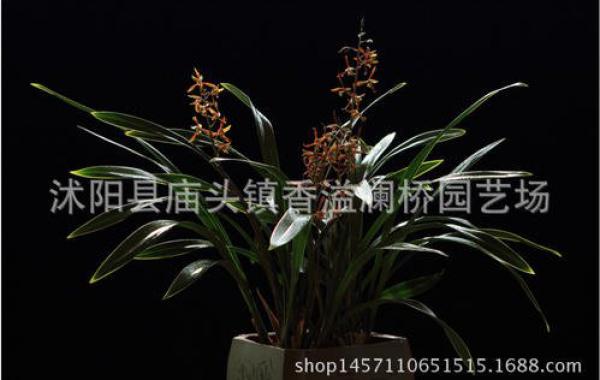
Orchids are plants that require very meticulous care during planting and maintenance, and if managed improperly, certain diseases can appear. Below, let me introduce to you how to prevent and control black spots on orchid leaves.
Preventing black spots on orchid leaves. Orchids have fairly meticulous care requirements, and the slightest carelessness can cause leaf black spots and the like. For example, when watering from overhead, it is easy to splash potting soil onto the leaves, causing the leaves to scorch. When fertilizing, if the fertilizer solution gets on the leaves and is not immediately rinsed off with clean water, it will cause black spots and scorching on the leaves. In spring and summer, if shade is not provided, the orchid leaves will turn yellow and scorch under the blazing sun. Placed in an environment with a lot of coal smoke, orchids develop black spots due to smoke damage. In addition, when orchids suffer from anthracnose, black spots often appear on the leaves.
Orchid anthracnose is especially likely to occur in the plum rain season with high temperatures and poor ventilation, or in seasons with continuous autumn rain, and is sometimes even quite severe. Its symptoms are that at first only semicircular or circular brown spots appear on the leaves, which gradually develop into dark brown; many lesions expand into strip-shaped dark brown lesions, and later the center of the lesions turns grayish white with many small black dots on them. This disease is mostly seen in the middle and upper parts of the leaves.
When this disease is discovered, the diseased leaves should be cut off. At the initial discovery, in addition to improving ventilation, you can spray 50% carbendazim wettable powder at 500 times dilution, or thiophanate wettable powder at 500 times dilution, once a week, spraying continuously 3 to 4 times, which can achieve fairly good results. To prevent infection by diseases and pests, orchids should not be placed too crowded or too dense, and orchid leaves should be kept from crossing each other; a well-ventilated and well-lit environment should be maintained.
The main prevention and control methods for black spot disease (anthracnose) are as follows: 1. Choose a place with air circulation and no pollution as the orchid site. It is best if there are trees, pools, and several small water jars around the orchid site to help increase air humidity. Use bamboo blinds for the shade shed, with shade netting placed on top; the shading degree should preferably be automatically adjustable, and it should be opened in the morning and evening for ventilation. The orchid pots should be arranged with appropriate spacing so that air can circulate. 2. Maintain cleanliness and hygiene. Frequently clean up diseased and withered orchid leaves. When dividing orchid clumps or purchasing new orchid seedlings, use thiophanate methyl to disinfect and sterilize them, and plant them after drying. The growing medium (leaf mold, pond mud, charcoal, etc.) must be sterilized at high temperature or exposed to the sun before use, so as not to let bacteria enter the orchid pots. 1. Spraying method. Use a sprayer to spray sterilizing liquid (Bordeaux mixture, zineb, carbendazim, thiophanate, anthracnose Fumei) on the orchid nursery, orchid soil, orchid pots, and orchid leaves. This method is mostly used for prevention and the early stage of disease onset. After the disease occurs, if the condition becomes increasingly severe, proceed to repot and change the soil. In order to thoroughly sterilize, the whole pot of diseased orchids should be removed from the soil and soaked in sterilizing liquid for several hours (for "serious cases," it can be soaked a bit longer), then the orchid plants should be rinsed clean with clean water, dried slightly, and repotted. Before putting them into new pots, spray the orchid roots and crown once more with a sterilizing agent using the spraying method. 2. The wrapping method. For fungus-infected leaves suffering from anthracnose that, from the perspective of the whole plant or a large patch, still have preservation value and would be a pity to cut off, the "wrapping method" of local elimination can be adopted. The method is: according to the size, shape, and position of the lesion, choose soft thin toilet paper, napkin paper, etc., and wrap and apply it above and below the lesion, then use a pen or cotton swab to apply sterilizing liquid onto the paper. Do this several times a day. This method holds more medicine and is not easily lost, and can achieve a strong-effect treatment. 3. The separation method. Separate out orchid leaves and orchid plants that cannot be cured. Orchid growers are often "as fond of orchids as of life itself," but for "serious cases," one should be willing to "cut off what one loves." Depending on the condition, decide the extent of the operation: either cut off the whole plant, or cut the grass and remove the roots of one leaf. As long as it is seen as beyond cure, do not spare it at all. But when using the separation method, two points should be noted: first, the cutting tools must be sterilized; second, the separated "cases" must be handled properly and must not be thrown away randomly, so as to avoid contaminating the orchid site and infecting other healthy orchid seedlings with the pathogen. 4. The prevention method. In treating orchids, the principle of "prevention first" should also be carried out. Orchid anthracnose occurs mostly in the humid spring and summer seasons, and is especially severe in July and August. During this stage, sterilizing liquid should often be sprayed on the orchid nursery, orchid pots, potting soil, and pot leaves, so that the pathogens are eliminated in the bud. Second, closed, stuffy, high-temperature, and high-humidity conditions should be avoided; climbing plants can be used as companion plants for orchids to block strong light and lower the temperature of the orchid site. In addition, nitrogen fertilizer should be controlled and phosphorus and potassium increased. Pay attention to collecting leftover animal bones, snail and mussel shells, etc., burning them, and crushing them. 5. Ventilation, humidity control, and temperature control. When cultivating orchids, choose a place with relatively good air circulation, which can greatly reduce the occurrence of anthracnose. But it also should not be too ventilated, because if the air flows too much, the humidity will be too low, which is not conducive to orchid growth. The orchid pots should be arranged with appropriate spacing and absolutely must not be too dense, lest the orchid leaves interlace and overlap each other, affecting ventilation and air permeability and causing cross-infection by anthracnose pathogens. When the temperature is above 22~28°C and the relative humidity is above 95%, it is most likely to cause the reproduction and spread of orchid anthracnose pathogens; therefore, temperature and humidity must be controlled below these limits.