How to grow white champaca? Cultivation methods and precautions
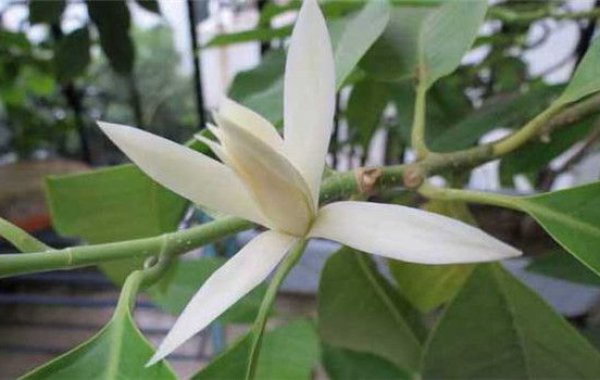
White champaca belongs to the magnolia family. It originates from countries such as the Philippines and Indonesia. White champaca was introduced to Shexian County in our province nearly seventy years ago. Because white champaca is relatively difficult to propagate and labor-intensive to manage, its price is relatively high. In our province, white champaca is mostly grown in large pots or large vats. White champaca plants are 3 to 6 chi tall, with the tallest reaching over one zhang. White champaca blooms in summer. The flowers are white and strongly fragrant. Below we explain the propagation, management and harvesting methods for white champaca.
1. Propagation of white champaca. White champaca is mostly propagated by the approach grafting method and the layering method
Approach grafting method. Generally, purple magnolia is used as rootstock for approach grafting with white champaca. Every year during the plum rain season, cut off healthy branches and insert them as cuttings in small flower pots, and they will take root. After the cuttings have rooted, they are used for approach grafting the following year. Some also insert purple magnolia branches directly into a seedbed as cuttings, and after they have rooted, plant them into small flower pots for approach grafting. Before approach grafting, select healthy white champaca branches, and at the place where grafting is needed, use a knife to cut away the bark about 1.5 cun long down to the xylem, then also cut an incision of equal length on the purple magnolia rootstock in the small flower pot, so that the cambium layers of the two are aligned and pressed tightly together, then bind them with rope on the outside so that they will not be moved by wind or come loose. About two months after approach grafting, cut them away from the mother plant.
Layering method. Generally during the plum rain season, select healthy young white champaca branches, wound the part to be layered, and bury it in another flower pot, taking care with watering and management. After 2 to 3 months, cut it off to form a new individual white champaca plant. Alternatively, girdle the outer layer of a white champaca branch 3 to 4 fen wide (do not damage the cambium), then use a split bamboo tube or tile pot to enclose the girdled part, fill it with fertile soil and water grass, bind it tightly with rope on the outside, take care to water frequently and keep the inside of the tube moist. After 2 to 3 months it will root, and after the roots are well developed, cut it away from the mother plant.
To check whether the rootstock and white champaca have successfully taken through approach grafting or layering, you can use the water-cutoff method: stop watering the original white champaca mother plant for a few days to make it dry out. When the white champaca leaves become soft and appear shiny, water the small flower pot containing the rootstock. If the branch grafted in the small flower pot quickly resumes growth while the white champaca mother plant still appears dry, this proves that the graft has taken. If both the rootstock in the small pot and the mother plant in the large pot still appear dry, this proves that the graft has not taken. Those that have not taken must not be cut away from the mother plant.
2. Management of white champaca. Three key aspects must be mastered
First, watering and fertilizing. White champaca plants are tall and need a lot of water, so each watering should be thorough, but after watering the excess water must be quickly drained out of the pot, otherwise water accumulating in the pot will cause root rot, withered stems and leaves, and even death. Usually in summer, water once each morning and evening; in spring and autumn, water once every other day at noon; when overwintering indoors, water once a week. Water used for watering flowers should preferably be ditch, pond or river water. If tap water is used, it must be stored for one or two days so that the chlorine used for disinfection in the water evaporates, so as not to affect plant growth.
Whether white champaca is fertilized appropriately has a great bearing on the yield and quality of white champaca flowers. Therefore, in addition to applying decomposed manure water, some phosphorus and potassium fertilizer should also be applied. Usually after spring begins and the weather warms, when the flower pots are moved outdoors, apply decomposed fertilizer about once every 10 days. Before budding, apply a quick-acting liquid fertilizer. During the full flowering period, water with manure water once every three or four days. Fertilization should not be excessive, to prevent root rot and excessive vegetative growth of branches. After the flower pots are moved indoors for overwintering, fertilizing can be stopped.
Second, build a shade shed and remove old leaves. White champaca likes a warm, humid climate and a well-ventilated environment. Therefore, in summer a shade shed must be built to prevent exposure to the scorching midday sun. Before white champaca is moved outdoors, old leaves should be removed, leaving only a few leaves at the tips of the branches, to encourage the sprouting of new branches. After each flower harvest, leaves should be appropriately removed in order to inhibit tree vigor and favor flower bud formation.
Third, protect against cold and overwinter. White champaca is sensitive to cold, so it should be moved indoors relatively early in winter, and moved outdoors somewhat later in spring, generally only after the last frost or after Grain Rain. During severe cold in winter, the indoor temperature should be raised to above 10°C, otherwise it is prone to cold damage.
3. Harvesting of white champaca. After white champaca has taken through grafting, a small amount of flowers can be harvested in three years. As the tree age increases, the yield also increases year by year. White champaca blooms almost continuously throughout the year, among which the yield of summer flowers in June and July is the highest, accounting for about 70% of the total annual yield; the yield in August and September accounts for about 20%; and the yield in the remaining months accounts for about 10%. Picking is generally carried out in the morning, when the green flower bracts have fallen off, the flowers are about to open but have not yet opened, and the fragrance of the flowers is the strongest.