What is the flower language of the spider lily? Let us get to know the spider lily
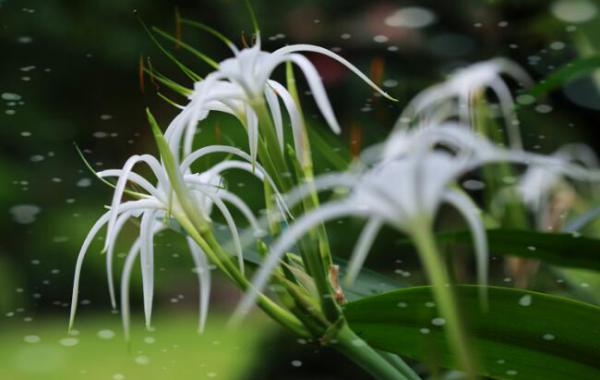
The spider lily belongs to a type of orchid, and is also called "beautiful water ghost banana." The spider lily sounds like a very distinctive name. Does the spider lily really look very much like a spider? So, what is the flower language of the spider lily?
What is the flower language of the spider lily?
Spider lily flower language: naturally beautiful
Flower divination: You inherently possess an irresistible charm and combine many strengths in one, making you a standard heartthrob. Unfortunately, others only appreciate your appearance and cannot see your efforts, which makes people mistakenly think you are just a beautiful vase.
Flower motto: An idle heart is the source of all ruin.
Introduction to the spider lily
The spider lily belongs to the Amaryllidaceae family, Hymenocallis genus. It is an annual herb with a spherical underground stem about 7-11 cm in diameter. The leaves grow in clusters, have short stalks, and the leaf blades are long sword-shaped, soft, fleshy, dark green, and glossy.
Spider lily, alias type: beautiful water ghost banana
Morphological characteristics: A perennial herbaceous plant of the Amaryllidaceae family, Hymenocallis genus. It has spherical underground bulbs, 7-10 cm in diameter. The plant height is 1-2 m. The leaves are basal, bright green, oblanceolate, sharply pointed at the tip, about 60 cm long, with longitudinal grooves at the base. The scape is thick, grayish green, flattened, and solid; the umbel is terminal, bearing 10-15 flowers; the flowers are large, with a flower diameter reaching 23 cm, white; fragrant; the flowers open successively from the outside inward; there are 5-6 involucral bracts, lanceolate, green, 7-10 cm long; the floral tube is greenish, 8-10 cm long; the tepals are linear, 2 times longer than the tube; the corona is tooth-shaped and funnel-shaped, about 4 cm long. The flowering period is summer and autumn.
Origin and habits: Native to the West Indies. It grows vigorously and has strong adaptability. It likes warmth and humidity, and sufficient light. It is not choosy about soil, but sandy loam rich in humus, loose, fertile, and well-drained is best.