How to care for Phalaenopsis orchids during the flowering period? These methods you need to master
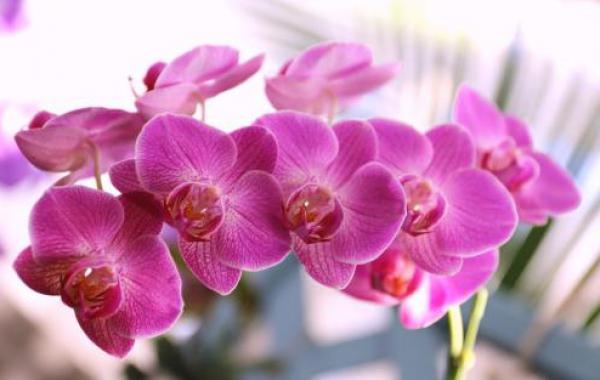
The flowering period of Phalaenopsis orchids can be controlled
The normal flowering period for most Phalaenopsis varieties is from March to May, and the flowering period needs to be regulated in order to achieve blooming at Spring Festival
In northern regions, mid-June before and mid-September after are the peak periods for Phalaenopsis orchids to send out flower stalks. In July to August, during the high temperatures, they are in a dormant state. After 5 to 6 months of vegetative growth, when the leaf span reaches 30 cm, flower forcing can be carried out. Artificially apply flower-forcing fertilizer, supplementing with high-phosphorus fertilizer, alternating nitrogen-phosphorus-potassium ratios of 9:45:15 and 10:30:20, to promote flower bud differentiation. After about 45 days, flower buds can form. From the emergence of the flower stalk to blooming takes about 90 days
In southern regions, taking them up the mountain to force flowering is a relatively economical and feasible method for commercial production of Phalaenopsis orchids for Spring Festival. Mountain conditions at an altitude of 700 to 1000 m can provide a large day-night temperature difference, ensuring the temperature and day-night temperature difference needed for Phalaenopsis flower bud differentiation. After 20 to 40 days of mountain treatment, flower buds can differentiate. When the flower buds grow to a certain extent, move them back down the mountain; through greenhouse cultivation, they can bloom at Spring Festival. For choosing the timing of mountain treatment for Phalaenopsis orchids, it should be determined according to the age of the plant and the condition of vegetative growth. The larger the leaf area, the earlier the flower stalk sprouts, the faster the flower stalk develops, and the earlier it blooms
Watering: ensure moisture, generally water about once every five days
Do not fertilize too much; it is fine not to fertilize
The temperature should not be lower than 15 degrees
Partial shade is enough; do not let strong light shine directly.
How should Phalaenopsis orchids be cared for after the flowering period? Please explain in detail, then I will give points; if satisfied, I will add more points.
1. Should the flower spike of Phalaenopsis be cut after blooming?
After Phalaenopsis finishes blooming, the flower stem can be cut, but it is best not to cut it all (decide according to the condition of the whole plant; if the roots and leaves are very healthy and strong, it is recommended to keep a few nodes of the flower stem, and generally new flower buds can emerge after more than 2 months), cutting it off near the first flower or the first branch. The remaining spent flower stalk still has buds and can sprout again after being grown for a certain period. For orchid family plants, do not let them set fruit, because even if they can set fruit, propagation by seed is very difficult, and the fruiting process consumes nutrients. Whether to fertilize can be determined after flowering by observing the plant's growth condition.
2. How to care for Phalaenopsis after blooming
After Phalaenopsis blooms, you can give a little slow-release fertilizer. It should be placed in a place with diffused light. Water when it is dry, and spray frequently. Be careful not to wet new buds, otherwise they are prone to rot. In summer, place it in a ventilated and cool place; in winter, it is best not to let it go below 15 degrees.
After Phalaenopsis root rot occurs, first dig the potting soil out of the flower pot and break it apart, wash the plant's roots with clean water, then cut off all the rotten roots. The intact parts should be retained as much as possible; residual roots also have a chance of being saved.
Put the cut wounds and the retained residual roots into a potassium permanganate solution at 2 percent concentration and soak for about 10 minutes, then dry them. After that, carefully smear the cut wounds with plant ash, and the plant can be repotted.
The potting soil must be disinfected. A simple method is to pour boiling water through the potting soil, wait for it to cool, and then use it again. When repotting, pat the root crown area firm, water thoroughly, place it in a shaded place, cover with a layer of plastic film, and cultivate at a temperature of about 20°C. After about 20 days, new roots can grow.
Which months are the flowering period of Phalaenopsis orchids?
When caring for Phalaenopsis orchids at home, pay attention to the following points: Temperature. When growing Phalaenopsis at home, the first thing is to ensure temperature. Phalaenopsis is native to tropical regions and likes a high-temperature and high-humidity environment. During the growth period, the minimum temperature should be kept above 15°C. When the daytime temperature is 27°C and the nighttime temperature is kept at about 18°C, Phalaenopsis (especially white-flowered Phalaenopsis) grows well. In autumn and winter, at the turn of winter and spring, and when winter temperatures are low, attention should be paid to increasing warmth. Generally, in rooms with heating equipment in winter, this temperature is not difficult to achieve, but be careful never to place the flowers directly on the radiator or too close to it. When summer temperatures are on the high side, cooling is needed, and attention should be paid to ventilation. If the temperature is higher than 32°C, Phalaenopsis usually enters a semi-dormant state, and continuous high temperatures should be avoided. Around Spring Festival is the full flowering period; appropriately lowering the temperature can prolong the viewing time. During flowering, the nighttime temperature is best controlled between 13°C-16°C, but cannot be lower than 13°C. Water. Phalaenopsis is an epiphytic orchid. In its place of origin, it mostly grows on tree trunks, with its roots exposed in the air, and it can absorb moisture from the humid air. When cultivated artificially, the roots are buried in the growing medium. If watered too much, the medium's aeration will worsen, and the fleshy roots will rot, generally causing the leaves to turn yellow and, in severe cases, leading to death. The principle for watering is to water when dry and stop when wet. When the surface of the growing medium becomes dry, water thoroughly again. Generally, watering should be done on a clear, sunny morning, and the water temperature should be close to room temperature. When the indoor air is dry, a sprayer can be used to spray directly onto the leaf surface; but note that during the flowering period, water mist should not be sprayed onto the flowers. Light. Although Phalaenopsis prefers shade, the orchid plant still needs to receive some light, especially before and after the flowering period. Appropriate light can promote Phalaenopsis blooming and make the flowers brighter and longer-lasting. Generally, it should be placed in a place with diffused light indoors, and direct sunlight should not be allowed. If placed on an indoor windowsill, use a window screen to block part of the sunlight. Nutrition. For cultivating Phalaenopsis, sphagnum moss and moss are generally used as the growing medium. The principle of fertilizing should be to apply less fertilizer and apply dilute fertilizer. During normal growth, apply orchid-specific fertilizer at 2000 times dilution for root fertilization; depending on the growth condition, once every 2 to 3 weeks. Before flowering, a water-soluble high-phosphorus fertilizer 15-30-15 at 1000 to 2000 times dilution can be used, sprayed about once every 10 days; stop fertilizing during the flowering period and in seasons with lower temperatures. From young seedling to flowering takes about 2 years, and the flowering period is generally around Spring Festival, with a viewing period of up to 2 to 3 months. When the flowers wither, the faded flowers must be cut off as early as possible, as this can reduce nutrient consumption. If the flower stem is cut from the base at the 4th to 5th node, it can bloom again after 2 to 3 months. But this consumes too many nutrients from the plant and is not conducive to growth the following year. If you want it to bloom well again the next year, it is best to cut the flower stem from the base. When the medium ages, it should be replaced in a timely manner; otherwise, aeration will worsen, causing root rot and weakening the plant's growth or even death. Generally, repotting in May, when new leaves grow, is appropriate.
Flowering-period care for Phalaenopsis and how to grow it after blooming
After the flower buds of Phalaenopsis form, more phosphorus should be applied until flowering. When the flower stem extends upward and tends to lean to one side, a support should be set up and tied so that the flower stalk does not break. After that, as the flower stalk gradually grows longer and taller, tying should also be carried out gradually, with the support slightly curved to enhance the beauty. Stop fertilizing during the flowering period and before new leaves grow.
There are four major taboos in flowering-period care. The four major taboos are avoiding heavy watering, avoiding fertilizing, avoiding high temperatures, and avoiding not pruning after the flowers fade. The Phalaenopsis we buy at flower markets is generally cultivated with sphagnum moss as the medium. Sphagnum moss has very good water retention and aeration, so do not water too frequently.
After the flowers fade, for healthy orchid plants with more than 5 leaves, the lower 3 to 4 nodes of the stem can be left and cut back. Later, it can be expected to bloom again on the remaining flower stem. Watering should not be too frequent; water only after it dries completely.