How to control the flowering period of freesia? Sharing a few practical regulation methods
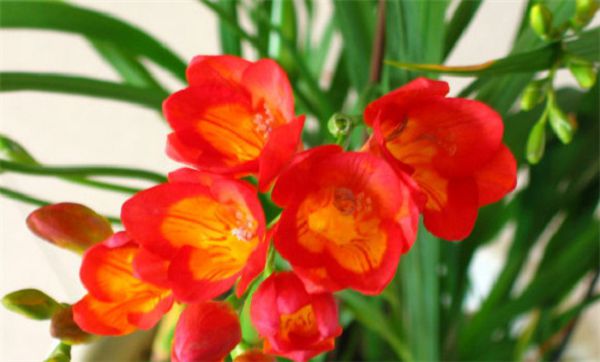
Freesia has unusual and beautiful forms and a strong fragrance. Its flowering period is best controlled to fall during New Year's Day and the Spring Festival, making it an excellent potted flower and cut flower material. Below we will learn about methods for controlling the flowering period of freesia, so as to better cultivate this flower variety.
The place of origin of freesia
Freesia is native to southern Africa. It prefers a warm, humid environment with ample light. The suitable growing temperature is 15-20°C, and 14-16°C is ideal in winter. Its cold tolerance is relatively weak.
Methods for controlling the flowering period of freesia
Common measures for controlling the flowering period of freesia include changing the planting time and regulating temperature and day length. For blooming on New Year's Day, the bulbs need low-temperature treatment (13-15°C) for 1 week in July-August to break dormancy, and after planting they should be kept at 15-20°C. For blooming at the Spring Festival, flower forcing is needed 1 month before the Spring Festival at 18-20°C.
The morphological characteristics and ornamental features of freesia
Freesia, also known as fragrant snow orchid and foreign evening fragrance king, is an autumn-planted bulbous flower of the genus Freesia in the iris family. The corm is conical, covered with a membrane that has a netted pattern and dark red markings. The leaves are linear and arranged alternately in two rows. The inflorescence is a spiral cyme, with the inflorescence axis spreading horizontally or slanting; the flowers are upright, narrowly funnel-shaped, and come in bright yellow, pure white, pink, bright red, purple-red, blue-purple, and other colors, and are fragrant. The flowering period is winter and spring. There are rich horticultural varieties with diverse flower colors; besides flower color, there are also variations in flower size, flowering time, and flower stem length.