How to extend the flowering period of the Christmas cactus? These methods you need to master
Fertilizing tips for the Christmas cactus. When it comes to fertilizing the Christmas cactus, many flower lovers are unsure - first, they don't know what fertilizer to use, and second, they don't know when to fertilize. Compared with other flowers and plants, fertilizing the Christmas cactus requires a bit more care. Today let's introduce the timing and methods of fertilizing the Christmas cactus. What fertilizer to use for the Christmas cactus: generally, during the growing season of the Christmas cactus, we can apply a light...
Many flower lovers enjoy grafting the Christmas cactus, the Thanksgiving cactus, and others. To improve the survival rate of grafting, today we will introduce how to improve the survival rate of grafted Christmas cactus. How to improve the survival rate of grafted Christmas cactus: 1. Grafting time should be timely: grafting should be carried out when both the scion and the rootstock are growing vigorously and have sufficient fluid within them; generally the survival rate is best when the temperature is 20-25°C. In northern regions, roughly April to June or September to October. Grafting from spring to early summer gives the best results.
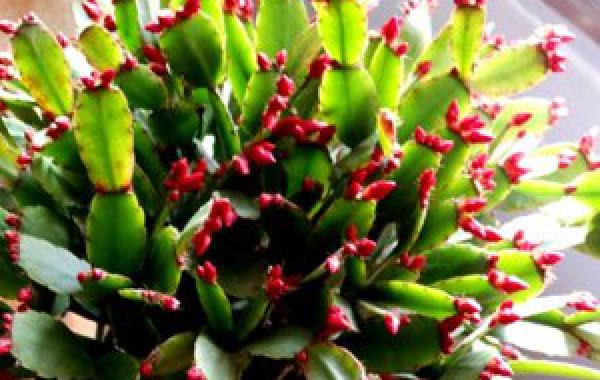
Generally, the flowering period of the Christmas cactus runs from November to April of the following year. Is there a way to extend the flowering period of the Christmas cactus? Actually there is. Let me tell you the specific methods, so that the Christmas cactus you grow will bloom for a longer time.
The Christmas cactus is a typical short-day plant; under long-day conditions it cannot undergo flower bud differentiation, and if the temperature is too high as well, such as in midsummer, it will be forced into dormancy or semi-dormancy. During the process of forcing it to bloom, do not place the potted plant in a place with artificial light at night, otherwise the extra light may affect the plant's flower bud differentiation and subsequent flowering. For example, if you want it to bloom ahead of time for National Day, you can begin shading at the end of July and the beginning of August, covering it with a black cloth sheet every day from 4 p.m. to 8 a.m. the next morning, and by late September small flower buds will form at the top of each stem segment. Continue shading until the end of September, and from the beginning of October its buds can open.
The Christmas cactus is relatively sensitive to temperature and grows well within the range of 16 to 28°C. During its flowering control process, the ambient temperature must not be lower than 5°C, otherwise the plant is easily damaged by frost. Generally, when the temperature is below 13°C, the flowers of the Christmas cactus can develop normally regardless of the photoperiod; when the temperature is above 15°C, flower bud differentiation of the Christmas cactus can only proceed under short-day conditions; when the temperature is above 21°C, the plant will not undergo flower bud differentiation under either long-day or short-day conditions.
The natural flowering period of the Christmas cactus can be delayed until March. For this purpose, if a plant has already formed buds and is about to bloom, you can keep its temperature above 5°C; low temperatures can delay the opening of the buds. If the buds are still small, you can raise the room temperature above 15°C to speed up their opening. Through the two means of low-temperature delaying and high-temperature promoting, during the Spring Festival you will see the Christmas cactus blooming gorgeously as you wish.
The above methods can extend the flowering period of the Christmas cactus. I hope the above information can help everyone.