What are the characteristics of the large-flowered clivia? Do you know?
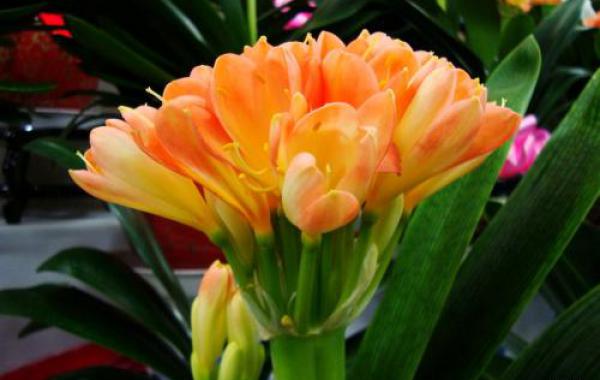
What are the growth habits of the large-flowered clivia
The large-flowered clivia is also known by the names clivia, Dam clivia, Damu clivia, sword-leaf lycoris, and others. It belongs to the genus Clivia in the Amaryllidaceae family and is an evergreen perennial herbaceous plant. The plant is elegant and handsome, with the bearing of a gentleman, and it gets its name because its flowers resemble orchids. Clivia is native to the mountain forests of South Africa and prefers a sparse-shade, warm, humid environment with good ventilation. It is not cold-tolerant, dislikes high temperatures and intense summer heat, and fears strong direct sunlight, let alone exposure to baking sun. Clivia has strict requirements for soil and is not tolerant of saline-alkaline conditions; it can only grow normally in extremely loose, well-drained humus soil. Neutral and slightly acidic soil is best.
1. Purchasing guidelines When buying potted flowers, choose plants that are upright, with deep green glossy leaves, a tower-shaped plant form, and 10 to 15 leaves that are opposite, neatly arranged, and symmetrical.
2. Placement guidelines The optimal temperature for clivia growth is between 18 and 22°C. Below 5°C or above 30°C, growth is inhibited. An air humidity of 70% to 80% is suitable, so potted plants are appropriately placed indoors in a living room, study, or bedroom with good indirect light.
The main appeal is that it blooms more and larger, has higher ornamental value, blooms more vividly, and has a longer flowering period. Placing it indoors in a bright, ventilated spot is better, and applying phosphorus and potassium fertilizer as a top dressing makes growth better and more vigorous.
What color flowers does a clivia produce that make it a top-grade specimen
Overall, leaves that are short and wide, thick and hard, bright and glossy on the surface, upright and neat, with rounded leaf tips and raised veins, indicate a superior variety, while large yellow flowers indicate a premium specimen. A good clivia should look like "a single line when viewed from the side, and like a folding fan when viewed from the front." "A single line when viewed from the side" means that when viewed from directly above or from the side, the clivia leaves are basically in the same straight line, with no leaves sticking out or receding. "Like a folding fan when viewed from the front" means that when viewed from the front, the clivia leaves should grow in an inverted "eight" pattern, extending flatly toward the upper sides, with the length of the leaves changing evenly between layers, just like an unfolded folding fan, giving a sense of dignified balance...
How do you manage the flowering period of the large-flowered clivia
If cultivation and management are improper, during the flowering period the flower scape may fail to emerge and flowers may bloom at the leaf base or among the leaves, a phenomenon called "clamped arrow," which affects ornamental value and flowering and seed set. Causes: ① Unsuitable temperature. The suitable temperature for clivia flowering is 15 to 25°C, and a day-night temperature difference of about 10°C is ideal. Temperatures above 25°C affect scape emergence, and below 15°C is also unfavorable for scape emergence. ② Insufficient nutrients. During the flowering period, clivia needs relatively more phosphorus and potassium fertilizer. If too much nitrogen fertilizer is applied while phosphorus and potassium fertilizer and trace elements are lacking, it will affect scape emergence and flowering. ③ During the scape emergence stage, clivia needs more water. If the water supply is insufficient at this time, the "clamped arrow" phenomenon can also occur. In addition, factors such as dry air, overly strong light, and a small day-night temperature difference can all affect scape emergence in clivia. To prevent "clamped arrow" in clivia, the potting soil should be changed once a year, watering should be frequent to keep the potting soil moist but not soggy, more phosphorus and potassium fertilizer should be applied, and watering with warm water around 25°C plus a small amount of beer is also helpful for forcing the scape.
Large-flowered clivia flower prices
Clivia prices: 1. Drooping clivia price
The growth cycle of the drooping clivia is extremely long, generally requiring about 10 years. The leaves of the drooping clivia are hard and thick, strap-shaped, about 300 to 800 mm long and 25 to 50 mm wide, with very blunt leaf tips. It usually has 20 to 26 flowers, which hang downward. The flower color is mostly dark orange, with green flower tips. Its fruit generally contains about 2 seeds, the fruit skin is red, and the maturation period takes 9 months. The price of drooping clivia is generally around 400 to 500 yuan.
2. Large-flowered clivia price
The large-flowered clivia is a perennial herb, with white, unbranched roots. The leaves are neatly arranged in a fan shape and are evergreen. The flower shape resembles a trumpet, generally orange or red, with a yellow-white inner center. Of course, there are other color lines as well. When blooming, one flower bud can generally produce 20 or even 40 flowers. The price of a slightly better large-flowered clivia is generally around 300 yuan.
3. Garden clivia price
The garden clivia generally reaches 80 to 130 mm in height. The leaves are bright green, 350 to 900 mm long and 25 to 60 mm wide, with pointed leaf tips. The flowering period is long, from late autumn to winter. The flower color is generally orange-red, and there are also other colors ranging from yellow to red, with extremely obvious green flower tips. The flowers hang downward in an arc shape. Each berry contains 1 to 2 seeds, and the fruit takes 12 to 15 months to mature. A fully grown garden clivia is around 4000 to 5000 yuan.
4. Stemmed clivia price
The stemmed clivia is 50 to 150 cm in height. Adult plants have an aboveground stem reaching 1 m or even 3 m in length. The soft, flat, pointed leaves are bow-shaped, about 35 to 70 mm wide and 30 to 60 cm long. It generally blooms in spring and summer. The flowers hang downward like those of the drooping clivia, with orange-red flower color and green petal tips. The round red berries contain 1 to 4 seeds, and the berry diameter is 9 to 13 mm. The seeds generally mature in winter, with a maturation period of 6 months after pollination.
5. Miraculous clivia price
The miraculous clivia is a newly discovered variety, and they either grow alone or in clusters. The area where it grows generally has a semi-arid Mediterranean-style climate, and in winter it often experiences a rainy period. Its leaves have a white stripe in the center, which distinguishes it from other clivia varieties, and its seeds take only 5 months to mature. One bulb of the miraculous clivia costs around 30 yuan.
6. Swamp clivia price
The swamp clivia is one of the most recently discovered clivia species and also the largest clivia, capable of growing to 1.8 m tall. It grows in swamp areas, and in rare cases its root system can reach 4.5 m long. The leaves are flexible, with smooth edges, rounded leaf tips, and pale white stripes in the center of the leaves. The flowering period is generally from March to August, and it can produce 15 to 40 flowers in many colors. The fruit is spherical and red, generally containing no more than 4 seeds, with a maturation period of up to 12 months. The price is hard to say; they are generally wild and in their original ecological state.