A Detailed Analysis of the Growth Habits of Cineraria
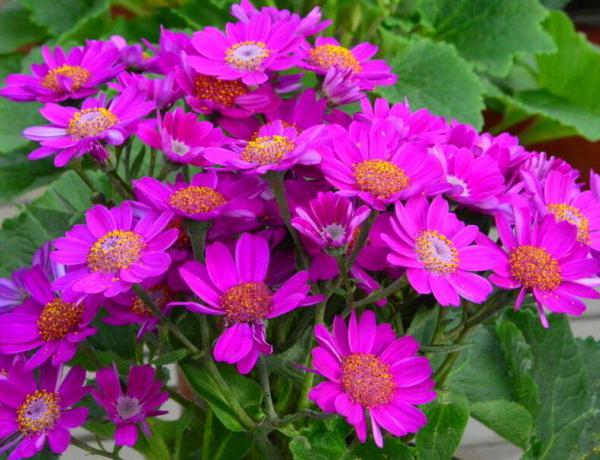
Cineraria is native to the Canary Islands in the Atlantic. It thrives in greenhouses that are warm in winter and cool in summer, with the most suitable growing temperature being 10°-18°C. It enjoys light but dislikes direct strong sunlight. It requires loose, fertile sandy loam rich in humus with good drainage, and dislikes waterlogging; too much water easily causes root rot.
Cineraria, also known as Qianri Lian, Huanggua Hua, Qianye Lian, etc., is a perennial herbaceous plant of the genus Senecio in the Asteraceae family, often cultivated as a biennial or annual greenhouse flower. The plant height is 30-50 cm. The stem is upright with flower heads, much branched, and covered with rough hairs. The leaves are heart-shaped and triangular, large like melon leaves. The flower heads are dense and clustered into hemispherical shapes, with brilliant and colorful flowers and varied flower forms, usually in red, light red, pink, white, blue, purple and other colors. The natural flowering period is from February to May.
1. How to cultivate cineraria?
From sowing to flowering, cineraria needs to be transplanted 3-4 times. Taking sowing in early August in the Beijing area as an example: about 20 days after sowing and emergence, when there are 2-3 true leaves, carry out the first seedling transplant, moving them into shallow pots at a spacing of 5 cm between plants and rows. The soil mix is 2 parts leaf mold, 2 parts loam, and 1 part river sand. Reducing the leaf mold content and increasing the soil content makes the seedlings grow robustly.
2. How to propagate cineraria?
The sowing method is mostly used. After the seeds mature, harvest them immediately and expose the seeds to sunlight so they fully mature, then put them into paper bags and store them in a dry place. The best sowing period is April to May, and also up to September. Sow the seeds in a pot filled with plain sandy soil, cover with fine sandy soil, and use the immersion method to water so that water enters through the drainage hole at the bottom and the pot walls; cover the seedlings in the pot with a glass pane to maintain temperature and humidity inside the pot. Generally, seedlings emerge seven days after sowing. Remove the glass to let them ventilate, keep the greenhouse between 12°C-15°C, and when 2-3 true leaves grow, begin separating the seedlings and carry out three transplants.
3. How to avoid cineraria having few flowers and excessive leaves?
Suitable temperature: Cineraria needs to be moved into a greenhouse for cultivation in winter. The nighttime temperature should be kept at 10°C, and the daytime temperature is best at 15°C. Exceeding 15°C easily causes the plant to grow leggy, with excessive leaves and few flowers.
Sufficient light and good ventilation: Cineraria likes light, and it should be placed in a location with sufficient light and good ventilation to benefit its growth and bud formation.
Fertilizing and watering: During flower bud differentiation and the bud stage, fertilizer mainly based on phosphorus and potassium should be applied, and fertilization should stop after the flower buds appear. Cineraria should not be watered too much; otherwise, higher temperatures will cause the branches and leaves to grow leggy.
4. How to make cineraria bloom during festive holidays?
To make cineraria bloom during festive holidays, it can be regulated through the following methods:
Variety selection: Because different varieties require different amounts of time to bloom, the desired flowering period can be achieved by selecting varieties. Usually, early-flowering varieties need 5-6 months after sowing to bloom; mid-flowering varieties need 7-8 months to bloom; late-flowering varieties need about 10 months to bloom.
Adjustment of sowing time: In the Shanghai area, if flowering is needed for New Year's Day, sow in July; if flowering is needed for the Spring Festival, sow in August; if sown in September, it can bloom around April of the following year, with the flowering period lasting until May.
5. How to care for soilless potted cineraria?
Application of nutrient solution. After planting, apply the first nutrient solution and water thoroughly, that is, enough nutrient solution should flow out of the drainage hole at the bottom of the pot. During the growth period of cineraria, a nutrient solution mainly based on nitrogen fertilizer should be applied, preferably once a week; during the bud stage, apply a nutrient solution mainly based on phosphorus and potassium fertilizer twice a week until flowering. The leaves need to be sprayed with a 0.1% potassium dihydrogen phosphate solution once a week for 4 consecutive times.
6. What to do if cineraria roots and stems rot?
Sanitation of the cultivation environment. To prevent damping-off disease during the seedling stage, both the seedling pots and the culture soil must be disinfected. The growing medium should be loose and well aerated. In daily cultivation, the environment should be kept ventilated and exposed to light.
7. How should cineraria be transplanted into pots?
When the seedlings grow 3 true leaves, first apply a light application of diluted fertilizer water, then transplant them with soil into a larger clay pot with a diameter of 20 cm. First add an appropriate amount of slow-release base fertilizer at the bottom of the pot, such as cake fertilizer powder and phosphate fertilizer, mix it with the pot soil, then fill the pot with soil, and afterward transplant the seedlings with their soil ball from the small pot into the pot, immediately water thoroughly after potting by seepage, and then carry out normal care and management.