How to grow star jasmine? A detailed guide to its care
During the pandemic, everyone stays at home every day. Apart from writing articles, the biggest area of activity for me, the editor, is the garden at home. Whenever I have nothing to do, I go look at the flowers, and when I am bored I talk to them, always hoping they will grow faster. Vining flowers in particular, as my favorite kind, get even higher expectations from me - I hope they can quickly grow into a wall of flowers, covering the trellises I handmade for them months in advance. As a die-hard fan of vining flowers, I previously introduced yellow banksia rose, bougainvillea, orange jasmine, and wisteria, and yesterday I wrote about blue plumbago, so today let's talk about star jasmine.
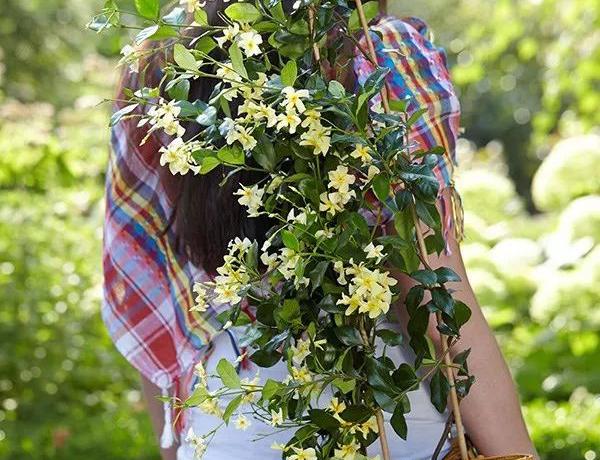
Star jasmine is also called silver-thread jasmine and Italian jasmine, and is an evergreen vine in the genus Trachelospermum. Its peak bloom period is from April to June each year, though if the climate is cool and care is proper, it can keep blooming until November. Its flowers are mainly white, with five petals, resembling a spinning pinwheel. In recent years, pink and yellow varieties have also been introduced from abroad, but they are much more expensive than the white star jasmine. No matter which kind, after 3 or more years of care, it can cover a wall and bloom into a sea of flowers, accompanied by a fragrance like that of jasmine.
Star jasmine has tenacious vitality. Whether in the 35-degree heat of summer or in winter low temperatures of minus 17 degrees, it performs excellently, and during its growing period it basically has no pests or diseases. It likes sun and also tolerates shade, and has low requirements for soil. It is the easiest to grow among vining flowers, very suitable for beginners to cultivate. When star jasmine is in full bloom it is as white as snow, with fragrance filling the courtyard. But before enjoying the flowers, you must first learn to grow them. Below, I, the editor, will introduce its growing methods:
1. Soil preparation
Star jasmine really is an incredibly easy flower to grow, with excellent adaptability to soil. Whether slightly acidic or slightly alkaline, it adapts perfectly, so gardeners in both southern and northern China can plant it, without deliberately adjusting the soil's acidity or alkalinity. As long as the soil is not especially alkaline, there is no problem; even slightly clayey soil is fine.
However, no matter what soil is used, there is one prerequisite, which is to keep it loose and well-draining. For container gardeners, you can refer to the following soil mix ratios to adjust.
1) 3 parts leaf mold + 1 part garden soil + 1 part vermiculite + 1 part decomposed chicken manure fertilizer
2) 4 parts garden soil + 2 parts river sand + 2 parts leaf mold + 1 part bone meal
Of course, gardeners in zones 7-11 had best grow it in the ground, as overwintering outdoors in winter is completely fine. For ground planting, you can directly use the garden soil in your yard. If it is too compacted and clayey, you can add leaf mold and mix evenly. For base fertilizer, decomposed sheep manure, chicken manure, or soybean cake residue all work. It is best to choose a spot in the yard with higher terrain that favors drainage, and dig over the soil before planting.
2. Light and temperature requirements
Star jasmine is a sun-loving flower. For home growing, it is best to plant it in the ground, in a spot with good ventilation and ample light. The plant then grows relatively quickly, with emerald-green leaves and good flower bud differentiation, abundant blooms, and a strong fragrance. Although the leaf color turns red after temperatures gradually drop in autumn and winter, this is not a problem; my beloved hydrangea also has this trait.
In regions that are warm year-round, as long as there is ample light with 4-6 hours of direct sunlight each day, its branches and leaves can stay evergreen all year and it will bloom continuously. It also tolerates partial shade, so those of us who can only keep container plants on a balcony need not worry. As long as there is half a day of light each day, star jasmine can still grow well, only the number of flowers will be somewhat fewer than with outdoor cultivation.
Generally, in summer when high temperatures exceed 32 degrees, star jasmine needs to be shaded. Although it tolerates high temperatures, when the sun is too intense on hot days you must be careful about the plant getting scorched, and too strong light can also prevent blooming. In summer it is best to avoid direct sun and let it get more mild, diffused light. In other seasons, it can be placed in a spot with ample light for care. Especially in winter, let it bask in the sun more so it can overwinter healthily.
Some gardeners may be confused here: the growing habits clearly said it can tolerate low temperatures of minus 17 degrees, so why does it say here that in winter it needs more sun to overwinter healthily? The reason is actually simple: tolerating minus 17 degrees generally refers to star jasmine planted in the ground, while our home container plants generally need to be moved indoors once temperatures drop to around 8 degrees, and letting them get more sun during the day strengthens their own tolerance to cold.
3. Water requirements
For flowers that are simple to care for, the key care points generally center on water and fertilizer management, and this is also where star jasmine needs attention. It likes moisture and fears waterlogging, so for ground planting I suggest planting it in a spot with higher terrain, precisely to avoid situations of continuous rain where rainwater cannot drain promptly and causes its roots to rot and die.
For our home container plants, when watering, be sure not to water too frequently. In spring and autumn, watering once a day is recommended. In summer, high temperatures make water evaporate quickly, and it is also star jasmine's bloom period, so water demand is relatively high. Normally we should water it once every morning, and from time to time also spray water around the pot to increase humidity, to prevent high temperatures from scorching the leaves. If there is continuous rainy weather, then wait until the potting soil is dry before watering.
For winter care, I generally adjust according to the weather. If there is continuous rain or snow, do not water; if there are consecutive sunny days, water once every 15-20 days or so. In winter, watering can only be done at noon on sunny days; watering in the evening is prohibited to prevent the potting soil from freezing as temperatures drop at night. Gardeners who choose to plant it in the ground in their yard do not need to water it at all in winter; the deep soil underground dries slowly, and star jasmine can absorb water itself and will not dry out and die.
4. Nutrient supplementation
Star jasmine likes fertilizer. Gardeners who have followed me for a while surely know that I have said more than once that flowers with abundant blooms generally like fertilizer. Supplementing nutrients should start from the early spring growing period. It is generally recommended to apply a fertilizer rich in nitrogen twice a month, such as diluted decomposed soybean cake fertilizer liquid - that is, mix the fertilizer liquid from well-decomposed soybean cake fertilizer with a large amount of water to water the flowers. This high-nitrogen fertilizer can accelerate the rapid growth of star jasmine's branches and leaves, producing more flowering branches. However, be careful not to get it on the leaves when fertilizing, and it is best to keep the fertilizer solution concentration at about 1000 times.
When the plant is forming flower buds, switch to a fertilizer high in phosphorus and potassium, such as the commonly used high-purity 0.1% potassium dihydrogen phosphate solution. Gardeners can use it once every 10 days as a foliar spray or to water the roots; both can effectively promote flower bud formation, produce abundant blooms, and carry the fragrance far. For our ground-planted star jasmine, it is recommended to use bone meal or a compound fertilizer high in phosphorus and potassium, dug into shallow holes a little away from the roots, and watered the next day after fertilizing.
After blooming, only watering is needed, no fertilizing. Gardeners who do not understand often think that fertilizing during bloom will make it bloom better. In fact, it is just the opposite: flowers blooming draw on nutrients accumulated before blooming, not those supplemented at the time. The several applications of phosphorus and potassium fertilizer before blooming are completely enough for it to bloom.
So if you fertilize again during bloom, the roots that were originally transporting nutrients to the flowers end up concentrating instead on absorbing the newly applied nutrients, and cannot supply the flowers, which instead causes the flowers to wither. After the flowers fade, you can supplement with a general-purpose granular slow-release fertilizer, letting it slowly absorb nutrients and overwinter smoothly. During this period no other fertilizer is needed; one application of slow-release fertilizer can last about 90 days, releasing slowly without harming the roots.
5. Setting up a climbing frame
Star jasmine is good at climbing. As long as you set up a frame for it, it can climb upward along it. The style of the flower frame is up to you; build it freely according to your preference, and it can cling to it and produce the effect you want. In my case, because I had several hundred bamboo strips at home, I would whittle bamboo strips whenever I had time and hand-make netting, plus a steel arch purchased online, to let them climb.
If you feel that letting it climb freely might look a bit messy, you can also manually guide it to achieve the ideal effect. However, this process requires wearing gloves, because star jasmine is a plant in the dogbane family and the whole plant is toxic. If the sap accidentally gets on your hands, it will burn and hurt.
6. Pruning and pinching
Star jasmine tolerates pruning. With this kind of flower-wall plant, generally the more diligently you prune, the more flowers it blooms and the more vigorously it grows. Gardeners can prune it before spring budding and after the flowers fade in autumn.
The main targets of pruning are excessive branches at the base and diseased or weak branches. Because if you want a climbing plant to quickly grow branches, you must limit the many fine shoots sprouting from the base. Only by pruning away these fine basal shoots can you reduce the scattered loss of nutrients, concentrating nutrients on the few strong branches you keep. In late autumn you can also lightly prune the main branches you keep, cutting off just 1/3 of the original height, which can reduce wasteful consumption and help overwintering.
To make it bloom more, you also need to keep pinching. I explained this in more detail yesterday when introducing blue plumbago; you can refer to its pinching method. As with guiding, gardeners need to wear rubber gloves to prevent the sap from getting on the skin. Do not simply see me say "pinch" and really pinch with your fingers; be sure to use sterilized pruning shears to prevent poisoning.
7. Propagation methods
Star jasmine can be propagated by cuttings and layering. Layering is more suitable for gardeners growing it in the ground, while cuttings are more suitable for those growing it in containers.
The layering propagation method is very simple; you could say it is a propagation method that even beginners can do without making mistakes. Apart from winter, which is unsuitable for propagation, it can be done in other seasons. Gardeners only need to choose a healthy branch, pull it toward the nearby ground, bend the branch, and bury it in the soil. After about 1 month, once the buried part has rooted, it can be cut and separated from the mother plant and transplanted separately.
The timing for cutting propagation is the same as for layering. Gardeners likewise select a healthy branch and cut it off, with a length of no less than 10 cm. Trim off all the lower leaves, keeping only the top leaves for photosynthesis, then insert it into the cutting medium. The medium does not need a special mix; you can directly use the growing soil. If the temperature is low when cutting, cover with a plastic bag or cling film to retain moisture and increase warmth. If the cutting temperature is high, no cover is needed; keep it ventilated and the potting soil moist, avoid light, and it will root in about 2 months.
Tips:
(1) Generally, after star jasmine finishes blooming from April to June, it will not bloom a second time. However, there are exceptions: if the growing environment temperature can remain stable at around 20-25 degrees, with good ventilation and ample light, it can keep blooming.
(2) If star jasmine does not bloom, besides the temperature mentioned above, gardeners should also consider whether it is caused by light that is too strong or too weak. Generally, ensuring 4-6 hours of light per day allows it to bloom abundantly, but note that excessively strong direct light should be avoided.
That concludes the introduction to star jasmine care. In fact, after reading this article, do you see that it really is very easy to care for? The key points are only water and fertilizer. In other respects, as long as you give it ample light and prune it appropriately, it can bloom into flowers as white as snow. The older the plant, the more flowers it produces. I once saw star jasmine that had been grown for nearly 10 years; when in bloom it was as spectacular as a white waterfall, and its fragrance was in no way inferior to that of orange jasmine, jasmine, and banksia rose.