How to handle a succulent Tia after it blooms
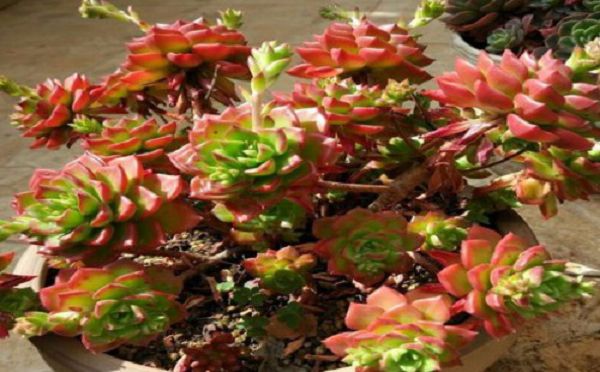
Spring is the season when a hundred flowers bloom and a hundred birds sing. Even many succulents tend to bloom on schedule. This is especially true of the succulent Tia (Sedeveria 'Letizia'): once spring arrives, flowers open one after another on the branches, adding a great deal of vitality to the potted plant.
However, for many succulents, blooming is not a good thing. Some succulents die after flowering, with only their offsets surviving; for other succulents, although they do not die after blooming, the flowering process consumes a large amount of nutrients. If the nutrients in the pot are insufficient, the plant's growth tends to weaken, affecting the ornamental value of the potted plant.
Tia is also a succulent that can bloom, and many people like to grow it in pots as a bonsai to admire. But when the flowering season arrives, Tia sends up long flower stalks and blooms. Should you let it keep blooming or cut it off? For this situation, we need to look at it on a case-by-case basis and try to find a suitable solution.
If several Tia plants are grown in one pot but only one sends up a flower stalk and blooms, then the flower stalk will naturally not consume too many nutrients and will not compete heavily for the nutrients that maintain the plant's normal growth, so it is recommended to keep it. Sometimes it may even produce a rather nice ornamental effect! But to avoid spoiling the overall ornamental effect of the bonsai, you can also cut it off.
If, however, several Tia plants in the pot send up many flower stalks, they will naturally consume a large amount of nutrients, which will inevitably affect the growth of the bonsai Tia. So we can selectively cut off the more vigorously growing flower stalks in a targeted way. Only in this way can we ensure there are enough nutrients in the pot to promote growth and sprouting, and even to encourage the production of offsets, while also avoiding too many flower stalks sprouting and ruining the beauty of the plant's shape.
Of course, if there is only one Tia in the pot, in principle we can keep the flower stalk and flower branches. But it is advisable to cut off the less attractive flower branches on the stalk, to avoid spoiling the beauty of the flower stalk's form and also to reduce the nutrient consumption when the flower spikes are sent up, so that nutrients are not wasted in vain.
However, if several Tia plants in the bonsai send up flower stalks and bloom, it is advisable to keep the flowers on the longer and shorter spikes that look relatively good to accent the bonsai, and cut off the flower spikes that have grown too long and spoil the overall beauty of the bonsai. Still, since more flowers will consume a large amount of nutrients, we need to replenish nutrients in time to ensure the quality of the blooms and the normal growth of the plants.
Besides the situations above, the editor actually thinks that if you feel Tia's flowers are not beautiful and keeping them is just a waste of nutrients, then it is advisable to cut off all the flower stalks. On the one hand, they can be used for cuttings to propagate more young plants; on the other hand, they can be tied together to form a bouquet and enjoyed on their own as cut flowers for a short time.