Detailed diagnosis and treatment process of classical swine fever in piglets, sharing of one case
Classical swine fever, commonly known as “rotten intestine fever”, is an acute, febrile, contact infectious disease caused by the classical swine fever virus of the genus Pestivirus in the family Flaviviridae, and is highly contagious and lethal. Even though the classical swine fever virus has only one serotype (C strain), the classical swine fever virus in many places currently shows a certain degree of virulence variation, which is due to high-intensity, high-density immunization with classical swine fever vaccines on pig farms. The same strain, due to differences in the genetic background, age, nutritional status and immune activity of susceptible animals, shows different clinical symptoms. There are mainly acute, chronic and mild types of classical swine fever.
The general clinical manifestations of acute classical swine fever are that affected pigs prefer to lie down and huddle together, arch their backs, are listless, shiver and walk unsteadily, with continuous fever, and body temperature between 40 and 42°C.
1 Onset situation and clinical symptoms
At the end of November 2014, at a pig farm in Bayi Township, Nanchang County, the sow inventory was 200 head. Piglets in the farrowing house began to develop the disease after 10 days of age. The main symptoms were elevated body temperature, reaching above 41°C, accompanied by diarrhea (yellow), with an incidence rate above 80%. As of December 15 (the day the author rushed to the pig farm), 7 head died that day, and a total of 103 piglets had died, with a mortality rate above 53%. The piglets in the farrowing house were depressed and huddled together curled up. The body temperatures of 5 affected pigs were measured on site, and the body temperatures were obviously elevated, as specifically shown in Table 1 and Figure 1.
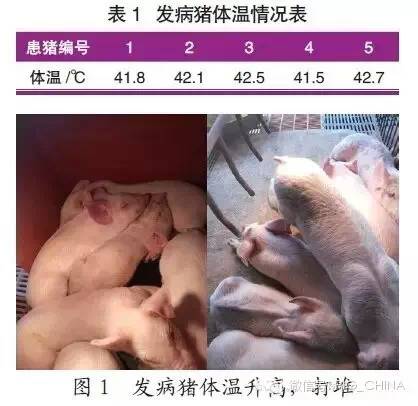
2 Necropsy lesions
Subcutaneous hemorrhage; necropsy showed severe hemorrhage of the inguinal lymph nodes, obvious hemorrhage of the mesenteric lymph nodes, obvious pinhead-sized hemorrhagic spots on the surface of the kidneys, infarction at the edge of the spleen, severe hemorrhage of the bladder mucosa, and obvious hemorrhage of the intestinal mucosa (as shown in Figure 2, Figure 3, Figure 4, and Figure 5).
3 Etiological analysis and diagnosis
3.1 Etiological analysis
Upon inquiry with the owner, the pig herd had been affected for 1 week. The sow classical swine fever vaccine immunization program was immunization with each pregnancy, and the vaccine selected was ordinary cell vaccine. The pig herd had previously always been very stable, so it was speculated that there might be a certain problem with the potency of the classical swine fever cell vaccine, and coupled with loopholes in management, this led to the outbreak of classical swine fever.
3.2 Diagnosis
3.2.1 Preliminary diagnosis
After inquiring about the onset situation and immunization program of the pig farm, combined with the clinical symptoms of the affected pigs and the pathological necropsy tissue lesions, a preliminary diagnosis was classical swine fever.
3.2.2 Laboratory diagnosis
When performing necropsy, the author collected 3 tissue samples and sent them to the Veterinary Hospital of Jiangxi Agricultural University for RT-PCR diagnosis of classical swine fever antigen, and all results were positive for classical swine fever, as shown in Figure 6.
4 Treatment plan and results
4.1 Emergency vaccination and adjustment of immunization program
1) Emergency vaccination of all sowsbreeding pigswith classical swine fever spleen and lymph vaccine, 3 doses/head, with a booster immunization 1 month later.
2) Emergency vaccination of affected piglets in the farrowing housebreeding pigswith classical swine fever spleen and lymph vaccine, 3 doses/head.
3) Superimmunization of newborn piglets (continued for 1 month), vaccinatedbreeding pigswith classical swine fever spleen and lymph vaccine, 1 dose/head, with a booster immunization at 28 days of age, and another booster immunization at 63 days of age.
4.2 Strengthen feeding management
Do a good job of heat preservation and ventilation in the farrowing house pens, and keep the pens dry. Use amoxicillin soluble powder and high-grade multivitamins for drinking water of the piglets to control secondary infection.
4.3 Feedback on treatment results
On December 16, 2014, when the laboratory confirmed classical swine fever, the author immediately called the pig farm owner and required execution according to the above 4.1 and 4.2 plans. On December 20, a follow-up call showed that the mortality rate had decreased. On December 27, another follow-up call showed no new cases, and the pig herd began to stabilize. On January 10, 2015, the author visited the pig farm for follow-up, entered the farm to learn about the health status of the pig herd, and production had already resumed, with everything normal.
5 Preventive measures
The prevention and control of classical swine fever requires comprehensive prevention and control measures, because classical swine fever is a viral disease and there is no drug that cantreatit. Once the disease occurs, the consequences are unimaginable. In order to better prevent and control classical swine fever, the author introduces several prevention and control measures for reference by peers.
5.1 Biosafety
Adhere to the principle of self-breeding and self-raising, and under normal circumstances do not introduce newbreeding pigsfrom other places. When introduction is necessary, it is necessary to test the newly introducedbreeding pigsfor classical swine fever antigen and antibodies, eliminatebreeding pigspositive for classical swine fever antigen testing, and isolate and observe them for more than 1 month before they can enter the pig farm. At the same time, do a good job of disinfection work for personnel and other animals entering and leaving the pig farm.
5.2 Disinfection of pig houses
Adhere to all-in all-out, do a good job of various cleaning and sanitation work inside the pig houses every day, and disinfect regularly with pigs present.
5.3 Control the source of infection
Regularly perform classical swine fever antibody testing and classical swine fever wild virus testing, cull sows with high parity, and at the same time do a good job of harmless disposal of dead pigs.
5.4 Reduce stress
Provide a comfortable environment for the pig herd, do a good job of cold protection, heat protection and cooling, and reduce various external stresses and stresses brought about in production.
5.5 Timely health care
According to the season and the health status of the pig herd, provide timely drug-based health care. Do a good job in the prevention and control of the two major immunosuppressive diseases of the pig herd (porcine reproductive and respiratory syndrome and porcine circovirus disease).
5.6 Vaccination
Vaccination is the most important, most economical, and most effective means of preventing classical swine fever. The choice of vaccine and immunization program should be comprehensively considered according to the location of the pig farm, the surrounding environment, the scale of the pig farm, the herd immunity status, and the historical occurrence of the disease. According to the current use of classical swine fever vaccines in China, tissue vaccines are more effective than cell vaccines, among which classical swine fever spleen and lymph vaccine is the most effective. The basis for selecting classical swine fever vaccine is obtained from the “Veterinary Biological Products Regulations” and the results of parallel immunization tests with cell vaccines and tissue vaccines: for vaccination of healthy pig herds, the effects of the 2 vaccines are comparable; for emergency vaccination, tissue vaccines are superior to cell vaccines. Recommended immunization program for classical swine fever vaccine: first immunization for piglets at 25-28 days of age, booster immunization 1 time at 60-63 days of age, immunization 2 times for replacement pigs before mating, and only after good basic immunization can they enter the production herd.breeding pigsThe herd is universally vaccinated 3 times a year. (Source: Tao Minghua, "Swine Industry Science")