First-time sows giving birth to many stillborn piglets? Check the causes from 10 aspects
First-time sows giving birth to many stillborn piglets? You can investigate from 10 aspects...
The ones with relatively more fresh stillborn piglets are replacement sows. Because replacement sows are still developing themselves, and it is their first farrowing, their birth canal is relatively narrow, making dystocia and prolonged farrowing very likely, which causes stillborn piglets. Misconceptions that easily occur in production:
1. Pushing fetal growth too early in sows
The latest data and practice prove that pushing fetal growth too early in sows easily causes poor mammary gland development, sows being too fat, piglets being too large, and difficulty in increasing postpartum feed intake. Flushing/pushing feed for fetal growth should be carried out only after the sow has been pregnant for 90d.
2. Replacement sows are fed the same as multiparous sows, with fetal growth pushed in late pregnancy
Too much feed causes piglets to be too large; when piglets have a birth weight of 1.4-1.6kg, their later growth rate is faster than that of pigs with too low birth weight,
and they will reach market earlier; multiparous sows' piglets can reach a birth weight of 1.4-1.5kg, while replacement sows only need piglets to have a birth weight of about 1.2-1.3kg. If the piglets born to replacement sows reach a birth weight of 1.4-1.5kg, the possibility of normal delivery is very low, and dystocia with stillborn piglets is extremely likely.
3. Using the same feeding amount for all multiparous sows when pushing fetal growth
When pushing fetal growth in the last 20d of pregnancy, the sow's belly size and backfat need to be observed first, and the number of piglets to be born and backfat should be predicted. When the belly is relatively small and the number of piglets is estimated to be relatively low, and when body condition is moderate, we cannot push fetal growth excessively or at all, otherwise dystocia and stillborn piglets are extremely likely.
2.Sow constipation
Sow constipationis the first important signal the sow's body sends to us, but most pig farms do not take it seriously, or even pay no attention to it at all. It must be known thatsow constipationhas a very large impact on production performance.
1. The anatomical and physiological structure of the sow
The topmost is the rectum, the middle is the birth canal, and the bottom is the bladder. Whensow constipationoccurs, the hard fecal balls in the rectum directly press on the birth canal, causing poor uterine blood flow, uneven nutrition of the uterine muscles, and deterioration of the intrauterine environment, ultimately resulting in poor uniformity of newborn piglets and even stillborn piglets.
2. Constipation occurs in sows
If a sow develops constipation, feces gradually accumulate in the intestinal tract, causing toxins in the feces to be absorbed by the intestinal tract, which in turn causes the liver's detoxification function and the kidneys' toxin excretion function to fail, and then causes cardiopulmonary function to decline. However, farrowing requires a great deal of physical strength for the sow. When cardiopulmonary function is poor, the oxygen supplied to the uterine muscles is reduced, which increases the probability of dystocia and ultimately increases the probability of stillborn piglets.
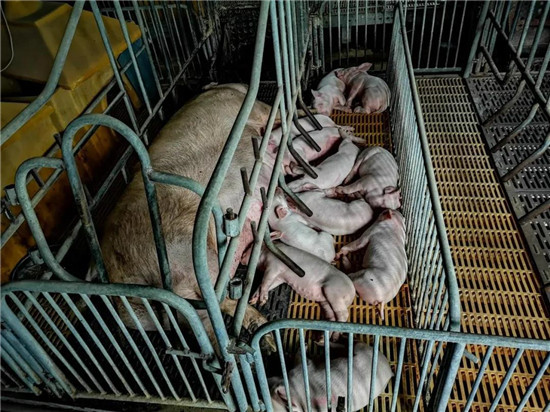
3. Farrowing room temperature too high
After fetal growth is pushed in late pregnancy, the sow's body condition is relatively fat, and the fetuses in the abdomen are also large, which affects one of the sow's breathing methods, thoracoabdominal breathing. During farrowing, sows are very afraid of heat. If the pig house temperature is too high, it may cause clinical symptoms of breathing difficulty in the sow during farrowing. This is because sows do not have sweat glands and usually use breathing and defecation to lower body temperature.
When a sow experiences breathing difficulty during farrowing, blood oxygen concentration decreases, oxygen supplied to the uterine muscles is reduced, and uterine muscle contractility decreases, resulting in dystocia.
When a sow cools down by breathing at a high frequency, a large amount of calcium ions is excreted, and the concentration of calcium ions is closely related to the contraction strength of the uterine muscles. The calcium ion concentration in the sow's body must reach a certain range to ensure that the uterus can contract freely.
Farrowing under a high-temperature environment is a very large stress for the sow. At this time, the sow itself secretes a hormone to fight the stress, and this hormone is adrenaline. Adrenaline causes uterine blood vessels to constrict, reducing oxytocin reaching the smooth muscle, so the uterine muscle cannot get oxygen, and both the frequency and strength of uterine contractions decrease. The duration of labor will be abnormally prolonged.
4. Lack of reproductive nutrition, relatively little amniotic fluid
The vast majority of pig farms regularly use antibiotics for health care and feed mold removers mixed into feed for a long time. Because mold removers adsorb mycotoxins, they also adsorb some nutrients, causing a lack of reproductive nutrition, which in turn causes poor piglet development, relatively little amniotic fluid, excessively low lubrication of the birth canal, and increased resistance such as friction in the birth canal, resulting in dystocia.
5. Long-term confinement
Due to the use of gestation stalls, sows seriously lack exercise, and the sow's physical strength, endurance, and muscle contractility all decline greatly. Sows often have prolonged farrowing. A common clinical finding is a farrowing process of more than 5 hours, and the sow shows symptoms of weak uterine contractions after giving birth to about 6 piglets. Some sows even give birth to two more piglets two days after farrowing, and these two piglets are mostly fresh stillborn piglets. A few sows will give birth to live piglets after two days, especially older sows.
6. Use of oxytocin to assist farrowing
Oxytocin excites uterine smooth muscle and causes uterine contractions, thereby promoting labor. Therefore, the vast majority of our pig farms use oxytocin to assist farrowing. In fact, when piglets reach the pelvic opening and press on the birth canal, the hypothalamus secretes oxytocin, causing uterine smooth muscle contraction and pushing the fetus into the birth canal. The sow automatically generates pushing force, and this stimulates the hypothalamus again and again to release oxytocin. The oxytocin released each time is at a low dose and is very safe, effectively stimulating uterine smooth muscle contraction, and the other piglets are also born one after another. At the same time, we can massage the sow's udder and let the piglets after birth suckle. Their sucking and massage can likewise stimulate the release of oxytocin. Therefore, we do not need to inject oxytocin at all.
7. Moving groups
When sows are moved from the gestation house to the farrowing house, due to pen conditions (such as the floor being very slippery and the connection between the farrowing crate and the floor being too high) and insufficient patience of workers, it is easy to handle sows roughly and cause sows to fall, resulting in fresh stillborn piglets.
8. Feeding
Leftover feed in the trough that is not cleaned thoroughly after each feeding, because long-term leftovers in the trough, especially with the large amount added for sows in late gestation, mean the trough will not be eaten very clean, so the feed becomes moldy, and mycotoxins cause fetal edema and death in the uterus.
9. Drugs
NL⟧ Abuse of antibioticsfor treatmentor health care causes liver and kidney damage. The liver's detoxification function declines, the kidneys' toxin excretion function declines, and more toxins accumulate in the body. After absorption, they are excreted through the birth canal, causing birth canal edema and poor piglet vitality or death.
10. Disease
Reproductive disorder diseases such as PRRS, circovirus, pseudorabies, Japanese encephalitis, chlamydia, etc. can all cause fetal death in the uterus. Generally, they are distinguished according to the sow's return-to-estrus rate, abortion rate, and the morbidity and mortality rates of piglets in the farrowing house. (Source: Zhuyou Zhijia)