How to Grow Brunfelsia pauciflora? Detailed Guide to Care Methods and Precautions
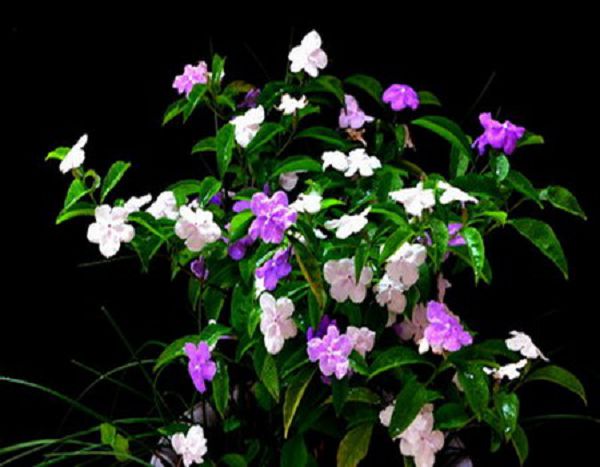
Brunfelsia pauciflora, also known as yesterday-today-and-tomorrow, belongs to the genus Brunfelsia in the Solanaceae family and is native to tropical America. The plant is an evergreen small shrub, about 1 m tall. Its leathery, oblong leaves are glossy, alternate, entire, with short petioles. Flowers are solitary or several clustered at the top of the stems, and the blooms are gorgeous and fragrant. During the blooming period, the color is different every day: when first open it is violet, gradually fading to blue, and finally almost turning white. The flower has 5 petals, spreading flat, with a small contracted white opening in the center. The flowering period is from April to October.
Brunfelsia pauciflora is generally grown as a potted plant, moved to a cold room in winter and to open ground in summer. Before planting, some decomposed organic matter can be applied in the pot as a base fertilizer. The potting soil should be loose and breathable. After planting, water thoroughly, and during the growing period keep the soil moist often, but do not let it become waterlogged. Apply liquid fertilizer once a month. Apply a phosphorus-potassium fertilizer once before flowering to promote flower bud formation and more blooms. Below, the editor introduces for you:
[Potting]
The substrate used for potting can be one of the following: garden soil: cinder = 3:1; or garden soil: medium-coarse river sand: sawdust (mushroom residue) = 4:1:2; or one of paddy soil, pond mud, or leaf mold. After potting, water once thoroughly and keep it in a shaded environment for one week. When transplanting seedlings, first dig the planting hole, spread a layer of organic fertilizer at the bottom of the planting hole as base fertilizer (bottom fertilizer), about 4~6 cm thick, then cover with a layer of soil and place the seedling in, so as to separate the fertilizer from the roots and avoid burning the roots. After placing the seedling, backfill the soil, cover the root system, and firm the soil with your feet, then water once thoroughly. Choose a flower pot of appropriate size. Cover the bottom hole of the pot with two pieces of tile or thin foam pieces, which should both keep the potting soil from being washed out and allow excess water to drain out in time. On top of the tile or foam, place a layer of ceramsite or crushed red brick as a drainage layer, about 2~3 cm thick.
[Light] Brunfelsia pauciflora likes a semi-shaded environment. In autumn, winter and spring, it can be given sufficient sunlight, but in summer it should be shaded by more than 50%. When kept indoors, place it in a place with bright light as much as possible, such as a well-lit living room, bedroom, study and other places. After keeping it indoors for a period (about one month), move it outdoors to a shaded place (with insulation conditions in winter) for a period (about one month), and alternate back and forth like this.
[Temperature] Brunfelsia pauciflora likes a semi-shaded, well-ventilated environment. It is not tolerant of direct strong light and has poor wind resistance. Around Qingming, move it outdoors to a sunny, wind-sheltered place for cultivation. In summer, place it in a ventilated, cool place or under a shade shed with 50% shading, to prevent direct sunlight, otherwise the leaves are prone to turning yellow and scorching. Because it is native to tropical regions and likes a high-temperature, high-humidity environment, it has very strict requirements for winter temperature. When the ambient temperature is below 10°C, growth stops, and it cannot overwinter safely when frost occurs. [1] Around the time of frost in autumn, move it back indoors for cultivation and place it in a place with stronger light.
[Watering] Brunfelsia pauciflora likes moisture and is not tolerant of waterlogging. It requires the relative air humidity of the growing environment to be 70~80%. If the relative air humidity is too low, the lower leaves turn yellow and fall off, and the upper leaves lose their luster. Daily watering should follow the principle of watering when dry and stopping when wet. In summer, the temperature is high and the air is dry. In addition to watering the potting soil sufficiently, spray the leaves with clean water 2-3 times a day, and sprinkle water around it to increase air humidity and lower the temperature. In winter, watering should be controlled and the potting soil kept on the dry side. Preferably, after each flowering, when the new shoots grow to about 75px, control watering to promote flower bud differentiation and help it bloom every month.
[Fertilizing] Brunfelsia pauciflora is a plant that likes fertilizer. It should be top-dressed and watered frequently to ensure sufficient nutrients and moisture. However, fertilization must be reasonable. Excessive or improper fertilization will cause the plant to grow leggy, with leaves but no flowers, or burn the seedlings due to too much fertilizer. For potted plants, in addition to adding organic fertilizer when potting, appropriate fertilizer and water management should also be carried out during usual care. Spring, summer and autumn are the peak growing seasons for Brunfelsia pauciflora, so fertilizer and water management should be done well.
[Pruning] In winter, when the plant enters dormancy or semi-dormancy, cut off weak, diseased, pest-infested, dead, overly dense and other branches. The branches can also be tidied up in combination with cuttings. Brunfelsia pauciflora should be pruned and shaped in good time. On the one hand, thoroughly remove the original old branches, dead branches, dry branches, diseased and weak branches, etc., to reduce nutrient consumption and prevent the plant from aging; on the other hand, maintain a graceful plant shape, which is conducive to sprouting new buds. After each flowering, promptly cut off the spent flowers, and cut off one-third or one-half of some long branches to promote more branching, making the tree shape compact and beautiful, so as to facilitate more flowering the next month. After the last flowering in late autumn, carry out heavy pruning, that is, keep 2-3 buds on each branch. Cut off the rest, and cut off weak branches, inward-facing branches, and diseased and pest-infested branches, so as to facilitate vigorous growth, a beautiful crown, and more flowering in the coming spring.
[Pest and disease control]: The main insect pests of Brunfelsia pauciflora are whiteflies, leafhoppers, scale insects, red spider mites, etc., and diseases occasionally include leaf spot and powdery mildew. Generally, spraying with 40% omethoate emulsifiable concentrate, thistle-aphid clear 1000-fold solution, etc. can prevent the occurrence of insect pests; spraying with 65% zineb, 50% carbendazim, 75% chlorothalonil, 70% thiophanate-methyl 500~800-fold solution can prevent diseases.
Summer care precautions:
① Strengthen air convection so that the heat inside the plant can be released;
② Place it in a semi-shaded place, or give it 50% shade;
③ Give it appropriate misting, 2~3 times a day.
Winter care precautions:
① Move it indoors to a place with bright light for care;
② Outdoors, it can be wrapped with plastic film to overwinter, but every two days at noon when the temperature is relatively high, uncover the film to let it breathe.