Fertilizing household potted flowers: avoid these timing taboos
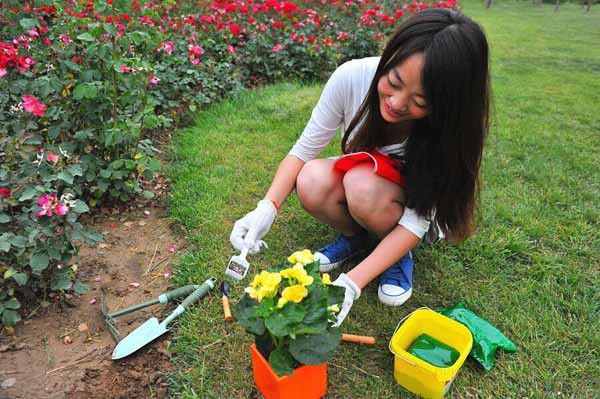
Many people like to grow flowers at home, as it beautifies the room, purifies the air, regulates temperature and relieves heat, and also cultivates character and pleases body and mind. However, to make potted flowers thrive with lush branches and leaves and large, brightly colored blooms, besides watering, fertilizing is also an important part of the flower-growing process. When flowers are in the growth period, fertilizing can promote vigorous growth, so more fertilizer should be applied, while when flowers are in the dormant period, potted flowers grow slowly, so less fertilizer should be applied. Therefore, fertilizing potted flowers is very important and must be done very carefully. Besides controlling the amount of fertilizer, the timing of fertilizing must also be avoided. Below I will tell you about the 3 time periods when potted flowers should not be fertilized.
1. Avoid fertilizing during the flowering period
For household potted flowers such as camellia, rose, Chinese rose, carnation and orchid, fertilizing should be stopped before the buds open and show color, and phosphorus and potassium fertilizers should not be applied continuously either. Because fertilizing during the flowering period, especially with nitrogen fertilizer, will stimulate vegetative growth, increase the respiratory metabolism of new leaves, reduce the nutrients obtained by the flower organs, and inhibit growth and development, delaying the flowering period. It can also cause scorched flowers, prompt flowers to fade early, and shorten the flowering period.
2. Avoid fertilizing on rainy days and at night
On rainy days and at night in early spring or late autumn, the temperature is low, leaf transpiration and root absorption are reduced, fertilizer use efficiency is low, and fertilizer accumulates in the soil. Combined with the effects of waterlogging and poor aeration, this easily damages the roots. Therefore, on rainy, low-temperature days and days of heavy pouring rain, fertilizing should be delayed until a sunny day.
3. Avoid fertilizing under high temperature and scorching sun
At noon in summer and autumn with high temperature and scorching sun, the air is dry and transpiration is strong. After fertilizing, it easily causes physiological metabolic disorders in the plant, resulting in yellowing and wilting of branches and leaves and decline of flowers. Therefore, flowers should be fertilized in the morning or after the high temperature in the afternoon, combined with watering. Do not fertilize at noon under high temperature and scorching sun.
Different types of flowers have different fertilizer requirements. For example, osmanthus and camellia like pig manure and avoid human feces and urine; southern flowers such as rhododendron, camellia and gardenia avoid alkaline fertilizers and like slightly acidic fertilizers; foliage-oriented flowers (such as money tree and pothos) can focus on nitrogen fertilizer; flower-oriented flowers (such as chrysanthemum and dahlia) need an appropriate amount of complete fertilizer during the flowering period to make the flower shape beautiful and the color bright; fruit-oriented flowers (such as kumquat and ornamental pepper) should appropriately control fertilizer and water during the flowering period, and apply sufficient complete fertilizer during the fruit-swelling period to achieve the expected effect; bulbous flowers (such as narcissus and tulip) should be given more potassium fertilizer to help the bulbs plump up. But have you fertilized correctly? Incorrect fertilizing can also lead to poor growth of household flowers, and in severe cases, death.
1. Do not fertilize newly planted plants. Newly planted plants have many wounds. If stimulated by the outside world, they cannot heal and will cause root rot.
2. Do not fertilize during the flowering period. Fertilizing during the flowering period will cause bud drop, flower drop and fruit drop.
3. Do not fertilize during the dormant period. Flowers stop or slow their growth during the dormant period, their metabolism is slow, and photosynthesis is poor. If fertilizer is applied, it will quickly break dormancy and cause the plant to continue growing, which will consume more nutrients and affect flowering the next year.
4. Do not apply concentrated fertilizer. When fertilizing potted flowers, the concentration must not be too high or the amount too much, otherwise it will cause death. Generally, the principle of frequent application of thin fertilizer should be followed, with a ratio of three parts fertilizer to seven parts water as suitable.
5. Do not apply raw fertilizer. If unrotted fertilizer is applied, it will not only easily breed insects and maggots, but also often give off a foul odor and pollute the environment. Moreover, when it encounters water it will ferment and damage the plant's root system.
6. Do not apply a single fertilizer. To grow household flowers and other plants well, besides traditional nitrogen-phosphorus-potassium compound fertilizer, medium and trace element foliar fertilizer can be appropriately sprayed; for newly planted flowers, bio-organic fertilizer can be mixed into the pot to retain water and fertilizer and prevent soil compaction.
7. Do not fertilize diseased and weak plants. The branches of diseased and weak plants are thin and weak, photosynthesis is poor, metabolism is slow, and they are too weak to benefit from tonics. If fertilized, it is easy to cause fertilizer damage.