Why Porcine Semen Becomes a Vector for Virus Transmission (Part Two)
Porcine Semen - A Vector for Virus Transmission (Part Two)
“A good boar makes the whole herd good”; likewise, a bad boar makes the whole herd bad. For domestic large-scale pig farms that use artificial insemination almost 100% of the time, the health status of boars and semen has an self-evident impact on the entire production system. This article thoroughly discusses the possibility of semen serving as a vector for virus transmission and countermeasures from the perspectives of the time at which different viral pathogens are detected in semen, their impact on reproductive performance, routine prevention and health monitoring, and biosecurity systems (facilities, logistics, etc.). In terms of depth, breadth and practicality, this article is a rare and authoritative piece on this specialized topic. Greatness begins with sharing. It is strongly recommended that pig producers, health managers, and professionals involved in the operation of specialized boar studs read, share, and even bookmark this article. Also, a quiet reminder: establishing multiple independent boar studs -- not putting all your eggs in one basket -- is also a common strategy for semen risk management.
Porcine Semen - A Vector for Virus Transmission (Part Two)
Porcine semen as a vector for transmission of viral pathogens-Part 2
Dominiek Maesa,*, Ann Van Sooma, Ruth Appeltanta, Ioannis Arsenakisa, Hans Nauwynckb
aBelgium, Merelbeke, Ghent University, Faculty of Veterinary Medicine, Department of Herd Health and Reproduction, Division of Reproduction
a Department of Reproduction, Obstetrics and Herd Health, Faculty of Veterinary Medicine, Ghent University, Merelbeke, Belgium
bBelgium, Merelbeke, Ghent University, Faculty of Veterinary Medicine, Laboratory of Virology, Department of Immunology and Parasitology, Division of Virology
b Department of Virology, Immunology and Parasitology, Laboratory of Virology, Faculty of Veterinary Medicine, Ghent University, Merelbeke, Belgium
Keywords:
porcine semen, pig, artificial insemination, virus, review/examination
Semen, Pig, Artificial insemination, Virus, Review
Continued from the previous article...
2.1 Viruses present in porcine semen and listed by the OIE
Viruses in porcine semen which are in the OIE list
2.1.2. Aujeszky’s disease virus (pseudorabies virus)
Table 4: Viral pathogens present in porcine semen and not listed by the OIE (2015): boar reproductive tract lesions, effects on semen quality, and the impact of virus transmission to sows after artificial insemination (AI).
Table 4: Viral pathogens not on the OIE list (2015) that have been found in porcine semen: lesions in the genital tract of boars, impact on semen quality, and transmission to recipient sow on artificial insemination (AI).
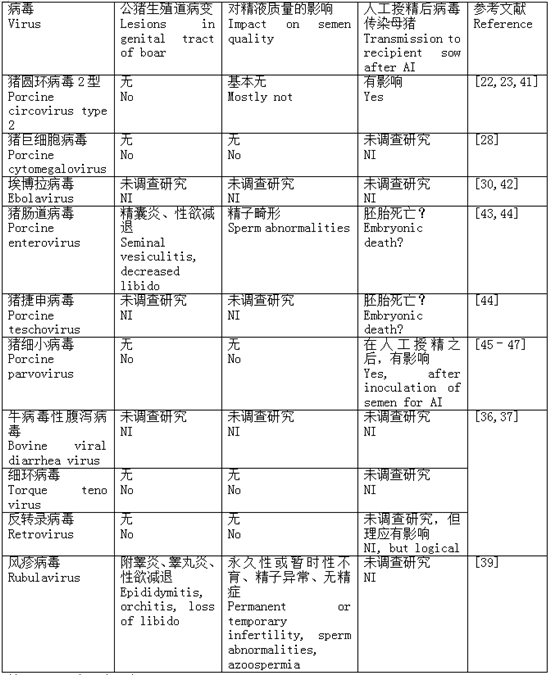
Abbreviation: NI, not investigated.
Abbreviation: NI, not investigated.
2.1 Viruses present in porcine semen and listed by the OIE
Viruses in porcine semen which are in the OIE list
2.1.3. Classical swine fever virus
Classical swine fever virus
Classical swine fever virus is an enveloped RNA virus belonging to the family Flaviviridae, genus Pestivirus. The virus has been eradicated from many countries or regions, such as Western Europe, North America and Australia [53]. However, following contact with wild boar, the virus may potentially be introduced into domestic pig herds. During the 1997-1998 classical swine fever (CSF) epidemic in the Netherlands, two artificial insemination (AI) centers were infected, and subsequently 1,680 pig herds were declared suspected of CSF infection [54]. This highlights the capacity of AI centers to spread potential diseases. Experiments have demonstrated that after infection with classical swine fever virus, boars can shed the virus in semen for up to 53 days [11]. The virus has no effect on sperm morphology or motility, and sperm concentration remains normal. When sows are inseminated with infected semen, seroconversion may occur, and the virus may cross the placental barrier causing embryonic death, after which the virus can be isolated from the fetuses [10].
Classical swine fever virus is an enveloped RNA virus belonging to the family flaviviridae, genus Pestivirus. The virus has been eradicated from many countries or regions such as Western Europe, North America, and Australia [53]. However, the virus has been periodically reintroduced into domestic pigs via contact with wild boars. During the CSF epidemic in the Netherlands in 1997 to 1998, two AI centers became infected and 1680 pig herds were declared CSF suspect [54]. This highlights the importance of potential disease spread by AI centers. Boars experimentally infected with CSF virus have been shown to shed the virus in semen for up to 53 days after infection [11]. The virus does not affect the semen morphology and motility, and the concentration is within the normal range. Sows that are inseminated with contaminated semen may show seroconversion, the virus may cross the placental barrier causing embryonic mortality, and the virus can be isolated from fetuses [10].
Because the virus is highly contagious, especially in endemic areas, its impact will persist. Compared with piglets, infectedbreeding pigsmay not show significant clinical signs and pathological features. If CSF virus immunotolerant piglets are born and show normal clinical signs, they can shed the virus for months without any sign of disease or serological response [10]. ⟦21 2.1.4. Foot-and-mouth disease virus
The virus will remain important, especially in areas in which it is endemic, because the virus is highly contagious, and in contrast to piglets, infection in breeding pigs is not always associated with prominent clinical and pathologic signs. If clinically normal CSF virus immunotolerant piglets are born, they can spread the virus for months without showing signs of disease or eliciting a serologic response [10].
2.1.4. Foot-and-mouth disease virus
Foot-and-mouth disease virus
Foot-and-mouth disease virus is a non-enveloped small RNA virus belonging to the family Picornaviridae, genus Aphthovirus. The virus is endemic in Asia and in some regions of Africa and South America [55]. In naturally infected boars, foot-and-mouth disease (FMD) virus can be detected in semen after 9 days, but sows mated with virus-carrying semen through artificial insemination are not infected [12]. The effect of the virus on semen quality cannot yet be described. Foot-and-mouth disease virus infection causes viremia, after which the virus disseminates to almost all tissues throughout the body, including the reproductive tract and the skin around the preputial orifice [56]. The concentration of this virus in semen is low [12]. Many countries have eradicated foot-and-mouth disease infection, and other countries closely monitor boars, so the risk of this virus being transmitted through semen is very low.
Foot-and-mouth disease virus is a small nonenveloped RNA virus that belongs to the family of picornaviridae, genus Aphthovirus. The virus is endemic in Asia and some areas in Africa and South America [55]. After natural infection, FMD virus has been recovered from semen from infected boars for up to 9 days, but AI with contaminated semen failed to transmit the disease to serviced sows [12]. An effect on semen quality has not been described. Infection with FMD virus leads to viremia, with subsequent dissemination of the virus throughout virtually all tissues of the body, including the genital tract and the skin around the preputial orifice [56]. The viral concentration in semen has been found to be low [12]. Because infections are officially eradicated in many countries, and because boars are intensively monitored in other countries, the risk for transmission of this virus by the semen is low.
2.1.5. Japanese encephalitis virus
Japanese encephalitis virus
Japanese encephalitis virus is an enveloped RNA virus belonging to the family Flaviviridae, genus Flavivirus, and is a mosquito-borne pathogen transmitted between humans and animals. The virus belongs tobreeding pigsreproductive pathogens, has a major economic impact on pig farming, especially in Asia and northern Australia, and may cause infertility in Japanese-line pigs [13]. After susceptible boars are infected, they show edema and testicular congestion, a large number of abnormal sperm appear in the semen, and the number of sperm and live sperm is markedly reduced [13]. These symptoms are usually transient, and most boars recover completely. The virus has been isolated from the testes of boars with orchitis, and it can be shed in semen for 5 weeks. If virus-carrying semen is used to inseminate gilts, the virus is easily transmitted [13,57].
Japanese encephalitis virus is an enveloped RNA virus that belongs to the family flaviviridae, genus Flavivirus. It is a mosquito-borne human and animal pathogen. The virus represents an economically important reproductive pathogen of breeding pigs, especially in Asia and Northern Australia, and may cause infertility in Japanese pigs [13]. Infection of susceptible boars resulted in edematous, congested testicles and semen with numerous abnormal spermatozoa, and significantly decreased total and motile sperm counts [13]. These changes are usually temporary, and most boars recover completely. The virus has been isolated from the testicles of boars with orchitis and also can be shed in the semen for 5 weeks. The virus can be easily transmitted if gilts are inseminated with infected semen [13,57].
2.1 Viruses present in porcine semen and listed by the OIE
Viruses in porcine semen which are in the OIE list
2.1.6. Porcine reproductive and respiratory syndrome virus (PRRSV)
Porcine reproductive and respiratory syndrome virus
PRRSV is an enveloped RNA virus belonging to the family Arteriviridae, genus Arterivirus. Infection with porcine reproductive and respiratory syndrome (PRRS) virus causes reproductive disorders in pregnant sows, mortality in suckling piglets, and respiratory disease in pigs of different ages [58]. Adult boars usually have no or only mild symptoms. The virus spreads easily between animals. Animals infected with PRRSV can shed the virus through saliva, nasal secretions, urine, feces and semen [19,20]. It has been confirmed that PRRSV can enter reproductive tract tissues via blood vessels and replicate there. It has also been proposed that infected monocytes and macrophages from the blood and lymph of the reproductive tract migrate into the semen [15,59].
The PRRSV is an enveloped RNA virus that belongs to the family arteriviridae, genus Arterivirus. Infections with PRRS virus are associated with reproductive failure in pregnant sows, mortality in suckling pigs, and respiratory disease in pigs of all ages [58]. Usually, no or only mild symptoms are seen in mature boars. The virus is easily transmitted between animals. Infected animals can shed PRRSV in saliva, nasal secretions, urine, feces, and also in semen [19,20]. Vascular dissemination and replication of PRRSV in tissues of the reproductive tract has been shown. Also migration of infected monocytes and macrophages from the blood and lymph of the reproductive tract into the semen has been suggested [15,59].
In experimentally infected boars, the period of virus shedding in semen varies greatly, ranging from 2 days [14] to 92 days [17] after infection (average 35 days; Table 1). In a subsequent study, boars were euthanized 101 days after infection, and PRRSV was isolated from the bulbourethral gland. The variation in shedding after infection may be caused by different factors, such as individual differences among boars [17,60], breed [60], strain type, and virus detectiontechniques(i.e., virus isolation, polymerase chain reaction [PCR], nested real-time PCR, reverse transcriptase PCR, pig bioassay). Using the bioassay method, infectious virus was found in semen samples from 4 to 42 days after infection [19]. Even without viremia and neutralizing antibodies, the virus can be shed in semen [17,60].
The duration of shedding in semen samples of experimentally infected boars varies widely, ranging from 2 [14] to 92 [17] days after infection (mean 35 days; Table 1). In the latter study, PRRSV was isolated from the bulbourethral gland of a boar euthanized 101 days after infection. This marked variability in shedding may be due to different factors including individual boar variation [17,60], breed of the boar [60], the type of virus strain, and the technique used for detection of the virus (i.e., virus isolation, polymerase chain reaction [PCR], nested real-time PCR, reverse transcriptase PCR, swine bioassay). Using a bioassay, infectious virus has been shown in semen samples from 4 to 42 days after infection [19]. The virus can be shed in semen, even in the absence of viremia and in the presence of neutralizing antibodies [17,60].
During the acute phase of the disease, in addition to anorexia, lethargy and respiratory clinical signs, boars may also show low libido. Different studies show that the impact of PRRSV infection on semen quality varies greatly. Some studies reported drastic changes in semen quality detected 2 to 10 weeks after infection, such as reduced sperm motility, acrosomal abnormalities, and changes in morphology and ejaculate volume, while other studies found no abnormalities [19,61].
During acute illness, in addition to anorexia, lethargy, and respiratory clinical signs, boars may also lack libido. The effect of PRRSV infection on semen quality varies considerably between studies. In some studies, drastic changes in semen quality, e.g., reduced motility, abnormal acrosomes, morphologic alterations, and volume of the semen, were observed 2 to 10 weeks after infection, whereas no abnormalities were found in other studies [19,61].
It has been confirmed that boars in the acute infection phase can transmit PRRSV through semen tobreeding pigherds [61]. However, the transmissibility of the virus depends on the amount of virus in the semen, so the virus may not be transmitted [62]. Prieto et al. [20] showed that in a single ejaculate of an infected boar, the PRRSV titer was 7×10² TCID50/mL. If a single ejaculate is diluted (15-30 fold), the virus titer is approximately 4×101 TCID50/mL, equivalent to a PRRSV titer of approximately 3×10³ TCID50 per 80 mL of diluted semen. When sows are mated with infected boars [61] or inseminated with experimentally infected semen [19,21], PRRSV seroconversion occurs even without viremia. Prieto et al. [21] showed that when seronegative or non-immunized gilts are inseminated with semen containing PRRSV, the conception rate is almost unaffected, but early embryonic infection and death may occur.
Transmission of PRRSV from fresh semen of acutely infected boars into breeding herds has been shown [61]. However, transmission does not always occur as it may depend on the amount of virus present in the semen [62]. In a study of Prieto et al. [20], the PRRSV titer in an ejaculate of an infected boar was 7×10² TCID50/mL. If the ejaculate is extended (15–30 times), the virus titer will be approximately 4×101 TCID50/mL of extended semen, corresponding with a total amount of approximately 3×10³ TCID50 of PRRSV in each dose of 80-mL extended semen. Sows bred by infected boars [61] or with experimentally contaminated semen [19,21] showed seroconversion to PRRSV, even in the absence of detectable viremia [17,60]. Prieto et al. [21] reported that insemination of seronegative or preimmunized gilts with semen containing PRRSV often has little or no effect on conception rates but may result in early embryonic infection and death.
2.1.7. Swine vesicular disease virus
Swine vesicular disease virus
Swine vesicular disease (SVD) virus is a non-enveloped small RNA virus belonging to the family Picornaviridae, genus Enterovirus. Outbreaks of SVD virus have been recorded in some countries in Europe, Asia and Central America. SVD virus and foot-and-mouth disease (FMD) virus may cause similar lesions. Therefore, special attention should be paid to the differential diagnosis of SVD and FMD. Within 4 days after natural infection, SVD virus can be isolated from the semen of infected boars, but sows mated with virus-carrying semen through artificial insemination are not infected [12].
The swine vesicular disease (SVD) virus is a small nonenveloped RNA virus of the family picornaviridae, genus Enterovirus. Outbreaks with SVD virus have been documented in some countries in Europe, Asia and Central America. Infection with the SVD virus may cause lesions similar to those on infection with the FMD virus. Therefore, SVD is important in the differential diagnosis of FMD. After natural infection, SVD virus has been isolated from infected boar semen for up to 4 days but AI with contaminated semen failed to transmit the disease to sows [12].
2.2 Viruses present in porcine semen and not listed by the OIE
Viruses in porcine semen which are not in the OIE list
2.2.1 Porcine circovirus type 2
Porcine circovirus type 2
Porcine circovirus type 2 (PCV2) is a non-enveloped small DNA virus belonging to the family Circoviridae, genus Circovirus. Pigs co-infected with PCV2 and exhibiting other related diseases are generally collectively referred to as PCV2-associated diseases [63]. After infection with PCV2 virus, sows may develop reproductive disorders such as late-term abortion and stillbirth, but this is not common in actual production. Adult boars infected with PCV2 usually show no clinical signs or lesions [24,26]. The virus has been detected in the semen of both naturally and experimentally infected boars [24]. In experimental infections, PCV2 DNA was detected in serum and semen on day 2 and day 5 after infection, respectively [24,26]. PCV2 viremia testing is usually performed before testing for semen-associated virus, but semen may shed the virus even without viremia. After experimental infection of boars, some studies found intermittent virus shedding in boar semen [24,25], while other studies found continuous virus shedding in semen [26]. McIntosh et al. [27] showed that naturally infected boars shed the virus occasionally in semen for up to 27 weeks. These data indicate that semen may be an important vector for PCV2. The virus often contaminates seminal plasma, but PCV2 can be detected in both seminal plasma and sperm [23,33]. Sperm rarely show changes in morphology, motility or concentration [26]. Breeding sows infected with PCV2 also rarely show clinical signs [64].
Porcine circovirus type 2 (PCV2) is a small nonenveloped DNA virus that belongs to the family circoviridae, genus Circovirus. Infections with PCV2 in pigs are associated with different disease conditions commonly referred to as PCV2-associated disease [63]. Reproductive problems in sows such as late-term abortions and stillbirths have also been described but are considered to be rare under field conditions. Mature boars infected with PCV2 generally lack clinical signs and lesions [24,26]. The virus has been detected in semen of naturally and experimentally infected boars [24]. On experimental infection, PCV2 DNA has been detected in serum and semen at 2 and 5 days after infection, respectively [24,26]. Detection of PCV2 viremia commonly precedes the detection of semen-associated virus, but semen shedding may occur in the absence of viremia. After experimental infection of boars, some studies found intermittent shedding in semen [24,25], whereas other studies observed continuous shedding of the virus [26]. McIntosh et al. [27] showed that naturally infected boars shed the virus sporadically in semen for up to 27 weeks. These data suggest that semen may be a significant vehicle for PCV2. The seminal plasma is usually contaminated, but PCV2 is not only detected in the non–sperm cell fraction but also in the sperm one [23,33]. Changes in semen morphology, motility, and concentration are not commonly found [26]. Clinical signs on PCV2 infection in breeding sows are rare [64].
When PCV2 is added to semen and non-immunized sows are experimentally infected, reproductive disorders and fetal infection occur [41]. However, under natural infection conditions, it is not yet clear whether the amount of PCV2 virus in semen is sufficient to infect sows or their fetuses. The virus can replicate in embryos without a zona pellucida, leading to embryonic death [65,66]. In PCV2-associated diseases, delayed farrowing or pseudopregnancy is uncommon. In litters affected by PCV2, the number of piglet deaths may increase [67].
Naïve sows inseminated with semen experimentally spiked with PCV2 exhibited reproductive failure, and their fetuses became infected [41]. However, it is not known if the quantity of PCV2 naturally shed in semen is sufficient to infect sows or their fetuses. The virus is able to replicate in zona pellucida–free embryos, leading to embryonic death [65,66]. Delayed farrowing or pseudopregnancy is less frequently observed with PCV2-associated reproductive failure. An increased number of nonviable piglets may be present in PCV2-affected litters [67].
2.2.2. Porcine cytomegalovirus
Porcine cytomegalovirus
Porcine cytomegalovirus, or porcine herpesvirus type 2, is a DNA virus belonging to the family Herpesviridae, subfamily Betaherpesvirinae, but not assigned to any genus. Adult pigs infected with porcine cytomegalovirus usually have subclinical infection. After infection in boars, the virus can be detected in the testes and epididymis [28]. Whether the ejaculated semen sheds the virus has not yet been clarified.
Porcine cytomegalovirus or suid herpesvirus type 2 is a DNA virus that belongs to the subfamily betaherpesvirinae of the family herpesviridae but is not assigned to any genus. Infection with porcine cytomegalovirus is usually subclinical in adults. After infection in boars, the virus was detected in the testis and epididymis [28]. Shedding of virus in ejaculated semen has not been determined.
2.2.3. Porcine parvovirus
Porcine parvovirus
Porcine parvovirus (PPV) is a non-enveloped small DNA virus belonging to the family Parvoviridae, genus Parvovirus. The virus is very common in pig herds. The main transmission routes of PPV are oronasal transmission and placental transmission. The virus has been isolated many times from the semen of naturally infected boars. During the acute infection period, boars can shed the virus in semen [34]; although it has not been confirmed whether shedding continues in later stages, early uterine infection may lead to the production of PPV immunotolerant individuals [68]. Semen contamination may also be caused by virus-containing fecal particles or the male reproductive organs [45,46]. In boar herds, there are usually no clinical signs after infection. In experimentally infected boars, there are rarely changes in fertility or libido [46], sperm count, semen volume, sperm motility or morphology [47]. After breeding sow herds are infected with PPV, they usually show only reproductive disorders: return to estrus, reduced litter size, and increased number of mummified fetuses [69]. The role of PPV-contaminated semen in causing reproductive disorders has not yet been clarified.
Porcine parvovirus (PPV) is a small nonenveloped DNA virus that belongs to the family parvoviridae, genus Parvovirus. The virus is ubiquitous in the pig population. The main transmission routes of PPV are oronasal and transplacental. The virus has been isolated many times from semen of naturally infected boars. Boars can shed the virus in semen during the acute phase of infection [34]; shedding beyond this phase has not been demonstrated, but the possibility of immunotolerant carriers of PPV as a result of early in utero infection has been suggested [68]. Semen may also become contaminated by fecal particles containing virus, or within the male reproductive tract organs [45,46]. In boars, usually no clinical signs after infection are observed. On experimental infection in boars, no alternations in fertility or libido [46] or in sperm output, ejaculate volume, motility, or morphologic defects [47] were found. In breeding females, the major and often only clinical sign of PPV infection is reproductive failure: return to estrus, fewer pigs per litter, and increased numbers of mummified fetuses [69]. The role of semen contaminated with PPV in creating clinical reproductive problems has not been clearly established.
Recently, a novel parvovirus, PPV4, was detected in 5 of 13 semen samples [70] (38.5%). This virus belongs to the family Parvoviridae, genus Bocavirus, and in the study by Csagola et al. [71], the virus was also detected in half of the semen samples. The impact of this virus on pig herd health is not yet certain. In different pig herds in Hungary, other novel porcine parvoviruses (PPV2, PPV3, porcine parvovirus 1 and 2, other porcine bocaviruses designated 6V and 7V, and porcine bocavirus) were found, but could not be detected in semen [71].
Recently, a novel parvovirus namely PPV4, belonging to the family parvoviridae, genus Bocavirus, was detected in 5 out of 13 (38.5%) semen samples [70], and in one out of two semen samples in a study by Cságola et al. [71]. The role of this virus in swine health has not been determined. Other novel porcine parvoviruses (PPV2, PPV3, porcine bocaviruses 1 and 2, other porcine bocaviruses labeled 6V and 7V, porcine boca-like virus) were found in pigs from different herds in Hungary, but they could not be detected in semen [71].
To be continued...
To be continued…