What to Do When Haworthia cooperi Variegata Gets Leggy? Learn the Correct Fix
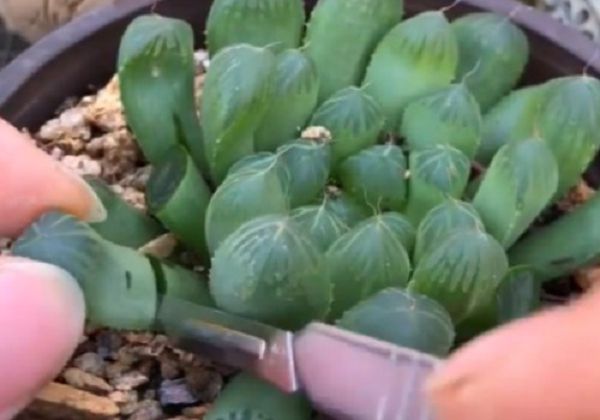
The leaves of Haworthia cooperi Variegata usually grow very plump and round, and they are also crystal clear, both cute and pleasing to look at. But sometimes you may run into the situation where its leaves become leggy. When it grows leggy, its leaves naturally change from their original plump and round state to being thin and long, so their ornamental value is not high either. So how do you save a leggy Haworthia cooperi Variegata?
If we find that our Haworthia cooperi Variegata has grown leggy and its leaves have grown too long, we can give it proper pruning treatment. This can speed up the consumption of the nutrients and water stored in the plant itself, thereby promoting growth and letting its leaves return to their normal plump and round state. However, when we prune a leggy Haworthia cooperi Variegata, the method must be correct.
When pruning, first select the leaves that have grown relatively thin and long, then use a small knife to make a horizontal cut from the middle part, cutting off the head of the leaf. For leaves in normal condition, we do not need to treat them this way. After the upper part of a cut leaf is damaged in its growth, the plant will speed up the consumption of the nutrients and water stored in the leaf, which naturally plays a role in stimulating the plant to regrow.
Generally, the part of the Haworthia cooperi Variegata leaf that we cut off can be thrown away directly, while the part left in the pot will, after being stimulated, quickly wither away, thereby growing new round and plump leaves. But to avoid the Haworthia cooperi Variegata continuing to grow leggy, we also need to adjust the care environment and methods in time, providing the plant with a good space that is suitable for growth and not prone to leggy growth.
As a succulent plant, when Haworthia cooperi Variegata grows leggy, it is generally caused by a relatively dark care environment and insufficient light, but it may also be caused by the ambient temperature being too low and watering being too abundant. So we need to ensure sufficient light, reasonably control the temperature, and also properly control watering. In this way, similar situations can be avoided.