A Detailed Guide to Clivia Care in Winter and Summer
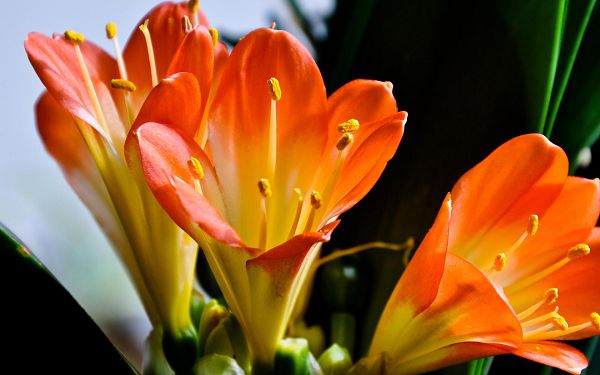
How should Clivia be cared for? For Clivia, care in summer and winter is crucial. Below, we explain its care techniques based on caring for Clivia in these two seasons.
(1) In summer, Clivia prefers a cool, humid, semi-shaded environment. The suitable temperature for growth is 15-25°C. If the temperature is higher than 26-28°C, it will enter a dormant or semi-dormant state. If the temperature rises further, it becomes prone to disease and may even die.
In summer, Clivia should be placed indoors or in a shaded, ventilated spot under a shade shed. The surrounding environment should be sprinkled with water frequently or have water basins placed around it, and the leaf surfaces should also be misted to increase air humidity and lower the temperature. When misting the leaves, do not let water run into the center, to prevent heart rot. Note that although the amount of watering in summer is greater than in other seasons, you must stick to the principle of not watering until dry, and watering thoroughly once you do. Also be careful not to wait until the potting soil is completely dry before watering; water when it is half dry, so that the potting soil stays consistently moist from top to bottom.
In terms of temperature, Clivia is a medium-light flower that prefers soft light and avoids harsh sun exposure. In summer, it must be placed in a shaded, ventilated spot under a shade shed, avoiding direct sunlight at midday. If exposed to strong direct light, it will develop "sunscald," with large brown patches appearing on the leaves and dead tissue. When the temperature rises above 25°C, the growth of Clivia is inhibited, and at this point fertilization should be stopped. If fertilization continues, root rot and stem rot are likely. If the ambient temperature around Clivia can be lowered to below 25°C, then in summer it can also be given a dilute liquid fertilizer at a ratio of 1:20 or more, once every half month. This can promote the growth of Clivia and shorten or eliminate its dormant period.
To improve Clivia's own resistance to adverse conditions, in the later stage of spring growth, appropriately reduce the application of nitrogen fertilizer according to the condition of the plants, while increasing the amount of phosphorus and potassium fertilizer. Starting in March, apply 13% potassium dihydrogen phosphate or superphosphate as a root drench once every 10 days. One month before the "plum rain" period begins, apply potassium dihydrogen phosphate as a foliar feed 3-4 times. In addition, during the plum rain period the humidity is high, and if there is also poor ventilation, combined with hot temperatures, Clivia's resistance to some infectious diseases will decline. For mass plantings, chemical control must be carried out. Pesticides such as carbendazim and thiophanate can be used alternately, at a concentration of 0.1%, sprayed once every 10 days.
If Clivia shoots up a flower stalk in summer, not only will it fail to produce good flowers, but it will also consume nutrients and affect normal flowering in winter and spring. Therefore, the flower stalk should be cut off promptly.
(2) In winter, as long as the room temperature is generally kept above 0°C, Clivia can overwinter safely. In early winter, when the room temperature is somewhat higher, most Clivia continue to grow indoors, and at this time fertilizer can continue to be applied, which benefits both the growth of branches and leaves and the future budding and flowering. If heating equipment is installed indoors and the temperature is kept constant above 10°C, Clivia can continue to grow throughout the winter; for Clivia citrina, applying dilute fertilizer once every 7 days can even bring flowering forward. If the room temperature drops below 10°C, fertilization should be suspended, because at this time Clivia is already in a slow-growth or dormant period, and applying more fertilizer not only makes it hard for the roots to absorb but is actually harmful.
After Clivia has finished flowering, if you want to keep seeds, do not trim off the flower stalk; if you do not want to keep seeds, it should be cut off or snapped off promptly from the base of the flower stalk. This can reduce nutrient consumption and is beneficial for development and growth.