How to Make a Flowering Quince Bonsai and Key Care Points
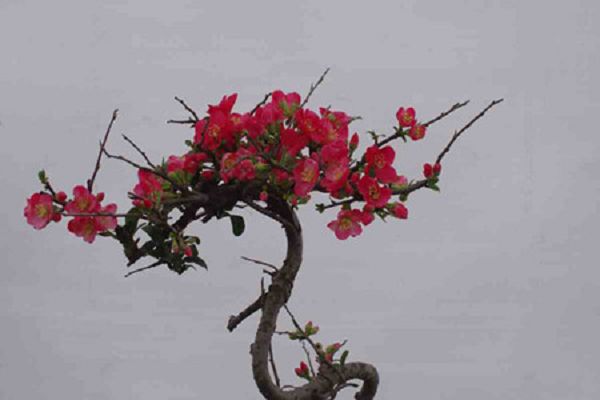
Bonsai Making
Propagation from Old Stumps
Old stumps that have grown for many years, with exposed roots and claws and an antique, unusual character, can be used for propagation to make bonsai.
Transplant after leaf fall in autumn and before sprouting in spring. When transplanting, keep plenty of the original soil, cut off the main root, and keep more lateral roots and fibrous roots. Also prune the branches and trunk: after cutting off the branches not needed for the design, first plant it in a larger clay pot or in the ground to "cultivate the blank." When it is cold in winter, pay attention to cold protection and maintain a certain air humidity, but the soil must not become waterlogged. After it survives, pay attention to cultivating the transition branches and main branches so that the framework is graceful and the transition between branches and trunk is natural.
Shaping and Pruning
Flowering quince is suitable for making bonsai in different styles, such as the straight trunk style, slanting trunk style, double trunk style, curved trunk style, waterside style, exposed root style, forest style, and multi-trunk from one base style.
For young trees, shaping is mainly by wiring, with pruning as a supplement. Process the trunk into a winding, interesting form, but the artificial traces must not be too heavy. The retained branches should not be too dense; sparse and open is better, making it fresh and elegant. For old stumps that have grown for many years, shape them according to the tree's vigor to create bonsai of different styles. The crown can be made into a neat round pad shape, or a natural, unrestrained form can be used, adopting a combination of pruning and wiring to make the branches and leaves lush.
Key Care Points
Pruning and Shaping
After leaf fall in autumn or before sprouting in spring, carry out one pruning and shaping. Cut off dead branches, diseased and pest-infested branches, water sprouts, crossing branches, overlapping branches, and other branches that affect the tree shape, so as to maintain the beauty of the tree shape and the internal ventilation and light penetration. Shorten the tops of old branches that flowered the previous year, so as to concentrate nutrients and produce more flowering branches.
Soil
Repot once every spring. The potting soil should be loose and fertile, rich in humus, and a sandy soil with good drainage and aeration. Place some decomposed cake fertilizer, animal hoof and nails, bones, etc. at the bottom of the pot as base fertilizer.
Light, Water and Fertilizer
Flowering quince likes a warm, humid environment with plenty of sunlight. During the growing season, it can be placed outdoors in a sunny, well-ventilated place for care.
Water according to the rule "do not water until dry, and when watering, water thoroughly," avoiding waterlogging in the potting soil. When the air is too dry, spray water on the plant to increase air humidity, which is beneficial to plant growth. Apply a dilute decomposed liquid fertilizer or compound fertilizer once every half month. In October each year, bury decomposed cake fertilizer in the flower pot to promote the plant's growth and flowering the following year.